Planet Formation
7 Early Evolution of Planetary Systems
7.1 Migration in Gaseous Disks
7.1.1 Planet-Disk Torque in the Impulse Approximation
our model:
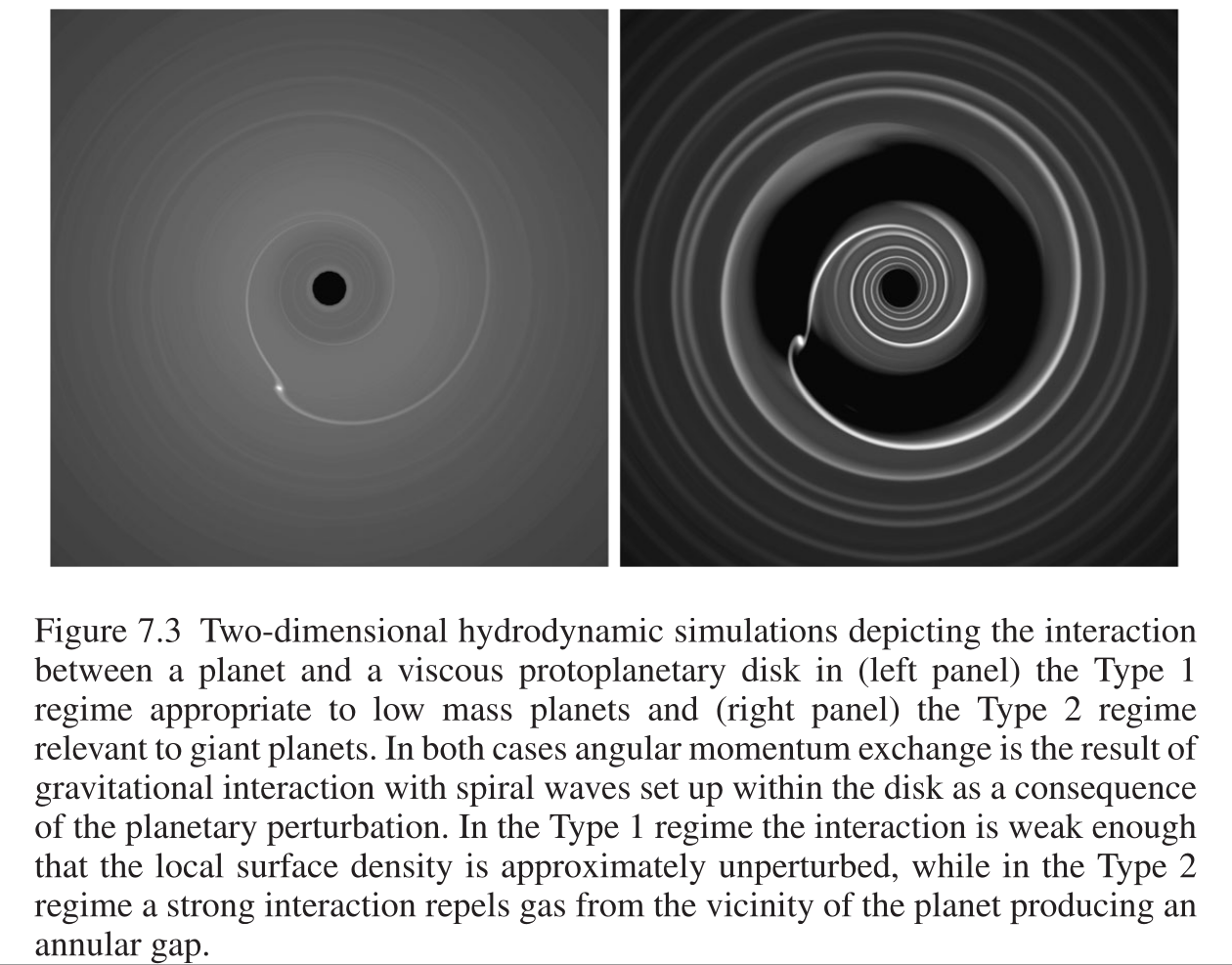
a planet and a gaseous disk orbiting a central object
the key derivation:
- the change to the perpendicular velocity of the free particle in the gaseous disk that occurs during the encounter
derivation (Eq. 5.58)
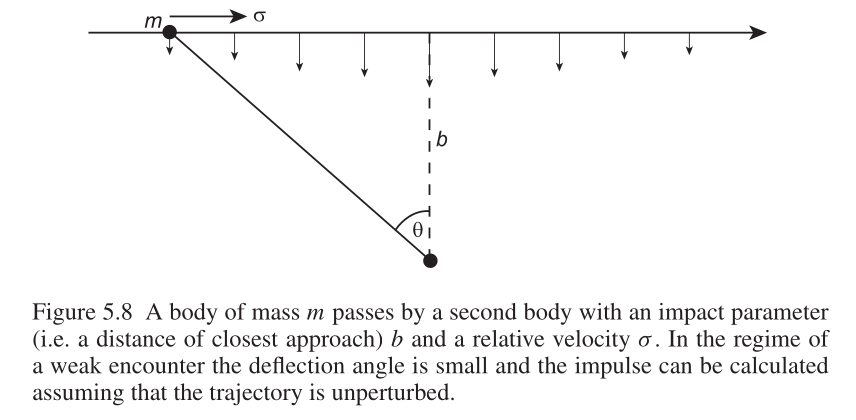
- considering the conservative kinetic energy of the gas particle, we can obtain the change of the parallel velocity
- denoting the semi-major axis
, the implied angular momentum change per unit mass of the gas is
- calculate for the total torque due to its interactions with the gas outside the orbit:
denoting the surface density of the gaseous disk
, the mass in the disk between and is all of the gas within the annulus will encounter the planet in a time interval
approximating
as approximation
in the Keplerian disk, the orbital angular velocity is
letting
, , , yields the total torque is
7.1.2 Physics of Gas Disk Torques
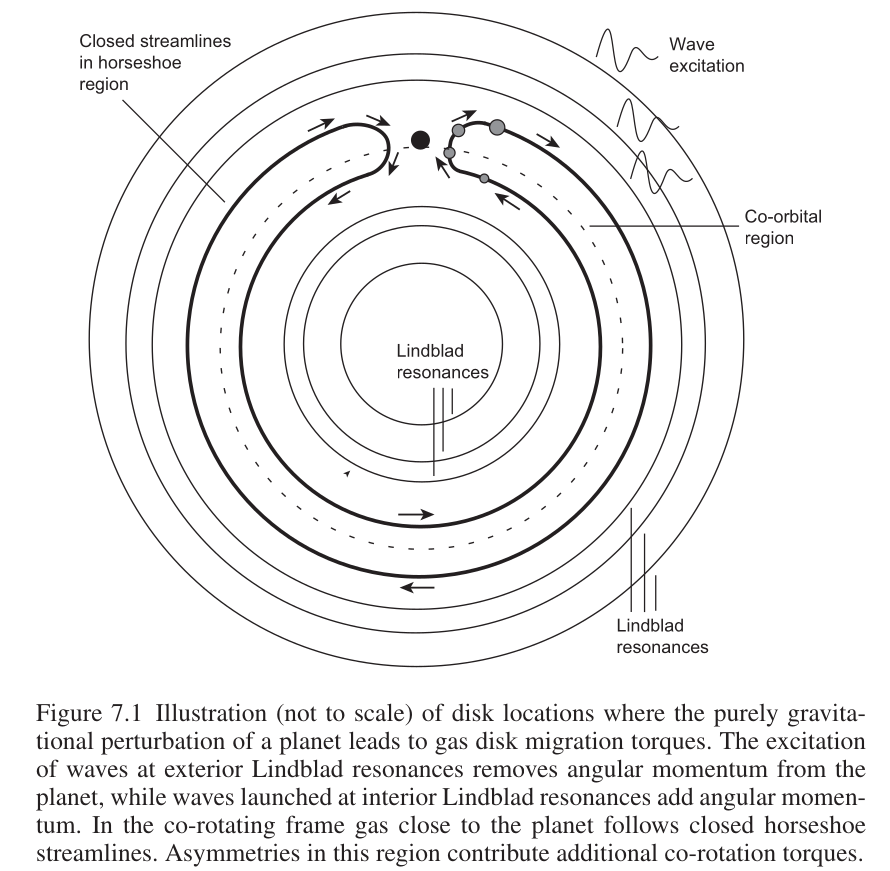
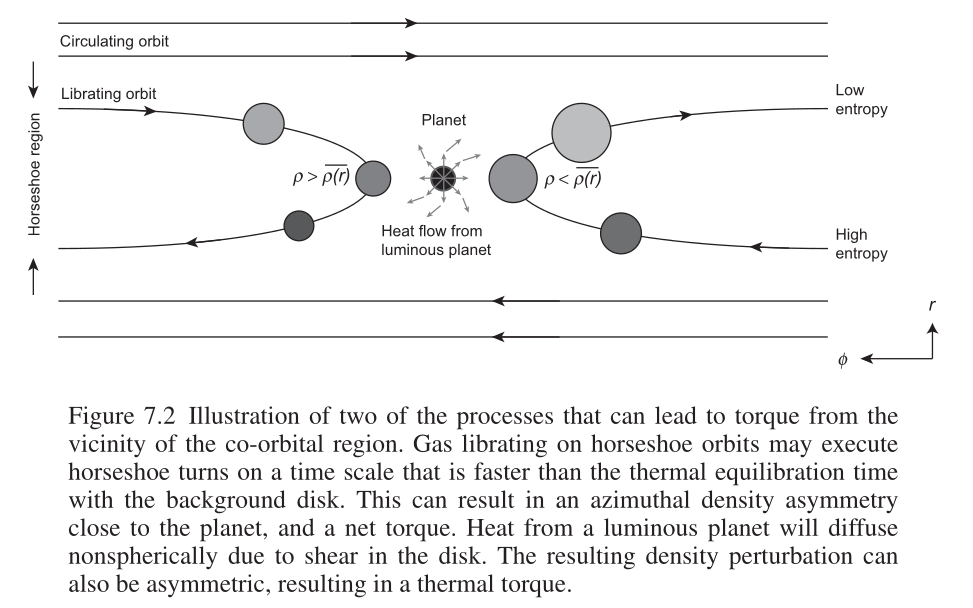
the physical effects that can lead to migration torques:
- the impulse approximation
- at Lindblad resonances
- at co-orbital (corotation) resonances
- the thermal effects from the vicinity of the planet
7.1.3 Torque Formulae
for a disk with a power-law scaling of surface density with radius,
- the net Lindblad torque on a planet of mass
in a circular orbit at distance from the star is given in linear theory as
where
- reference migration time scale for a planet with orbital angular momentum
as
e.g.
for a one sun-mass star system (
7.1.4 Gas Disk Migration Regimes