Dynamics of planetary systems

Tremaine, S. (2023). Dynamics of planetary systems. Princeton University Press.

Ogilvie, G. I. (2020, May). Dynamics of Astrophysical Discs. Department of Applied Mathematics and Theoretical Physics, University of Cambridge. https://www.damtp.cam.ac.uk/user/gio10/dad.html

Orbital elements

  • The six orbital elements:
    semimajor axis aa,
    eccentricity ee,
    inclination II,
    longtitude of the ascending node Ω\Omega,
    argument of periapsis ω\omega ( or longtitude of periapsis ϖΩ+ω\varpi\equiv\Omega+\omega ),
    and mean anomaly \ell ( or mean longtitude λϖ+\lambda\equiv\varpi+\ell ).

  • Delaunay variables:

    ,Λ(GMa)1/2,ω,L=[GMa(1e2)]1/2,Ω,Lz=LcosI.\begin{array}{ll} \ell,&\Lambda\equiv(GMa)^{1/2}, \\ \omega,&L=[GMa(1-e^2)]^{1/2}, \\ \Omega,&L_z=L\cos I. \end{array}

The epicycle approximation

  • The perturbation frequency in two directions κR,κz\kappa_R,\kappa_z

    x¨+κR2x=0,z¨+κz2z=0,\ddot{x}+\kappa_R^2 x=0,\quad\ddot{z}+\kappa_z^2 z=0,

    with the average frequency in azimuthal direction κϕ\kappa_\phi.

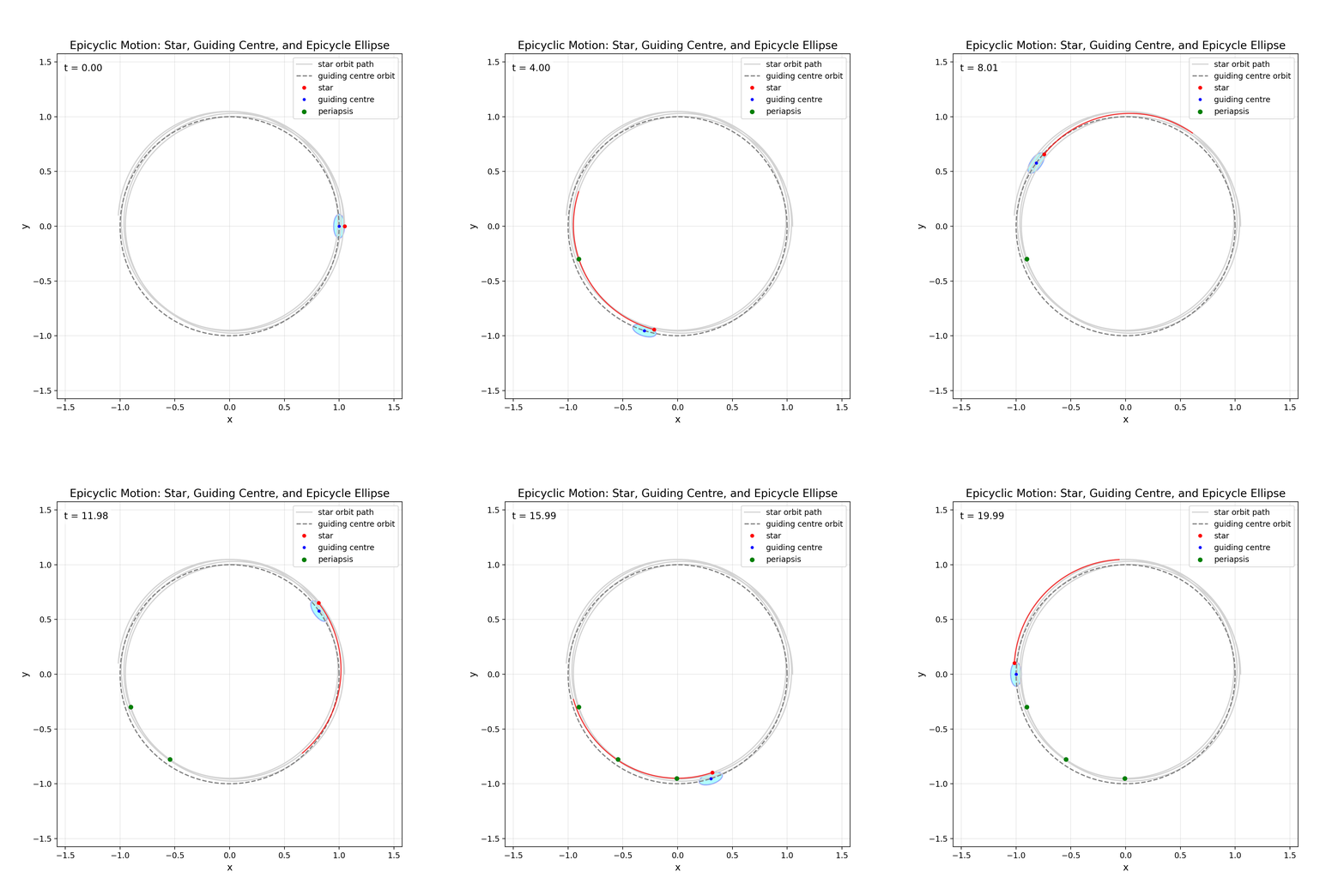
  • The epicyclic orbit:

    R(t)=a(1+ecos(κRt+η)),ϕ(t)=κϕt2κϕeκRsin(κRt+η)+ϕ0.\begin{align} R(t)&=a(1+e\cos(\kappa_R t+\eta)), \notag \\ \phi(t)&=\kappa_\phi t-\frac{2\kappa_\phi e}{\kappa_R}\sin(\kappa_R t+\eta)+\phi_0. \notag \end{align}

epicycle

The python script to generate this .gif

1
2
3
4
5
6
7
8
9
10
11
12
13
14
15
16
17
18
19
20
21
22
23
24
25
26
27
28
29
30
31
32
33
34
35
36
37
38
39
40
41
42
43
44
45
46
47
48
49
50
51
52
53
54
55
56
57
58
59
60
61
62
63
64
65
66
67
68
69
70
71
72
73
74
75
76
77
78
79
80
81
82
83
84
85
86
87
88
89
90
91
92
93
94
95
96
97
98
99
100
101
102
103
104
105
106
107
108
109
110
111
112
113
114
115
116
117
118
119
120
121
122
123
124
125
126
127
128
129
import numpy as np
import matplotlib.pyplot as plt
from matplotlib.animation import FuncAnimation, PillowWriter
from matplotlib.patches import Ellipse

# ==================== Parameters ====================
a = 1.0
e = 0.05
kappa_R = 1
kappa_phi = 1.1
eta = 0.0
phi0 = 0.0

T_max = 7 * np.pi / kappa_phi
n_frames = 700
t = np.linspace(0, T_max, n_frames)

# Star positions
def star_positions(t):
R = a + a * e * np.cos(kappa_R * t + eta)
phi = kappa_phi * t - (2 * kappa_phi * e / kappa_R) * np.sin(kappa_R * t + eta) + phi0
x = R * np.cos(phi)
y = R * np.sin(phi)
return x, y

x_star, y_star = star_positions(t)

# Guiding centre
x_guide = a * np.cos(kappa_phi * t)
y_guide = a * np.sin(kappa_phi * t)

# Reference circles
theta_circle = np.linspace(0, 2*np.pi, 200)
x_guide_circle = a * np.cos(theta_circle)
y_guide_circle = a * np.sin(theta_circle)

# Epicycle ellipse axes
radial_semiaxis = a * e
tangential_semiaxis = a * (2 * kappa_phi * e / kappa_R)

# ==================== Find periapsis points ====================
r_star = np.sqrt(x_star**2 + y_star**2)
periapsis_indices = []
for i in range(1, len(r_star)-1):
if r_star[i] < r_star[i-1] and r_star[i] < r_star[i+1]:
periapsis_indices.append(i)
if len(periapsis_indices) == 0:
min_idx = np.argmin(r_star)
periapsis_indices = [min_idx]

# ==================== Setup figure ====================
dpi = 200
fig, ax = plt.subplots(figsize=(8, 8), dpi=dpi)
ax.set_aspect('equal')
margin = 1.5 * a * (1 + e)
ax.set_xlim(-margin, margin)
ax.set_ylim(-margin, margin)
ax.set_xlabel('x', fontsize=12)
ax.set_ylabel('y', fontsize=12)
ax.set_title('Epicyclic Motion: Star, Guiding Centre, and Epicycle Ellipse', fontsize=14)
ax.grid(alpha=0.3)

# Static plots
ax.plot(x_star, y_star, color='lightgray', linewidth=1.5, label='star orbit path')
ax.plot(x_guide_circle, y_guide_circle, '--', color='gray', linewidth=1.5, label='guiding centre orbit')

# Moving artists
star_point, = ax.plot([], [], 'ro', markersize=4, label='star')
star_trail, = ax.plot([], [], 'r-', linewidth=1.5, alpha=0.7)
guide_point, = ax.plot([], [], 'bo', markersize=3, label='guiding centre')

# Epicycle ellipse
epicycle_ellipse = Ellipse((0, 0), width=2*radial_semiaxis, height=2*tangential_semiaxis,
angle=0, facecolor='cyan', edgecolor='blue',
alpha=0.3, linewidth=1.5)
ax.add_patch(epicycle_ellipse)

# Periapsis markers (scatter, same visual size as star)
periapsis_markers = ax.scatter([], [], s=25, c='green', marker='o', zorder=5, label='periapsis')

time_text = ax.text(0.02, 0.95, '', transform=ax.transAxes, fontsize=12,
bbox=dict(facecolor='white', alpha=0.7, edgecolor='none'))

ax.legend(loc='upper right', fontsize=10)

# ==================== Animation ====================
def init():
star_point.set_data([], [])
star_trail.set_data([], [])
guide_point.set_data([], [])
epicycle_ellipse.center = (0, 0)
epicycle_ellipse.angle = 0
periapsis_markers.set_offsets(np.empty((0, 2)))
time_text.set_text('')
return star_point, star_trail, guide_point, epicycle_ellipse, periapsis_markers, time_text

def update(frame):
# Star and its trail (last 50 points)
star_point.set_data([x_star[frame]], [y_star[frame]])
start_idx = max(0, frame - 49)
star_trail.set_data(x_star[start_idx:frame+1], y_star[start_idx:frame+1])

# Guiding centre
gx, gy = x_guide[frame], y_guide[frame]
guide_point.set_data([gx], [gy])

# Epicycle ellipse oriented along radial direction
epicycle_ellipse.center = (gx, gy)
angle_deg = np.degrees(np.arctan2(gy, gx))
epicycle_ellipse.angle = angle_deg

# Periapsis markers: show all points that have been reached up to current frame
coords = [(x_star[i], y_star[i]) for i in periapsis_indices if i <= frame]
if coords:
periapsis_markers.set_offsets(np.array(coords))
else:
periapsis_markers.set_offsets(np.empty((0, 2)))

time_text.set_text(f't = {t[frame]:.2f}')
return star_point, star_trail, guide_point, epicycle_ellipse, periapsis_markers, time_text

ani = FuncAnimation(fig, update, frames=n_frames, init_func=init,
blit=True, interval=50)

# Save with the same DPI as the figure
ani.save('epicyclic_orbit_with_ellipse.gif',
writer=PillowWriter(fps=20), dpi=dpi)
plt.close(fig)
print("GIF saved as 'epicyclic_orbit_with_ellipse.gif'")
  • The apsidal precession rate is

    ΔϕΔt=κϕκR.\frac{\Delta\phi}{\Delta t}=\kappa_\phi-\kappa_R.

    The minimum radius (periapsis) occurs at time intervals Δt=2π/κR\Delta t=2\pi/\kappa_R, corresponding to

    Δϕ=2πκRκϕ=2π(κϕκR1)+2π=2π(κϕκR1) mod 2π.\begin{aligned} \Delta\phi&=\frac{2\pi}{\kappa_R}\kappa_\phi \\ &=2\pi\left(\frac{\kappa_\phi}{\kappa_R}-1\right)+2\pi \\ &=2\pi\left(\frac{\kappa_\phi}{\kappa_R}-1\right) \text{ mod } 2\pi. \end{aligned}

    The apsidal precession rate is therefore

    ΔϕΔt=κϕκR.\frac{\Delta \phi}{\Delta t}=\kappa_\phi-\kappa_R.

The three-body problem

The circular restricted three-body problem

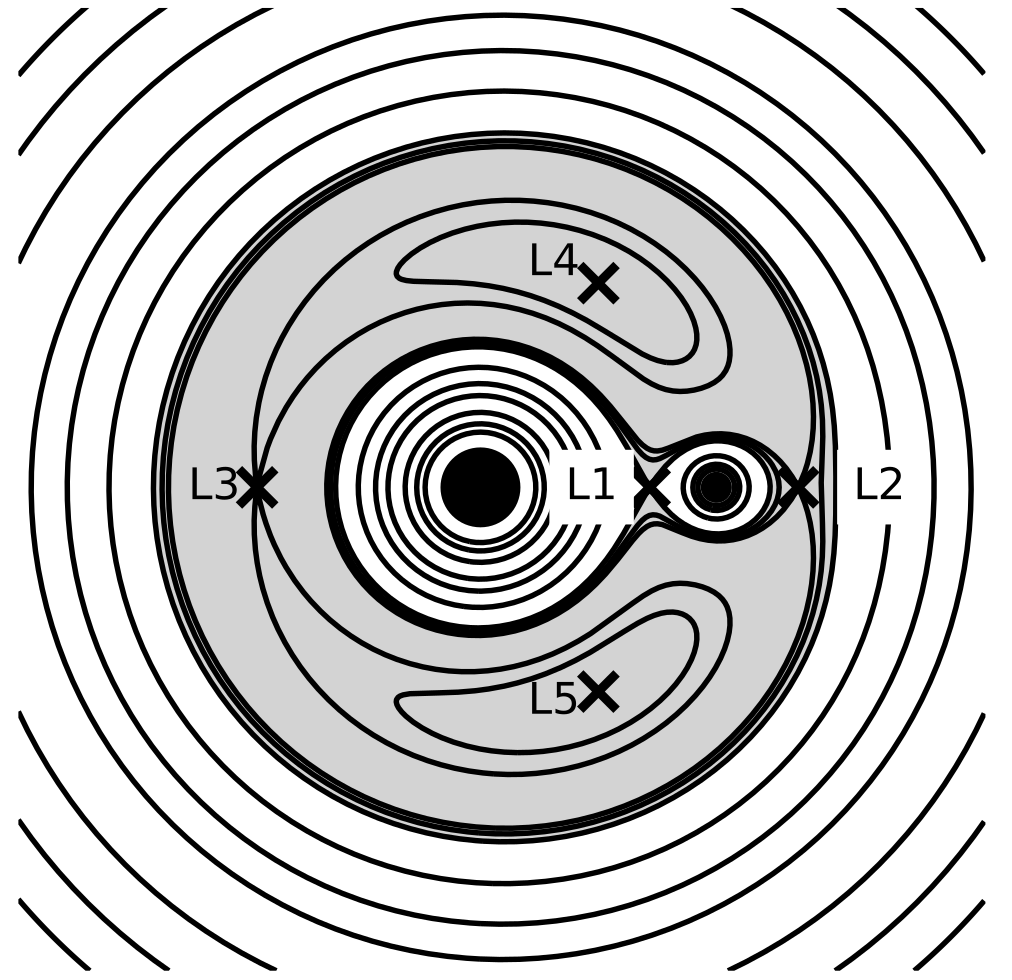
  • Effective potential

    Φeff(x)=Gm0xx0Gm1xx112Ω×x2.\Phi_{\text{eff}}(\boldsymbol{x})=-\frac{Gm_0}{|\boldsymbol{x}-\boldsymbol{x}_0|}-\frac{Gm_1}{|\boldsymbol{x}-\boldsymbol{x}_1|}-\frac{1}{2}|\boldsymbol{\Omega}\times\boldsymbol{x}|^2.

Roche Potential

  • Hill radius:

    when m1m0m_1\ll m_0, the collinear Lagrange points L1 and L2 are separated from the mass m1m_1 by the Hill radius,

    rHa(m13m0)1/3.r_\text{H}\equiv a\left(\frac{m_1}{3m_0}\right)^{1/3}.

  • Jacobi constant (total energy)

    EJ12x˙2+Φeff(x).E_\text{J}\equiv\frac{1}{2}|\dot{\boldsymbol{x}}|^2+\Phi_{\text{eff}}(\boldsymbol{x}).

  • Poincaré map / surface of section:

    considering the orbits crossing the locus xb=0x_b=0 and x˙b>0\dot{x}_b>0, so a point in the (xa,x˙a)(x_a,\dot{x}_a) plane can represent a crossing. The point (xa,x˙a)(x_a,\dot{x}_a) defines the orbit and also defines the next crossing (xa,x˙a)(x_a',\dot{x}_a'), which we call the Poincaré map, i.e., P(xa,x˙a)=(xa,x˙a)\mathbf{P}(x_a,\dot{x}_a)=(x_a',\dot{x}_a').

The disturbing function

  • The interaction potential

    Φij(ri,rj)=GmimjΔij,\Phi_{ij}(\boldsymbol{r}_i,\boldsymbol{r}_j)=-\frac{Gm_im_j}{\Delta_{ij}},

    1Δ12= 12a2m=b1/2mcos(mλ1mλ2)+ϵa2m={[14αb3/2m+2+12α2b3/2m+134αb3/2m]e1cos[mλ1(m+1)λ2+ϖ1]+[14αb3/2m1+12b3/2m34αb3/2m+1]e2cos[mλ1(m+1)λ2+ϖ2]}+ϵ2m=Xm+O(ϵ3),\begin{aligned} \begin{aligned} \frac{1}{\Delta_{12}}= \end{aligned} & \begin{aligned} \ \frac{1}{2a_2}\sum_{m=-\infty}^{\infty}b_{1/2}^m\cos(m\lambda_1-m\lambda_2)+\frac{\epsilon}{a_2}\sum_{m=-\infty}^{\infty} \end{aligned} \\ & \biggl\{\left[\frac{1}{4}\alpha b_{3/2}^{m+2}+\frac{1}{2}\alpha^2b_{3/2}^{m+1}-\frac{3}{4}\alpha b_{3/2}^m\right]e_1\cos[m\lambda_1-(m+1)\lambda_2+\varpi_1] \\ & +\left[\frac{1}{4}\alpha b_{3/2}^{m-1}+\frac{1}{2}b_{3/2}^{m}-\frac{3}{4}\alpha b_{3/2}^{m+1}\right]e_{2}\cos[m\lambda_{1}-(m+1)\lambda_{2}+\varpi_{2}]\biggr\} \\ & +\epsilon^2\sum_{m=-\infty}^\infty X_m+\mathrm{O}(\epsilon^3), \end{aligned}

    where α=a1/a2<1\alpha=a_1/a_2<1, and bsm(α)b_s^m(\alpha) is a Laplace coefficient.


Dynamics of planetary systems
http://jingliangwei.github.io/blog-hexo/2026/04/19/Dynamics-of-planetary-systems/
Author
Arwell
Posted on
April 19, 2026
Licensed under