Kerswell, R. R. (1993). The instability of precessing flow. Geophysical & Astrophysical Fluid Dynamics , 72 (1–4), 107–144. https://doi.org/10.1080/03091929308203609
pdf with notes
The shearing and elliptical instability of precessing flow.
Parameters
Parameters
Expression
Oblateness
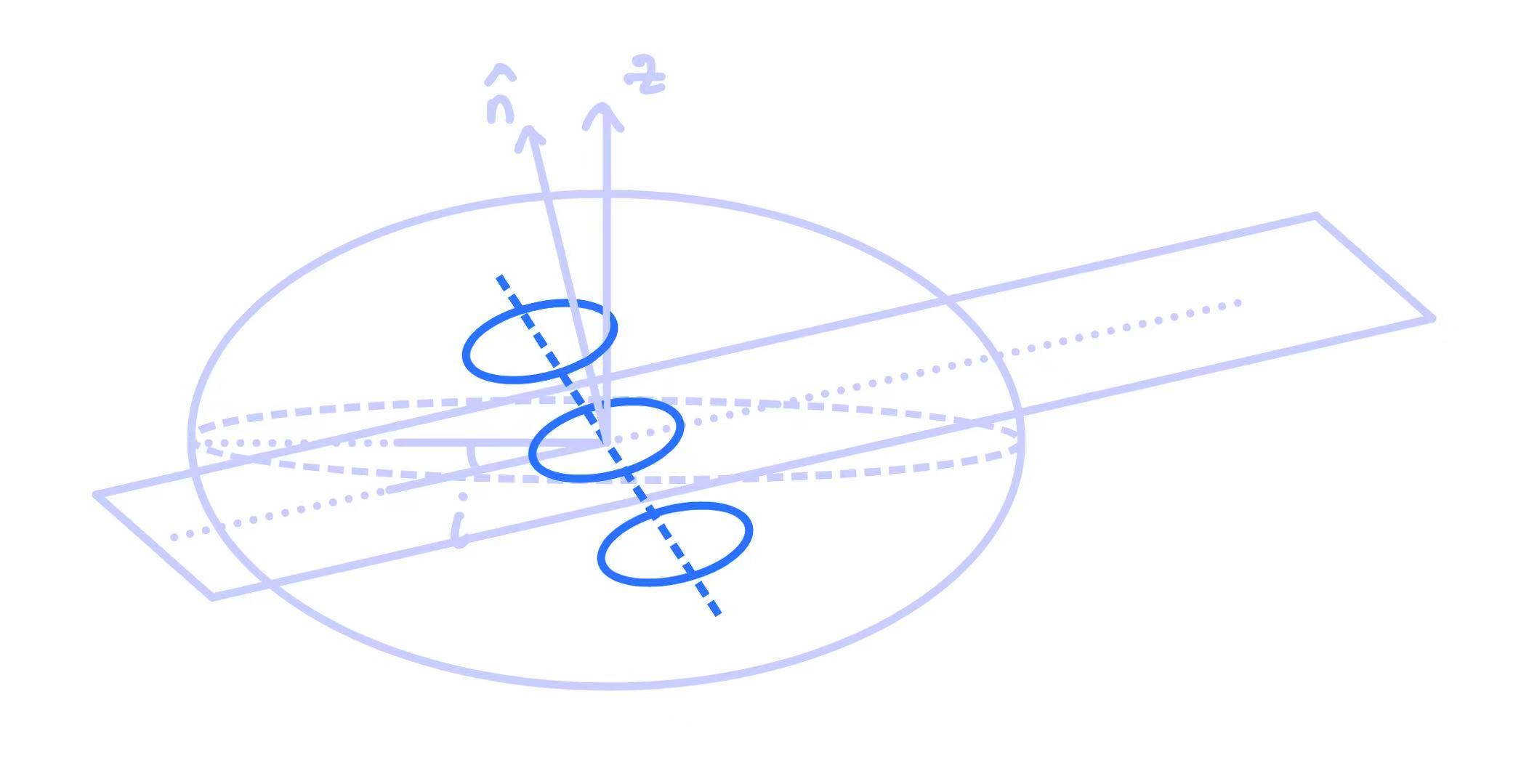
η , c \eta,c η , c r 2 + ( 1 + η ) z 2 = r 2 + z 2 c 2 = 1 r^2+(1+\eta)z^2=r^2+\dfrac{z^2}{c^2}=1 r 2 + ( 1 + η ) z 2 = r 2 + c 2 z 2 = 1
Precessional vector
Ω = [ Ω 1 , 0 , Ω 3 ] T \boldsymbol{\Omega}=[\Omega_1,0,\Omega_3]^T Ω = [ Ω 1 , 0 , Ω 3 ] T
Shearing of the streamlines
ε = η μ 2 + ( 2 + η ) μ 2 \varepsilon=\dfrac{\eta\mu}{2+(2+\eta)\mu^2} ε = 2 + ( 2 + η ) μ 2 η μ
Elliptical distortion of the streamlines
β = η μ 2 2 + ( 2 + η ) μ 2 \beta=\dfrac{\eta\mu^2}{2+(2+\eta)\mu^2} β = 2 + ( 2 + η ) μ 2 η μ 2
Relative magnitude of elliptical over shearing
μ = 2 Ω 1 η + 2 ( 1 + η ) Ω 3 \mu=\dfrac{2\Omega_1}{\eta+2(1+\eta)\Omega_3} μ = η + 2 ( 1 + η ) Ω 3 2 Ω 1
Poincaré’s solution
u = ω × r + ∇ A \boldsymbol{u}=\boldsymbol{\omega}\times\boldsymbol{r}+\nabla A
u = ω × r + ∇ A
ω = z ^ − 2 + η η + 2 ( 1 + η ) Ω ⋅ z ^ z ^ × ( z ^ × Ω ) \boldsymbol{\omega}=\hat{\boldsymbol{z}}-\frac{2+\eta}{\eta+2(1+\eta)\boldsymbol{\Omega}\cdot\hat{\boldsymbol{z}}}\hat{\boldsymbol{z}}\times(\hat{\boldsymbol{z}}\times\boldsymbol{\Omega})
ω = z ^ − η + 2 ( 1 + η ) Ω ⋅ z ^ 2 + η z ^ × ( z ^ × Ω )
A = η η + 2 ( 1 + η ) Ω ⋅ z ^ ( Ω × z ^ ⋅ r ) ( z ⋅ r ^ ) A=\frac{\eta}{\eta+2(1+\eta)\boldsymbol{\Omega}\cdot\hat{\boldsymbol{z}}}(\boldsymbol{\Omega}\times\hat{\boldsymbol{z}}\cdot\boldsymbol{r})(\hat{\boldsymbol{z}\cdot\boldsymbol{r}})
A = η + 2 ( 1 + η ) Ω ⋅ z ^ η ( Ω × z ^ ⋅ r ) ( z ⋅ r ^ )
This soluion is independent of the self-rotating velocity, because the self-rotating is treated as the boundary condition (need a thin boundary layer).
Derivation of equation
From u = u x x ^ + u y y ^ + u z z ^ \boldsymbol{u}=u_x\hat{\boldsymbol{x}}+u_y\hat{\boldsymbol{y}}+u_z\hat{\boldsymbol{z}} u = u x x ^ + u y y ^ + u z z ^ u = u s ~ + v ϕ ~ + w z ˉ ~ \boldsymbol{u}=u\tilde{\boldsymbol{s}}+v\tilde{\boldsymbol{\phi}}+w\tilde{\bar{\boldsymbol{z}}} u = u s ~ + v ϕ ~ + w z ˉ ~
u = 2 + ( 2 + η ) μ 2 2 1 + μ 2 1 − β 2 s ϕ ~ = Ω ˉ s ϕ ~ (1.6) \boldsymbol{u}=\frac{2+(2+\eta)\mu^2}{2\sqrt{1+\mu^2}}\sqrt{1-\beta^2}s\tilde{\boldsymbol{\phi}}=\bar{\Omega}s\tilde{\boldsymbol{\phi}} \tag{1.6}
u = 2 1 + μ 2 2 + ( 2 + η ) μ 2 1 − β 2 s ϕ ~ = Ω ˉ s ϕ ~ ( 1.6 )
The momentum equation projecting onto l ~ , m ~ , n ~ \tilde{\boldsymbol{l}},\tilde{\boldsymbol{m}},\tilde{\boldsymbol{n}} l ~ , m ~ , n ~
∂ u ∂ t + ( u ⋅ ∇ ) u − v 2 s − 2 ( Ω 3 ∗ + Ω 1 ∗ ε 1 − β 2 ) v + 1 ( 1 − β 2 ) [ 1 + 2 ε 2 1 + β ] ∂ p ∂ s = 2 ε cos ϕ 1 + β 1 − β 2 ∂ p ∂ z ˉ + 2 sin ϕ 1 + β ( Ω 1 ∗ − 2 Ω 3 ∗ ε 1 + β ) w + cos 2 ϕ { 2 ( Ω 1 ∗ ε + Ω 3 ∗ β ) 1 − β 2 v − 1 ( 1 − β 2 ) [ β + 2 ε 2 1 + β ] ∂ p ∂ s } + sin 2 ϕ { 2 ( Ω 1 ∗ ε + Ω 3 ∗ β ) 1 − β 2 u + 1 ( 1 − β 2 ) [ β + 2 ε 2 1 + β ] 1 s ∂ p ∂ ϕ } (1.7) \begin{align}
\frac{\partial u}{\partial t}+&(\boldsymbol{u}\cdot\nabla)u-\frac{v^2}{s}-2\left(\frac{\Omega_3^*+\Omega_1^*\varepsilon}{\sqrt{1-\beta^2}}\right)v+\frac{1}{(1-\beta^2)}\left[1+\frac{2\varepsilon^2}{1+\beta}\right]\frac{\partial p}{\partial s} \\
=&\frac{2\varepsilon\cos\phi}{\sqrt{1+\beta}\sqrt{1-\beta^2}}\frac{\partial p}{\partial\bar{z}}+\frac{2\sin\phi}{\sqrt{1+\beta}}\left(\Omega_1^*-\frac{2\Omega_3^*\varepsilon}{\sqrt{1+\beta}}\right)w \\
&+\cos 2\phi\left\{\frac{2(\Omega_1^*\varepsilon+\Omega_3^*\beta)}{\sqrt{1-\beta^2}}v-\frac{1}{(1-\beta^2)}\left[\beta+\frac{2\varepsilon^2}{1+\beta}\right]\frac{\partial p}{\partial s}\right\} \\
&+\sin 2\phi\left\{\frac{2(\Omega_1^*\varepsilon+\Omega_3^*\beta)}{\sqrt{1-\beta^2}}u+\frac{1}{(1-\beta^2)}\left[\beta+\frac{2\varepsilon^2}{1+\beta}\right]\frac{1}{s}\frac{\partial p}{\partial \phi}\right\}
\end{align}
\tag{1.7}
∂ t ∂ u + = ( u ⋅ ∇ ) u − s v 2 − 2 ( 1 − β 2 Ω 3 ∗ + Ω 1 ∗ ε ) v + ( 1 − β 2 ) 1 [ 1 + 1 + β 2 ε 2 ] ∂ s ∂ p 1 + β 1 − β 2 2 ε cos ϕ ∂ z ˉ ∂ p + 1 + β 2 sin ϕ ( Ω 1 ∗ − 1 + β 2 Ω 3 ∗ ε ) w + cos 2 ϕ { 1 − β 2 2 ( Ω 1 ∗ ε + Ω 3 ∗ β ) v − ( 1 − β 2 ) 1 [ β + 1 + β 2 ε 2 ] ∂ s ∂ p } + sin 2 ϕ { 1 − β 2 2 ( Ω 1 ∗ ε + Ω 3 ∗ β ) u + ( 1 − β 2 ) 1 [ β + 1 + β 2 ε 2 ] s 1 ∂ ϕ ∂ p } ( 1.7 )
∂ v ∂ t + ( u ⋅ ∇ ) v − u v s + 2 ( Ω 3 ∗ + Ω 1 ∗ ε 1 − β 2 ) u + 1 ( 1 − β 2 ) [ 1 + 2 ε 2 1 + β ] 1 s ∂ p ∂ ϕ = − 2 ε sin ϕ 1 + β 1 − β 2 ∂ p ∂ z ˉ + 2 cos ϕ 1 + β ( Ω 1 ∗ − 2 Ω 3 ∗ ε 1 + β ) w + cos 2 ϕ { 2 ( Ω 1 ∗ ε + Ω 3 ∗ β ) 1 − β 2 u + 1 ( 1 − β 2 ) [ β + 2 ε 2 1 + β ] 1 s ∂ p ∂ ϕ } + sin 2 ϕ { − 2 ( Ω 1 ∗ ε + Ω 3 ∗ β ) 1 − β 2 v + 1 ( 1 − β 2 ) [ β + 2 ε 2 1 + β ] ∂ p ∂ s } (1.8) \begin{align}
\frac{\partial v}{\partial t}+&(\boldsymbol{u}\cdot\nabla)v-\frac{uv}{s}+2\left(\frac{\Omega_3^*+\Omega_1^*\varepsilon}{\sqrt{1-\beta^2}}\right)u+\frac{1}{(1-\beta^2)}\left[1+\frac{2\varepsilon^2}{1+\beta}\right]\frac{1}{s}\frac{\partial p}{\partial \phi} \\
=&-\frac{2\varepsilon\sin\phi}{\sqrt{1+\beta}\sqrt{1-\beta^2}}\frac{\partial p}{\partial\bar{z}}+\frac{2\cos\phi}{\sqrt{1+\beta}}\left(\Omega_1^*-\frac{2\Omega_3^*\varepsilon}{1+\beta}\right)w \\
&+\cos 2\phi\left\{\frac{2(\Omega_1^*\varepsilon+\Omega_3^*\beta)}{\sqrt{1-\beta^2}}u+\frac{1}{(1-\beta^2)}\left[\beta+\frac{2\varepsilon^2}{1+\beta}\right]\frac{1}{s}\frac{\partial p}{\partial \phi}\right\} \\
&+\sin 2\phi\left\{-\frac{2(\Omega_1^*\varepsilon+\Omega_3^*\beta)}{\sqrt{1-\beta^2}}v+\frac{1}{(1-\beta^2)}\left[\beta+\frac{2\varepsilon^2}{1+\beta}\right]\frac{\partial p}{\partial s}\right\}
\end{align}
\tag{1.8}
∂ t ∂ v + = ( u ⋅ ∇ ) v − s uv + 2 ( 1 − β 2 Ω 3 ∗ + Ω 1 ∗ ε ) u + ( 1 − β 2 ) 1 [ 1 + 1 + β 2 ε 2 ] s 1 ∂ ϕ ∂ p − 1 + β 1 − β 2 2 ε sin ϕ ∂ z ˉ ∂ p + 1 + β 2 cos ϕ ( Ω 1 ∗ − 1 + β 2 Ω 3 ∗ ε ) w + cos 2 ϕ { 1 − β 2 2 ( Ω 1 ∗ ε + Ω 3 ∗ β ) u + ( 1 − β 2 ) 1 [ β + 1 + β 2 ε 2 ] s 1 ∂ ϕ ∂ p } + sin 2 ϕ { − 1 − β 2 2 ( Ω 1 ∗ ε + Ω 3 ∗ β ) v + ( 1 − β 2 ) 1 [ β + 1 + β 2 ε 2 ] ∂ s ∂ p } ( 1.8 )
∂ w ∂ t + ( u ⋅ ∇ ) w + ∂ p ∂ z ˉ = − sin ϕ [ 2 ε 1 + β 1 − β 2 1 s ∂ p ∂ ϕ + 2 Ω 1 ∗ 1 + β u ] + cos ϕ [ 2 ε 1 + β 1 − β 2 ∂ p ∂ s − 2 Ω 1 ∗ 1 + β v ] (1.9) \begin{align}
\frac{\partial w}{\partial t}+(\boldsymbol{u}\cdot\nabla)w+\frac{\partial p}{\partial \bar{z}}=&-\sin\phi\left[\frac{2\varepsilon}{\sqrt{1+\beta}\sqrt{1-\beta^2}}\frac{1}{s}\frac{\partial p}{\partial \phi}+2\Omega_1^*\sqrt{1+\beta}u\right] \\
&+\cos\phi\left[\frac{2\varepsilon}{\sqrt{1+\beta}\sqrt{1-\beta^2}}\frac{\partial p}{\partial s}-2\Omega_1^*\sqrt{1+\beta}v\right]
\end{align}
\tag{1.9}
∂ t ∂ w + ( u ⋅ ∇ ) w + ∂ z ˉ ∂ p = − sin ϕ [ 1 + β 1 − β 2 2 ε s 1 ∂ ϕ ∂ p + 2 Ω 1 ∗ 1 + β u ] + cos ϕ [ 1 + β 1 − β 2 2 ε ∂ s ∂ p − 2 Ω 1 ∗ 1 + β v ] ( 1.9 )
Consider small disturbances u \boldsymbol{u} u U = Ω ˉ s ϕ ~ \boldsymbol{U}=\bar{\Omega}s\tilde{\phi} U = Ω ˉ s ϕ ~ frame rotating with this flow ,
∂ u ∗ ∂ t ∗ + 2 z ^ × u ∗ + ∇ ˉ p = ⋯ L ( ⋯ ) (1.11) \frac{\partial \boldsymbol{u}^*}{\partial t^*}+2\hat{\boldsymbol{z}}\times\boldsymbol{u}^*+\bar{\nabla}p=\cdots\mathscr{L}(\cdots) \tag{1.11}
∂ t ∗ ∂ u ∗ + 2 z ^ × u ∗ + ∇ ˉ p = ⋯ L ( ⋯ ) ( 1.11 )
Scale of parameters
For the earth,
Ω 1 = 4 × 10 − 8 ≪ η ≈ 1 200 ≪ 1 \Omega_1=4\times 10^{-8}\ll\eta\approx\frac{1}{200}\ll 1
Ω 1 = 4 × 1 0 − 8 ≪ η ≈ 200 1 ≪ 1
The hierachy,
ε 2 , β ≪ ε ≪ 1 (1.18) \varepsilon^2,\beta\ll\varepsilon\ll 1 \tag{1.18}
ε 2 , β ≪ ε ≪ 1 ( 1.18 )
Shearing and elliptical parts
∂ u ∂ t + 2 [ − v u 0 ] + ∇ ˉ p = ε [ e i ( ϕ + t ) L S ( u , p ) + e − i ( ϕ + t ) L S ∗ ( u , p ) ] − 1 2 β [ e 2 i ( ϕ + t ) L E ( u , p ) + e − 2 i ( ϕ + t ) L E ∗ ( u , p ) ] (1.22) \begin{align}
\frac{\partial \boldsymbol{u}}{\partial t}+2\left[\begin{array}{c}-v \\ u \\ 0 \end{array}\right]+\bar{\nabla}p=&\varepsilon\left[e^{i(\phi+t)}\mathscr{L}_S(\boldsymbol{u},p)+e^{-i(\phi+t)}\mathscr{L}_S^*(\boldsymbol{u},p)\right] \\
&-\frac{1}{2}\beta\left[e^{2i(\phi+t)}\mathscr{L}_E(\boldsymbol{u},p)+e^{-2i(\phi+t)}\mathscr{L}_E^*(\boldsymbol{u},p)\right]
\end{align}\tag{1.22}
∂ t ∂ u + 2 − v u 0 + ∇ ˉ p = ε [ e i ( ϕ + t ) L S ( u , p ) + e − i ( ϕ + t ) L S ∗ ( u , p ) ] − 2 1 β [ e 2 i ( ϕ + t ) L E ( u , p ) + e − 2 i ( ϕ + t ) L E ∗ ( u , p ) ] ( 1.22 )
2 The shearing instability
Poincaré mode
The Poincaré mode [ u ( x , t ) , p ( u , t ) ] = [ Q n , m , k ( x ) , Φ n , m , k ( x ) ] e i λ t [\boldsymbol{u}(\boldsymbol{x},t),p(\boldsymbol{u},t)]=[\boldsymbol{Q}_{n,m,k}(\boldsymbol{x}),\Phi_{n,m,k}(\boldsymbol{x})]e^{i\lambda t} [ u ( x , t ) , p ( u , t )] = [ Q n , m , k ( x ) , Φ n , m , k ( x )] e iλ t ε = β = 0 \varepsilon=\beta=0 ε = β = 0
Q n , m , k = [ − i 4 − λ 2 ( λ Φ r + 2 m r Φ ) 1 4 − λ 2 ( 2 Φ r + m λ r Φ ) i λ Φ z ] e i ( m ϕ + λ t ) (2.1) \boldsymbol{Q}_{n,m,k}=\left[\begin{array}{c}
\dfrac{-i}{4-\lambda^2}\left(\lambda\Phi_r+\dfrac{2m}{r}\Phi\right) \\
\dfrac{1}{4-\lambda^2}\left(2\Phi_r+\dfrac{m\lambda}{r}\Phi\right) \\
\dfrac{i}{\lambda}\Phi_z
\end{array}\right]e^{i(m\phi+\lambda t)} \tag{2.1}
Q n , m , k = 4 − λ 2 − i ( λ Φ r + r 2 m Φ ) 4 − λ 2 1 ( 2 Φ r + r mλ Φ ) λ i Φ z e i ( m ϕ + λ t ) ( 2.1 )
the eigenfrequency λ \lambda λ
ν + 2 ∑ 1 N λ 2 c 2 λ 2 c 2 − x ˉ j 2 { 4 − λ 2 ( 1 − c 2 ) } = m c 2 λ 2 − λ (2.4) \nu+2\sum_1^N \frac{\lambda^2c^2}{\lambda^2c^2-\bar{x}_j^2\{4-\lambda^2(1-c^2)\}}=\frac{mc^2\lambda}{2-\lambda} \tag{2.4}
ν + 2 1 ∑ N λ 2 c 2 − x ˉ j 2 { 4 − λ 2 ( 1 − c 2 )} λ 2 c 2 = 2 − λ m c 2 λ ( 2.4 )
Shearing resonance condition
Assuming ε ≠ 0 \varepsilon\neq 0 ε = 0 β \beta β
u = A ( t ) Q a + B ( t ) Q b + ε u 1 + O ( ε 2 ) \boldsymbol{u}=A(t)\boldsymbol{Q}_a+B(t)\boldsymbol{Q}_b+\varepsilon \boldsymbol{u}_1+\mathrm{O}(\varepsilon^2)
u = A ( t ) Q a + B ( t ) Q b + ε u 1 + O ( ε 2 )
Projecting equation (1.22) onto Q a \boldsymbol{Q}_a Q a Q b \boldsymbol{Q}_b Q b
m b = m a + 1 m_b=m_a+1
m b = m a + 1
n b = n a n_b=n_a
n b = n a
− 2 ε ( 1 + λ a ) ( 1 − λ b ) ∣ I ∣ < λ b − λ a − 1 < 2 ε ( 1 + λ a ) ( 1 − λ b ) ∣ I ∣ -2\varepsilon\sqrt{(1+\lambda_a)(1-\lambda_b)}|I|<\lambda_b-\lambda_a-1<2\varepsilon\sqrt{(1+\lambda_a)(1-\lambda_b)}|I|
− 2 ε ( 1 + λ a ) ( 1 − λ b ) ∣ I ∣ < λ b − λ a − 1 < 2 ε ( 1 + λ a ) ( 1 − λ b ) ∣ I ∣
so the interaction integral read,
⟨ Q a , e − i ϕ L S ∗ ⟩ = ( 1 − λ b ) I , ⟨ Q b , e i ϕ L S ⟩ = ( 1 + λ a ) I ∗ (2.7) \begin{align}
\langle\boldsymbol{Q}_a,e^{-i\phi}\mathscr{L}_S^*\rangle&=(1-\lambda_b)I,\\
\langle\boldsymbol{Q}_b,e^{i\phi}\mathscr{L}_S\rangle&=(1+\lambda_a)I^*
\end{align} \tag{2.7}
⟨ Q a , e − i ϕ L S ∗ ⟩ ⟨ Q b , e i ϕ L S ⟩ = ( 1 − λ b ) I , = ( 1 + λ a ) I ∗ ( 2.7 )
3 The elliptical instability
In the case that ε 2 , β ≪ ε ≪ 1 \varepsilon^2,\beta\ll\varepsilon\ll 1 ε 2 , β ≪ ε ≪ 1
u = A Q a + B Q b + ε [ v 11 e i ( λ a − 1 ) t + v 12 e i ( λ a + 1 ) t + v 13 e i ( λ b + 1 ) t ] + β v 2 + O ( ε β ) \boldsymbol{u}=A\boldsymbol{Q}_a+B\boldsymbol{Q}_b+\varepsilon[\boldsymbol{v}_{11}e^{i(\lambda_a-1)t}+\boldsymbol{v}_{12}e^{i(\lambda_a+1)t}+\boldsymbol{v}_{13}e^{i(\lambda_b+1)t}]+\beta \boldsymbol{v}_2+\mathrm{O}(\varepsilon\beta)
u = A Q a + B Q b + ε [ v 11 e i ( λ a − 1 ) t + v 12 e i ( λ a + 1 ) t + v 13 e i ( λ b + 1 ) t ] + β v 2 + O ( εβ )
4 Exact linear solutions
Taking precessional vector Ω = Ω x ^ \boldsymbol{\Omega}=\Omega\hat{\boldsymbol{x}} Ω = Ω x ^ Ω 1 = Ω , Ω 3 = 0 \Omega_1=\Omega, \Omega_3=0 Ω 1 = Ω , Ω 3 = 0
U = [ 0 − 1 0 1 0 − ( 1 + η ) μ 0 μ 0 ] x = A ⋅ x (4.1) \boldsymbol{U}=\left[\begin{array}{ccc}
0 & -1 & 0 \\
1 & 0 & -(1+\eta)\mu \\
0 & \mu & 0
\end{array}\right]\boldsymbol{x}=\boldsymbol{A}\cdot\boldsymbol{x}\tag{4.1}
U = 0 1 0 − 1 0 μ 0 − ( 1 + η ) μ 0 x = A ⋅ x ( 4.1 )
The linearised disturbance equations in the precessing frame are
∂ u ∂ t + 2 Ω × u + A ⋅ x ⋅ ∇ u + A ⋅ u + ∇ p = 0 (4.2) \frac{\partial \boldsymbol{u}}{\partial t}+2\boldsymbol{\Omega}\times\boldsymbol{u}+\boldsymbol{A}\cdot\boldsymbol{x}\cdot\nabla\boldsymbol{u}+\boldsymbol{A}\cdot\boldsymbol{u}+\nabla p=\boldsymbol{0} \tag{4.2}
∂ t ∂ u + 2 Ω × u + A ⋅ x ⋅ ∇ u + A ⋅ u + ∇ p = 0 ( 4.2 )
The orthogonal vector spaces V n \mathscr{V}_n V n
V n = ⟨ Q n m k ; − n ≤ m ≤ n , k = 1 , . . . , k m a x ( n , m ) ⟩ \mathscr{V}_n=\langle\boldsymbol{Q}_{nmk};-n\le m\le n,k=1,...,k_{max}(n,m)\rangle
V n = ⟨ Q nmk ; − n ≤ m ≤ n , k = 1 , ... , k ma x ( n , m )⟩
4.1 Linear velocities
V 2 = { Q 2 , − 1 , 1 , Q 2 , 0 , 1 , Q 2 , 1 , 1 } \mathscr{V}_2=\{\boldsymbol{Q}_{2,-1,1},\boldsymbol{Q}_{2,0,1},\boldsymbol{Q}_{2,1,1}\}
V 2 = { Q 2 , − 1 , 1 , Q 2 , 0 , 1 , Q 2 , 1 , 1 }
u ( x , t ) = ∑ i = 1 3 α i ( t ) u i ( x ) \boldsymbol{u}(\boldsymbol{x},t)=\sum_{i=1}^3 \alpha_i(t)\boldsymbol{u}_i(\boldsymbol{x})
u ( x , t ) = i = 1 ∑ 3 α i ( t ) u i ( x )
α i ( t ) = α i e σ t \alpha_i(t)=\alpha_i e^{\sigma t}
α i ( t ) = α i e σ t
Three eigenfrequencies are
σ 1 = 0 , σ 2 = i κ , σ 3 = − i κ , κ = 1 − c 2 1 + c 2 \sigma_1=0,\quad \sigma_2=i\kappa,\quad \sigma_3=-i\kappa,\quad \kappa=\frac{1-c^2}{1+c^2}
σ 1 = 0 , σ 2 = iκ , σ 3 = − iκ , κ = 1 + c 2 1 − c 2
No instability in V 2 \mathscr{V}_2 V 2
4.2 Quadratic velocities
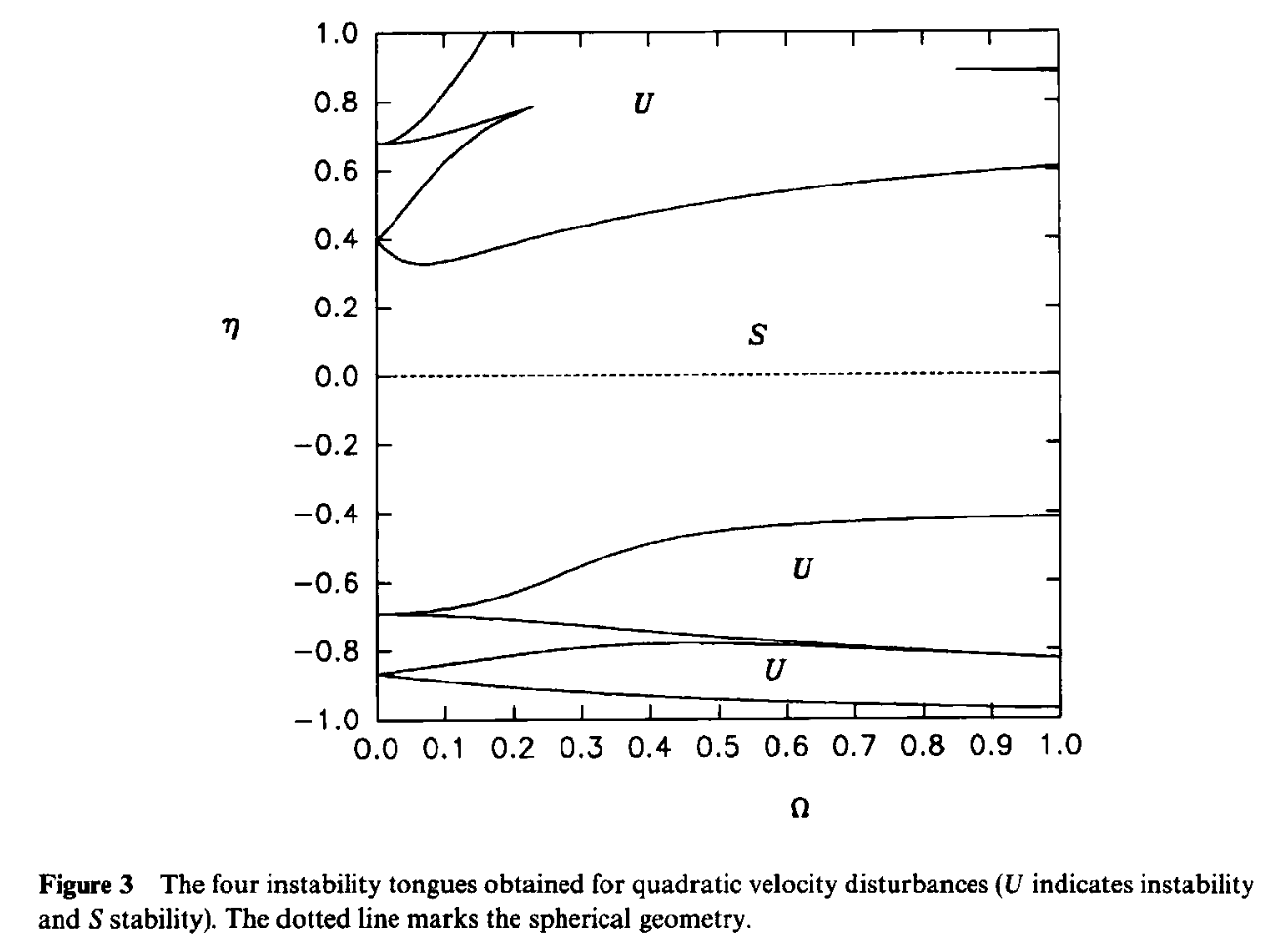
V 3 = { Q 3 , − 2 , 1 , Q 3 , − 1 , 1 , Q 3 , − 1 , 2 , Q 3 , 0 , 1 , Q 3 , 0 , 2 , Q 3 , 1 , 1 , Q 3 , 1 , 2 , Q 3 , 2 , 1 } \mathscr{V}_3=\{\boldsymbol{Q_{3,-2,1}},\boldsymbol{Q_{3,-1,1}},\boldsymbol{Q_{3,-1,2}},\boldsymbol{Q_{3,0,1}},\boldsymbol{Q_{3,0,2}},\boldsymbol{Q_{3,1,1}},\boldsymbol{Q_{3,1,2}},\boldsymbol{Q_{3,2,1}}\}
V 3 = { Q 3 , − 2 , 1 , Q 3 , − 1 , 1 , Q 3 , − 1 , 2 , Q 3 , 0 , 1 , Q 3 , 0 , 2 , Q 3 , 1 , 1 , Q 3 , 1 , 2 , Q 3 , 2 , 1 }
5 Unbounded streamlines
The unbounded basic flow is
u = [ 0 − 1 0 1 0 − 2 ε 0 0 0 ] x = D ⋅ x (5.1) \boldsymbol{u}=\left[\begin{array}{ccc}
0 & -1 & 0 \\
1 & 0 & -2\varepsilon \\
0 & 0 & 0
\end{array}\right]\boldsymbol{x}=\boldsymbol{D}\cdot\boldsymbol{x}\tag{5.1}
u = 0 1 0 − 1 0 0 0 − 2 ε 0 x = D ⋅ x ( 5.1 )
The perturbation equation is
d u ^ d t + D ⋅ u ^ + 2 Ω × u ^ + i k p ^ = 0 (5.3) \frac{\mathrm{d}\hat{\boldsymbol{u}}}{\mathrm{d}t}+\boldsymbol{D}\cdot\hat{\boldsymbol{u}}+2\boldsymbol{\Omega}\times\hat{\boldsymbol{u}}+i\boldsymbol{k}\hat{p}=0 \tag{5.3}
d t d u ^ + D ⋅ u ^ + 2 Ω × u ^ + i k p ^ = 0 ( 5.3 )
Floquet method
d u ^ i d t = A i l u ^ l \frac{\mathrm{d}\hat{u}_i}{\mathrm{d}t}=A_{il}\hat{u}_l
d t d u ^ i = A i l u ^ l
this is a Floquet problem, u ^ \hat{\boldsymbol{u}} u ^
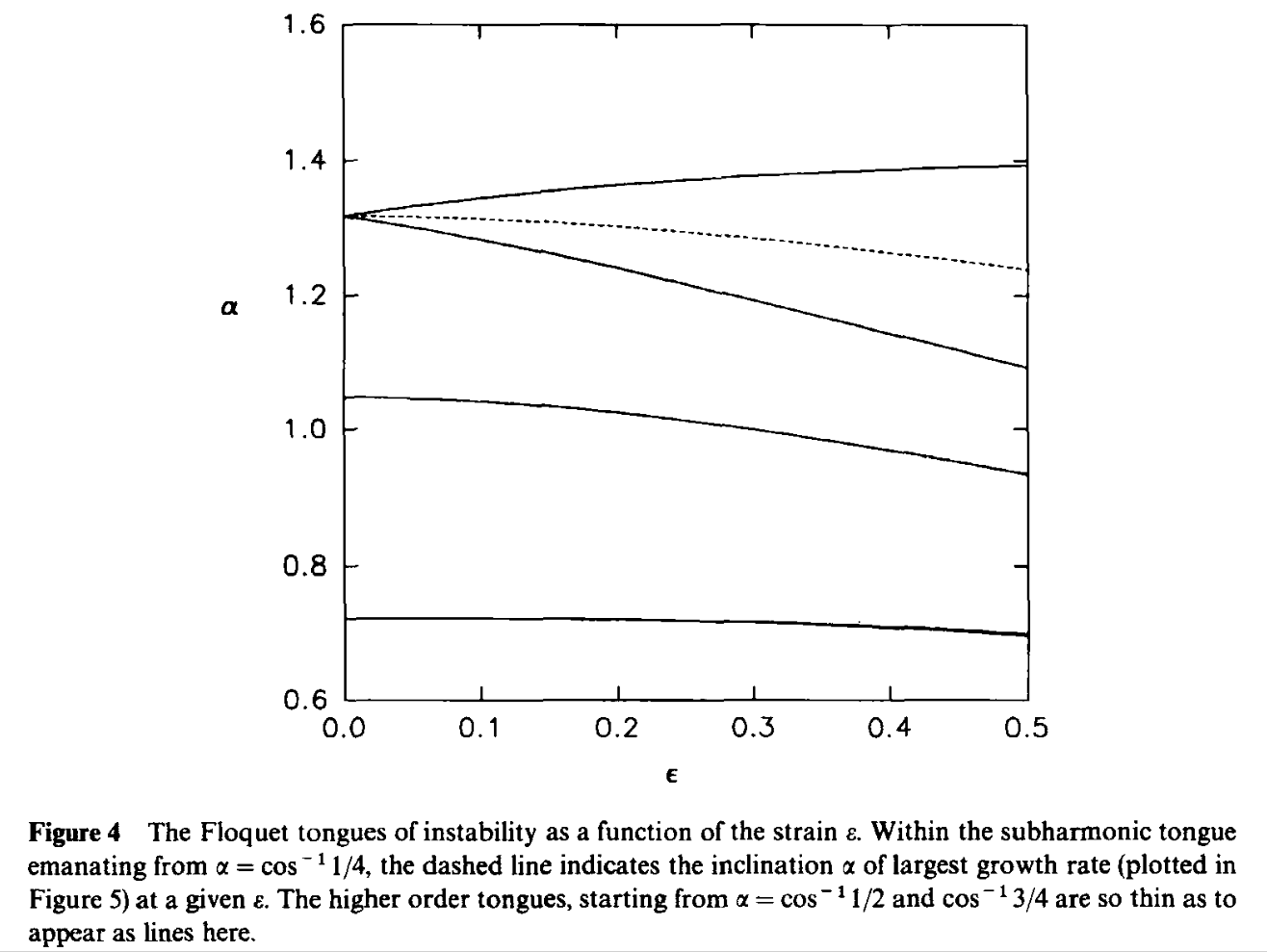
σ ˉ ( α , ε ) = 1 2 π ln ∣ μ ∣ \bar{\sigma}(\alpha,\varepsilon)=\frac{1}{2\pi}\ln|\mu|
σ ˉ ( α , ε ) = 2 π 1 ln ∣ μ ∣
where μ \mu μ M ( 2 π ) \boldsymbol{M}(2\pi) M ( 2 π )
Perturbation method
u ^ = [ u ^ 0 ( t ) + ε u ^ 1 ( t ) + O ( ε 2 ) ] e σ ε t \hat{\boldsymbol{u}}=[\hat{\boldsymbol{u}}_0(t)+\varepsilon\hat{\boldsymbol{u}}_1(t)+\mathrm{O}(\varepsilon^2)]e^{\sigma\varepsilon t}
u ^ = [ u ^ 0 ( t ) + ε u ^ 1 ( t ) + O ( ε 2 )] e σ εt
⟨ d d t ( 1 2 ∣ u ^ ∣ 2 ) ⟩ = ε tan α [ γ + 1 2 ] ⟨ cos ( 4 γ − 1 ) t ⟩ + O ( ε 2 ) \left\langle\frac{\mathrm{d}}{\mathrm{d}t}\left(\frac{1}{2}|\hat{\boldsymbol{u}}|^2\right)\right\rangle=\varepsilon\tan\alpha\left[\frac{\gamma+1}{2}\right]\left\langle\cos\left(\frac{4}{\gamma}-1\right)t\right\rangle+\mathrm{O}(\varepsilon^2)
⟨ d t d ( 2 1 ∣ u ^ ∣ 2 ) ⟩ = ε tan α [ 2 γ + 1 ] ⟨ cos ( γ 4 − 1 ) t ⟩ + O ( ε 2 )
For ε → 0 \varepsilon\rightarrow 0 ε → 0 γ = 4 , 2 , 4 3 , 1 \gamma=4,2,\dfrac{4}{3},1 γ = 4 , 2 , 3 4 , 1 cos α = 1 4 , 1 2 , 3 4 , 1 \cos\alpha=\dfrac{1}{4},\dfrac{1}{2},\dfrac{3}{4},1 cos α = 4 1 , 2 1 , 4 3 , 1
6 Discussion
Considering viscous, a pair of inertial waves can only grow if their joint rate of excitation exceeds the viscous decay rates.