Negative heat capacity

Velazquez, L. (2016). Remarks about the thermodynamics of astrophysical systems in mutual interaction and related notions. Journal of Statistical Mechanics: Theory and Experiment, 2016(3), 033105. https://doi.org/10.1088/1742-5468/2016/03/033105

Introduction to negative heat capacity in astrophysical systems.

Eddington’s idea

From the virial theorem in a radial potential field W1/rW\propto 1/r which reads

K=W2,\langle K\rangle=-\frac{\langle W\rangle}{2},

we have the total energy

U=K+W=K.\langle U\rangle=\langle K\rangle+\langle W\rangle=-\langle K\rangle.

Assuming the equipartition relation between kinetic energy and temperature K=3NkT/2\langle K\rangle=3NkT/2, we have

U=3NkT2C=dUdT=3Nk2<0,\langle U\rangle=-\frac{3NkT}{2}\Rightarrow C=\frac{\mathrm{d}\langle U\rangle}{\mathrm{d}T}=-\frac{3Nk}{2}<0,

which argues that the heat capacity of astrophysical systems could be negative.

Thirring stability conditions

Considering a closed system composed of two finite systems A and B, let us assume that the total energy UTU_T and entropy STS_T of the closed system are additive quantities, i.e., UT=UA+UBU_T=U_A+U_B and S=SA+SBS=S_A+S_B. Maximization of entropy STS_T at constant energy UTU_T demands the stability condition:

2STUA2=2SAUA2+2SBUB2<0CACBCA+CB>0,\frac{\partial^2 S_T}{\partial U_A^2}=\frac{\partial^2 S_A}{\partial U_A^2}+\frac{\partial^2 S_B}{\partial U_B^2}<0 \Rightarrow \frac{C_A C_B}{C_A+C_B}>0,

where CAC_A and CBC_B are heat capacities of these systems.

STUA=SAUASBUB=01TA=1TB(1T),\frac{\partial S_T}{\partial U_A}=\frac{\partial S_A}{\partial U_A}-\frac{\partial S_B}{\partial U_B}=0\Rightarrow \frac{1}{T_A}=\frac{1}{T_B}\left(\equiv\frac{1}{T}\right),

2SU2=U(1T)=1T2(TU)=1T2C.\frac{\partial^2 S}{\partial U^2}=\frac{\partial}{\partial U}\left(\frac{1}{T}\right)=-\frac{1}{T^2}\left(\frac{\partial T}{\partial U}\right)=-\frac{1}{T^2 C}.

A paradox

According to Thirring stability conditions, two systems with negative heat capacities cannot remain in equilibrium.
But what about binary stars? Two separable astrophysical systems in mutual interaction could support an additive total entropy STSA+SBS_T\simeq S_A+S_B. However, their total energy UTU_T cannot be expressed as the sum of their respective internal energies as UTUA+UBU_T\neq U_A+U_B because of the long-range character of gravitation.

So, it’s necessary to perform a re-examination of Thirring stability analysis for astrophysical situations.

Revisit thermal equilibrium condition

Consider two astrophysical systems A and B in mutual gravitational interaction. For each system, the internal degrees of freedom are the positions and their momenta {ri,pi}\{\vec{r}_i,\vec{p}_i\} relative to their own center of mass, while the collective degrees of freedom (R,P)(\vec{R},\vec{P}) refer to the relative separation vector of the centers of mass and its momentum. The Hamiltonian HH of this closed system can be expressed as:

H=HA+HB+WAB,H=H_A+H_B+W_{AB},

Hα=iα12miαpiα2iα<jαGmiαmjαriαrjα,α=A,B,H_\alpha=\sum_{i_\alpha}\frac{1}{2m_{i_\alpha}}\vec{p}^2_{i_\alpha}-\sum_{i_\alpha<j_\alpha}\frac{Gm_{i_\alpha}m_{j_\alpha}}{|\vec{r}_{i_\alpha}-\vec{r}_{j_\alpha}|},\quad \alpha=A,B,

WAB=12μABP2iAiBGmiBmiAR+riAriB.W_{AB}=\frac{1}{2\mu_{AB}}\vec{P}^2-\sum_{i_A i_B}\frac{Gm_{i_B}m_{i_A}}{|\vec{R}+\vec{r}_{i_A}-\vec{r}_{i_B}|}.

Then the additivity of the total energy UT=UA+UBU_T=U_A+U_B is now replaced by the following constraint:

UT=UA+UB+W(UA,UBD),U_T=U_A+U_B+W(U_A,U_B|D),

dUT=[1+(WUA)]dUA+[1+(WUB)]dUBϕA1dUA+ϕB1dUB,\mathrm{d}U_T=\left[1+\left(\frac{\partial W}{\partial U_A}\right)\right]\mathrm{d}U_A+\left[1+\left(\frac{\partial W}{\partial U_B}\right)\right]\mathrm{d}U_B\equiv\phi_A^{-1}\mathrm{d}U_A+\phi_B^{-1}\mathrm{d}U_B,

and the stability condition:

2STUA2<0ϕA[CA+CBCACB1η(ϕAUA+ϕBUB)]>0.\frac{\partial^2 S_T}{\partial U_A^2}<0\Rightarrow \phi_A\left[\frac{C_A+C_B}{C_AC_B}-\frac{1}{\eta}\left(\frac{\partial \phi_A}{\partial U_A}+\frac{\partial \phi_B}{\partial U_B}\right)\right]>0.

Stability of a binary system

Now expand the collective motions WABW_{AB} using quadrupole terms

WAB=P22μαRαΘR6,W_{AB}=\frac{\vec{P}^2}{2\mu}-\frac{\alpha}{|\vec{R}|}-\frac{\alpha\Theta}{|\vec{R}|^6},

where

μ=MAMBMA+MB,α=GMAMB,Θ=ξA(6ξA+1)qA+ξB(6ξB+1)qB2ξAξB,\mu=\frac{M_AM_B}{M_A+M_B},\alpha=GM_AM_B,\Theta=\frac{\xi_A(6\xi_A+1)q_A+\xi_B(6\xi_B+1)q_B}{2\xi_A\xi_B},

ξA=MBMA+MB,ξB=MAMA+MB,qA=916π2MAkTAGρA2,qB=916π2MBkTBGρB2.\xi_A=\frac{M_B}{M_A+M_B},\xi_B=\frac{M_A}{M_A+M_B},q_A=\frac{9}{16\pi^2}\frac{M_AkT_A}{G\rho_A^2},q_B=\frac{9}{16\pi^2}\frac{M_BkT_B}{G\rho_B^2}.

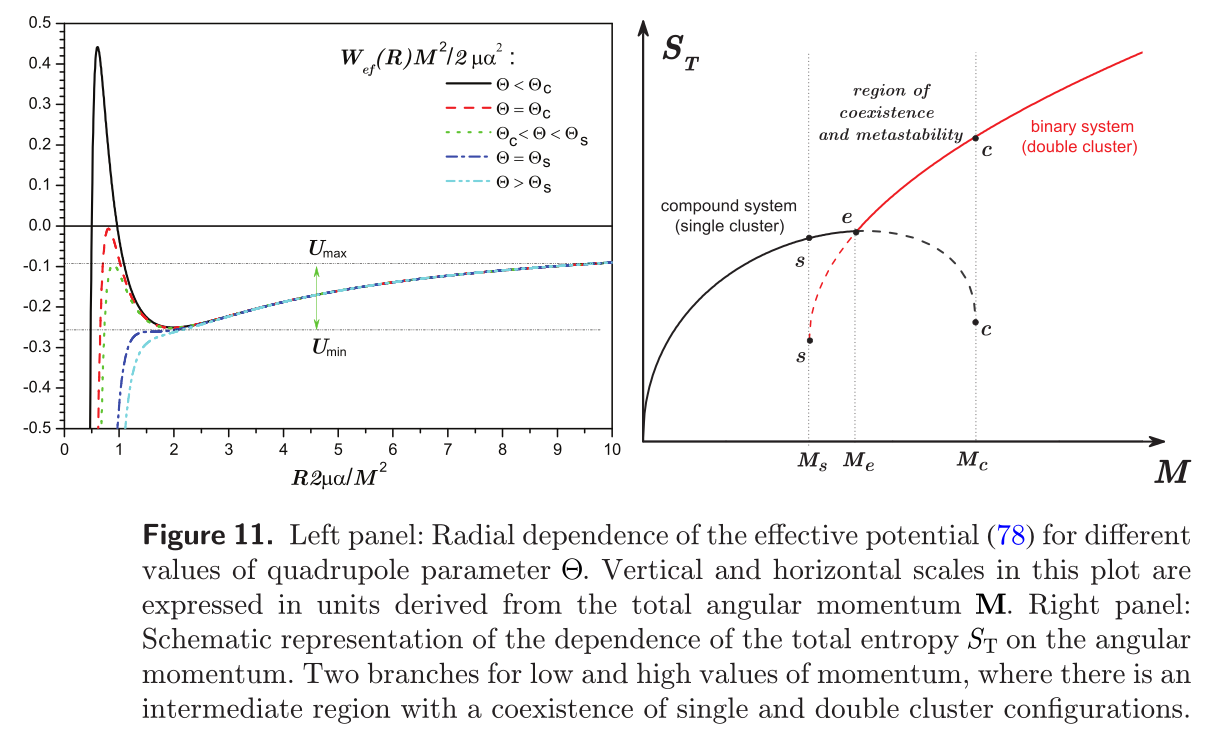
The effective potential reads

Wef(R)=M22μR2αRαΘR6.W_\text{ef}(R)=\frac{\vec{M}^2}{2\mu R^2}-\frac{\alpha}{R}-\frac{\alpha\Theta}{R^6}.

Fig11

Two critical values for quadrupole parameter Θ\Theta:

Θc=14(2M25μa)5,Θs=124(4M25μa)5.\Theta_c=\frac{1}{4}\left(\frac{2M^2}{5\mu a}\right)^5,\Theta_s=\frac{1}{24}\left(\frac{4M^2}{5\mu a}\right)^5.

Stability and instability situations:

  • ΘΘc\Theta\le\Theta_c: the binary system is always stable due to UC<0U_C<0;
  • Θc<Θ<Θs\Theta_c <\Theta<\Theta_s: the system only stable within a certain energy window UminUC<Umax<0U_\text{min}\le U_C<U_\text{max}<0, while the system is unstable and finally collapses to form a single structure within energy window Umax<UC<0U_\text{max}<U_C<0;
  • ΘΘs\Theta\ge\Theta_s: the system is always unstable.

Negative heat capacity
http://jingliangwei.github.io/blog-hexo/2026/05/14/Negative-heat-capacity/
Author
Arwell
Posted on
May 14, 2026
Licensed under