Quintic Formula
Ideas from Youtube vedio: https://youtu.be/BSHv9Elk1MU?si=jpgd7e8tOTUTmqLX
Also see the visual Youtube vedio: https://youtu.be/9HIy5dJE-zQ?si=Wu3Qy9d0OF5dXm2j
Why there is ‘no’ quintic formula? (A proof without Galois theory)
Fundamental theorem of algebra
Fundamental theorem of algebra:
A degree polynomial equation has solutions in the complex plane. (counting repeated roots)
A visual proof:
Considering a degree polynomial . While is large enough, the polynomial is mainly depend on the largest term . Then when varies from to , the polynomial will rotate the origin times in a orbit near circle. See the figure using as an example below.
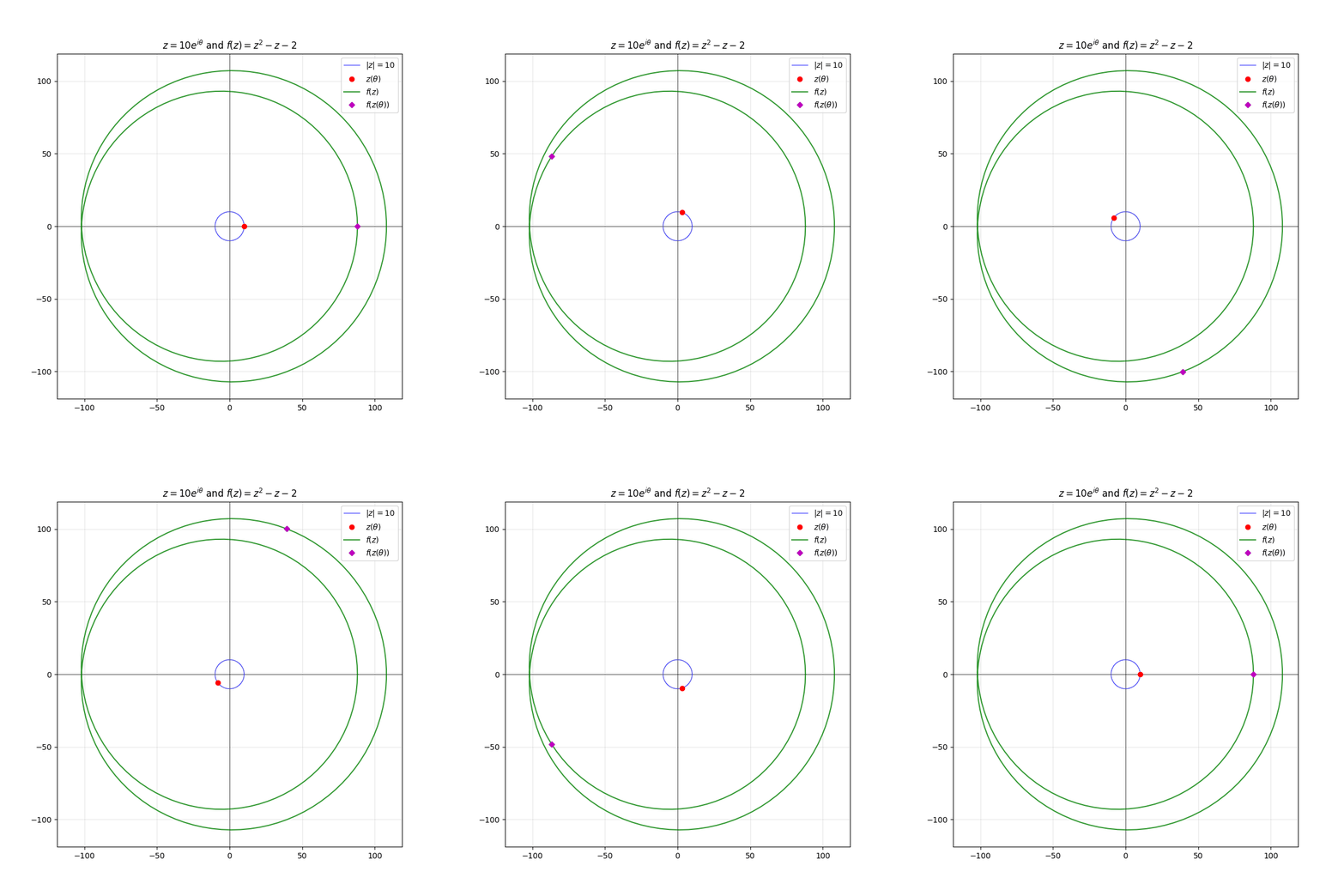
Then we decrease the amplitude of , and the trajectory of the will finally approach the constant term in the polynomial .
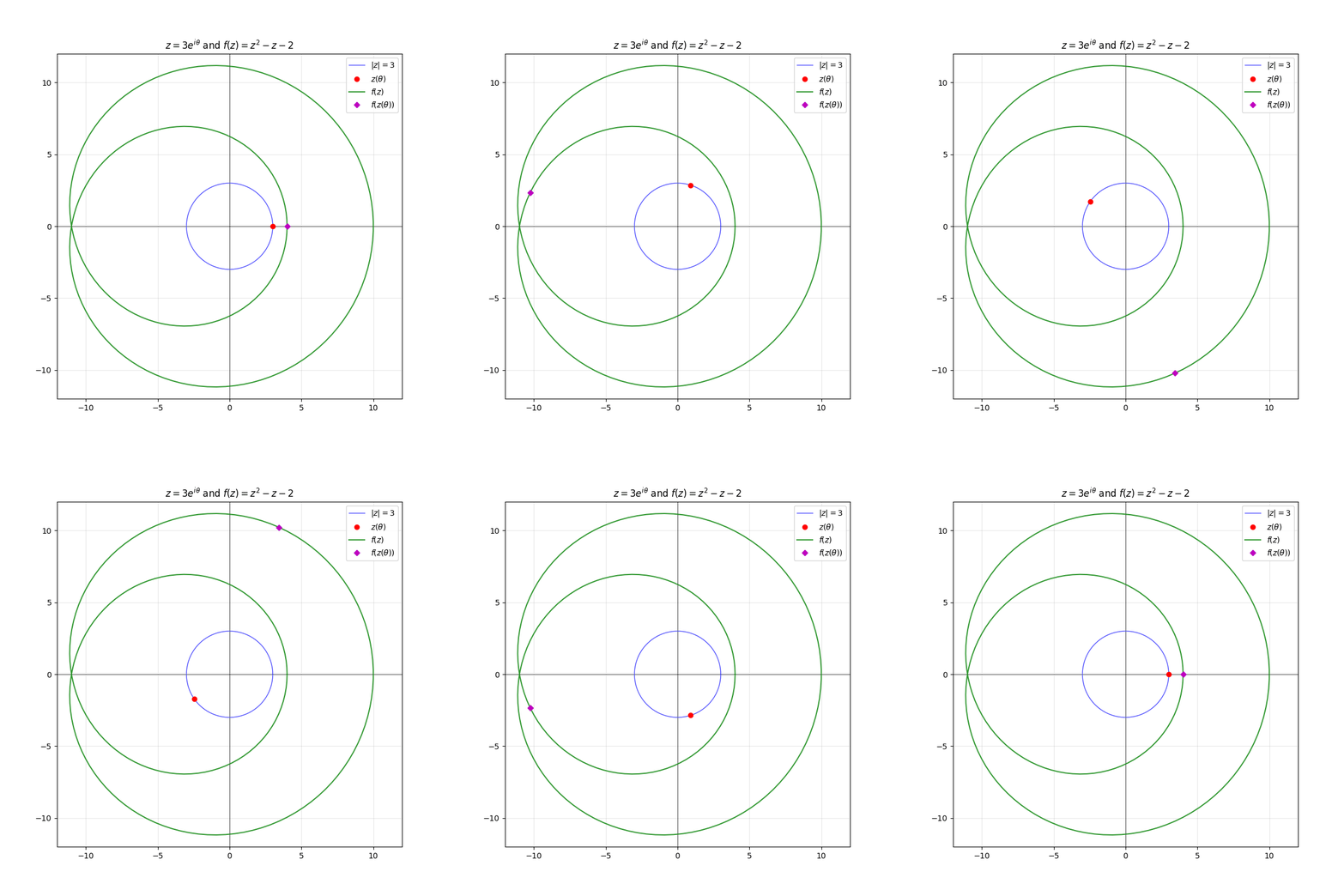
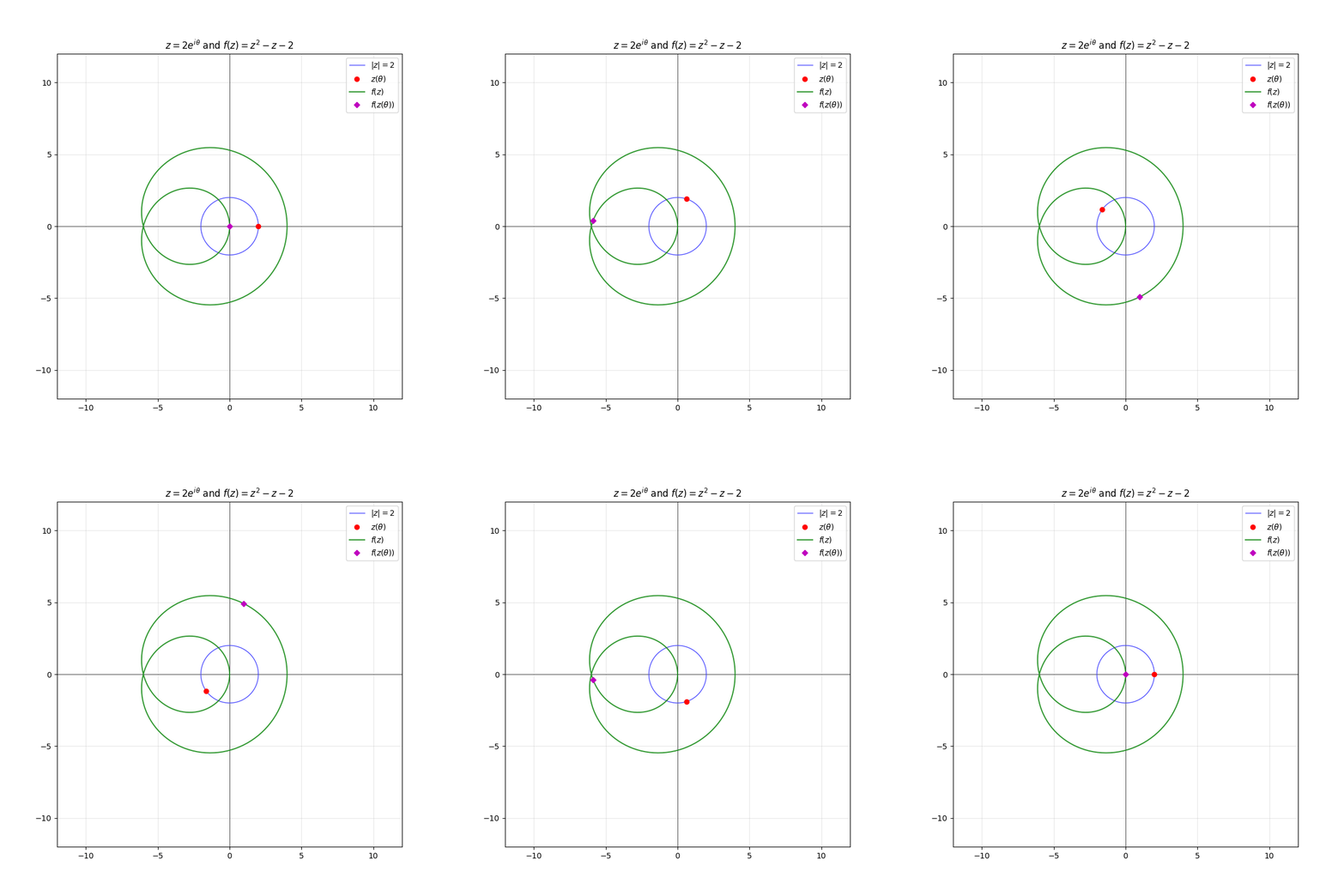
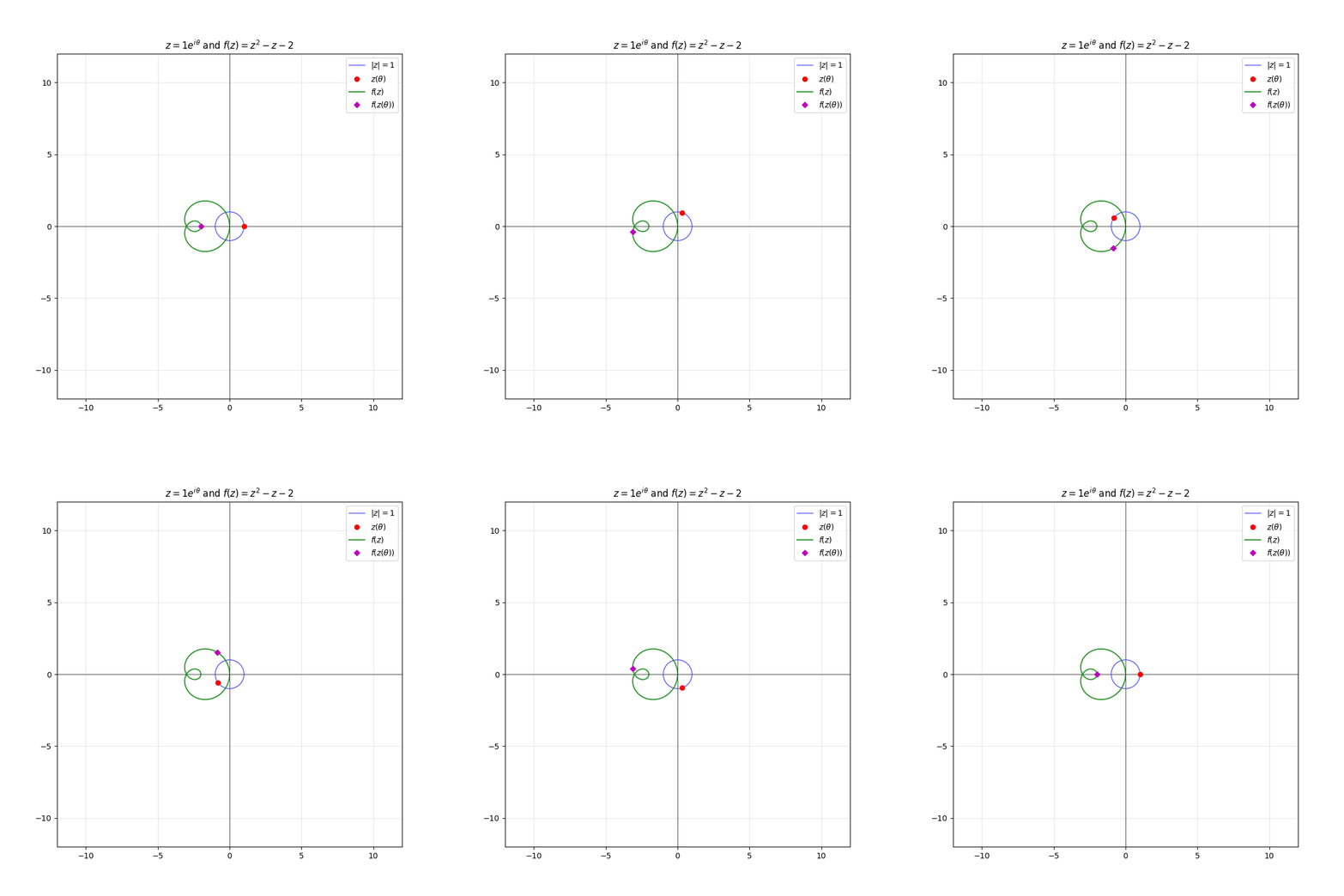
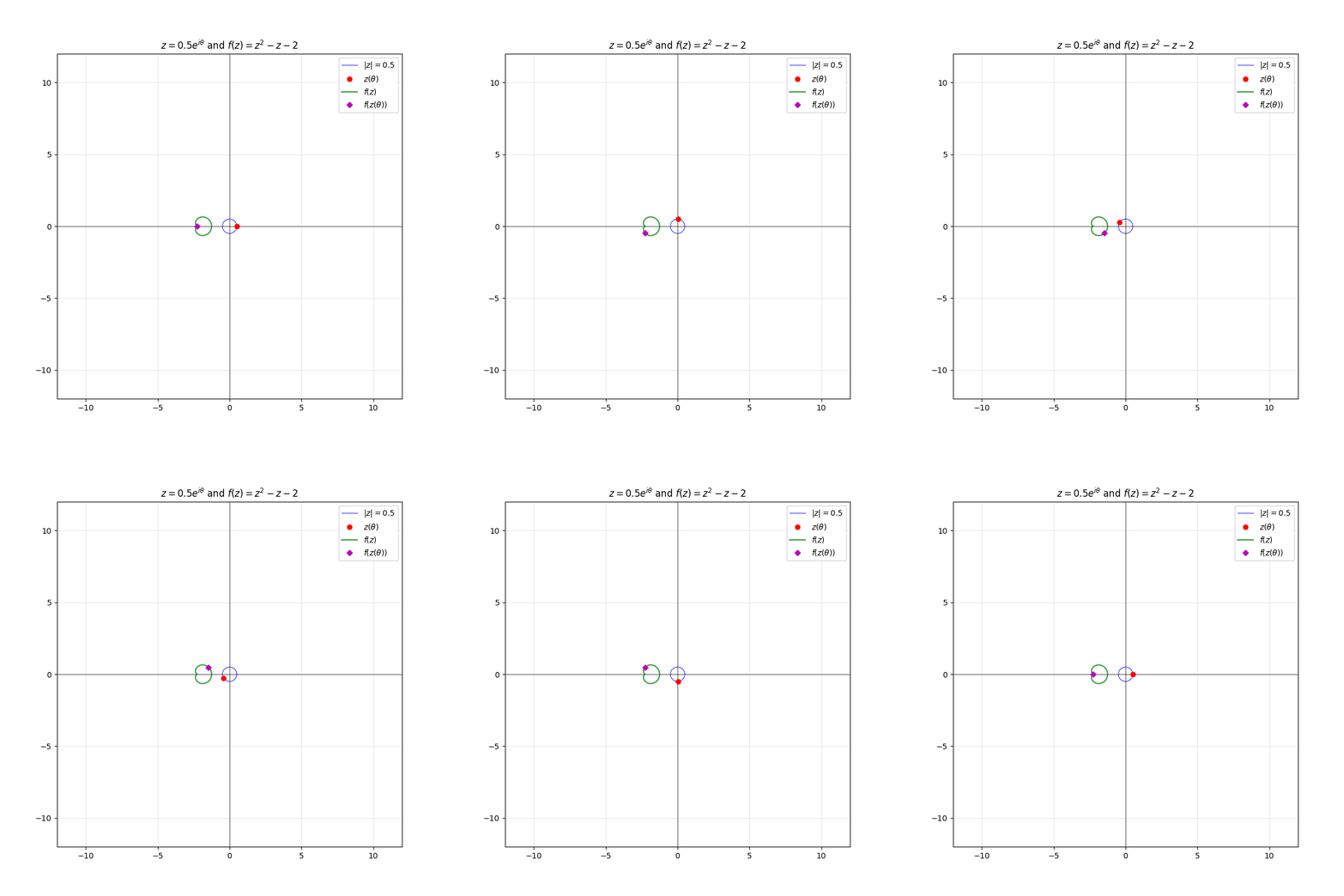
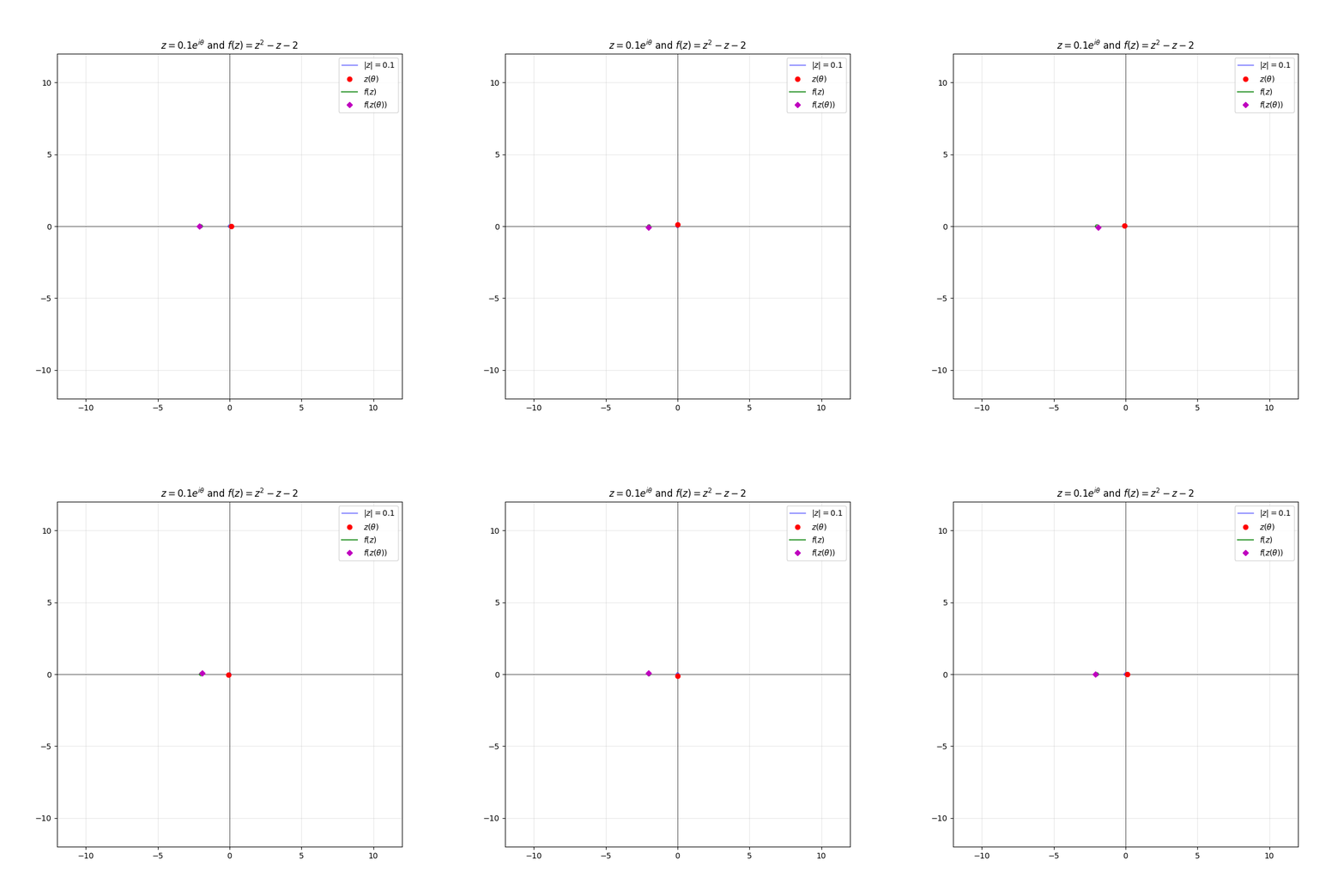
And through the whole process, the trajectory will cross the origin at times (here ), which mean there are solutions in the complex plane for a degree polynomial equation.
1 | |
The symmetry of roots
-
Quintic formula:
-
For :
If we change the continuously, for example , and you will find that the solution can be both and , when .
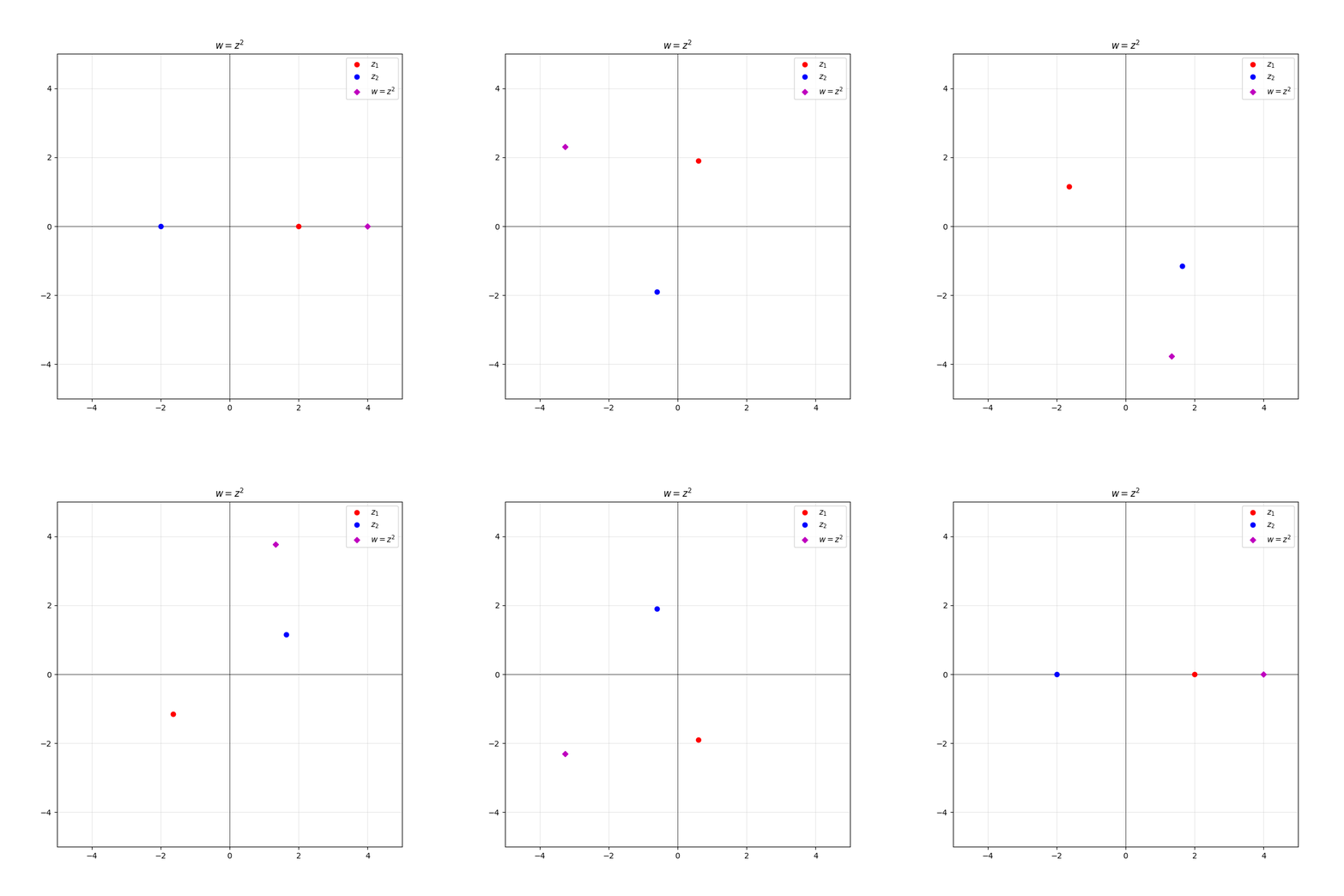
In other word, the solution is multivalued function, which mean there is no quadratic solution without square root ( is multivalued).The visual symmetry of square root help us to prove the theorem
Theorem: The quadratic equation cannot be solved with a rational function of .
Proof: Imagine could be written without roots.
Then it is a continuous single-valued function.
Now consider . Smoothly changing to , we guarantee must change (by continuity). (See the figure before)
But the equation and hence are unaltered, so has not changed (by single-valuedness).
So our idea to prove there is ‘no’ quintic formula can be:
Theorem: The quintic equation cannot be solved using a single root of .
Proof: Imagine could be written with just one roots.
Then it is a continuous tamely multi-valued function.
Now consider . Smoothly and cleverly swapping these, we guarantee must change (by continuity).
But hopefully are unaltered, so has not changed (by tameness?).
So our goal turn to: Can we swap the solutions without changing th roots of coefficients ?
Roots aren’t enough for cubic/quartic/…
Consider a th root , and the five solutions set
| values | |||||
|---|---|---|---|---|---|
| solutions |
If we take a continuously change of , which add onto the phase of and swap and , i.e.,
| values | |||||
|---|---|---|---|---|---|
| solutions |
and then add onto the phase of which swap and , we have
| values | |||||
|---|---|---|---|---|---|
| solutions |
and then undo the first step, i.e., onto the phase of and swap and back,
| values | |||||
|---|---|---|---|---|---|
| solutions |
and finally undo the second step, i.e., onto the phase of and swap \bata and back,
| values | |||||
|---|---|---|---|---|---|
| solutions |
So the keep unchanged while the five solutions set rearranged.
This process is a commutator .
Therefore we have prove that: There is no cubic/quartic/… formula with only one th root.
Nested roots for cubic and quartic
Nested roots, e.g.,
One comutator keep the inner root unchanged, but the outer root is not guaranteed unchanged.
We can take commutator of commutators, i.e., (comm.1)(comm.2)(comm.1)(comm.2), and this one will guarantee the outer root unchanged.
-
Prove all commutators of commutators permuting three points are trivial.
single operator commutator commutator of commutators 1 2 3
1 3 2
2 1 3
2 3 1
3 1 2
3 2 11 2 3
2 3 1
3 1 21 2 3 all 3 point permutations cyclic permutations nothing (all 3 point permutations -> cyclic permutations -> nothing) is called derived series in Galois theory.
-
The quartic formula has roots of roots of roots:
It can be proved that the commutators-of-commutators-of-commutators are trivial.
Onto the quintic
We want to prove that: The solutions to the quintic cannot be expressed using any finite number of nested roots, i.e., there are commutators of commutators of commutators of commutators of commutators … which mix up five points!
Proof:
consider the operation below
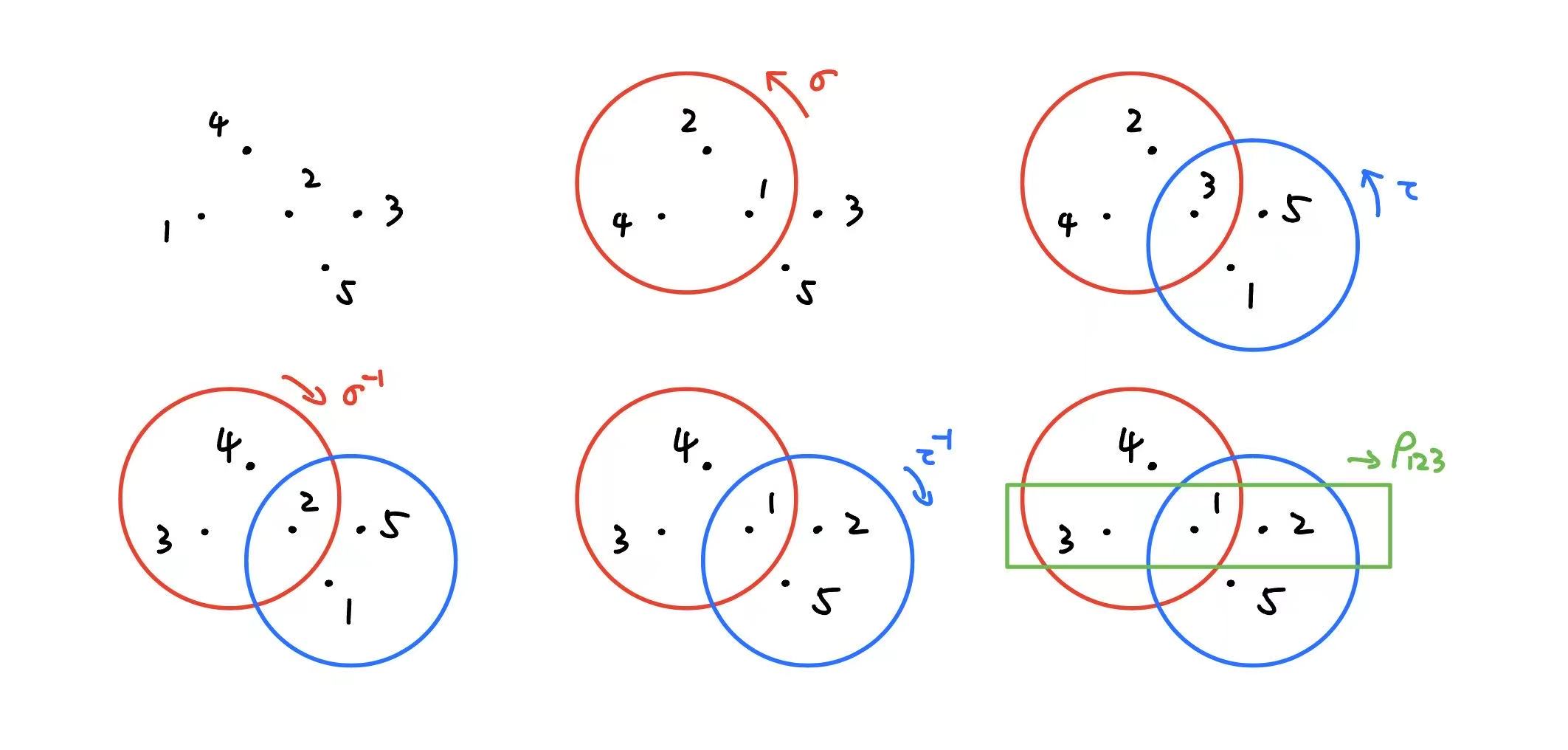
The cyclic permutation of 3 points can be the commutator of two other such permutations of 3 points
and this can generate a infinite series commutator of commutators that mix up the five points.
QED.