Image of a spherical black hole with thin accretion disk

Luminet, J.-P. (1979). Image of a spherical black hole with thin accretion disk. Astronomy and Astrophysics, 75(1-2), 228–235.

pdf with notes

Image of a Bare Black Hole

  • The Schwarzschild metric is

    ds2=(12Mr)dt2+(12Mr)1dr2+r2(dθ2+sin2θdϕ2)\mathrm{d}s^2=-\left(1-\frac{2M}{r}\right)\mathrm{d}t^2+\left(1-\frac{2M}{r}\right)^{-1}\mathrm{d}r^2+r^2(\mathrm{d}\theta^2+\sin^2\theta\mathrm{d}\phi^2)

    the unit system is chosen such that G=c=1G=c=1.
    The Schwarzschild radius rs=2Mr_s=2M.

  • The trajectories of photon in the “equatorial” plane ( θ=π/2\theta=\pi/2 ) satisfy

    (1r2drdϕ)2+1r2(12Mr)=1b2\left(\frac{1}{r^2}\frac{\mathrm{d}r}{\mathrm{d}\phi}\right)^2+\frac{1}{r^2}\left(1-\frac{2M}{r}\right)=\frac{1}{b^2}

    where b=L/Eb=L/E is the impact parameter at infinity.
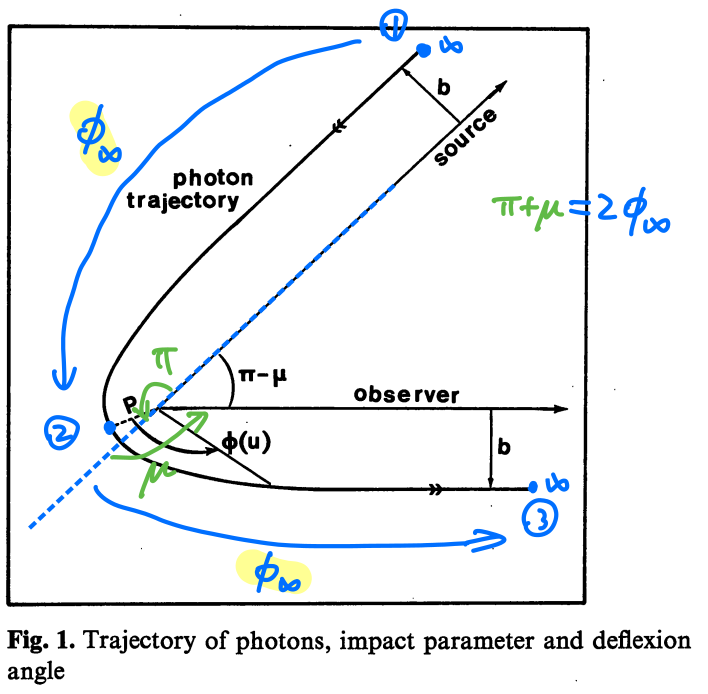
Fig.1

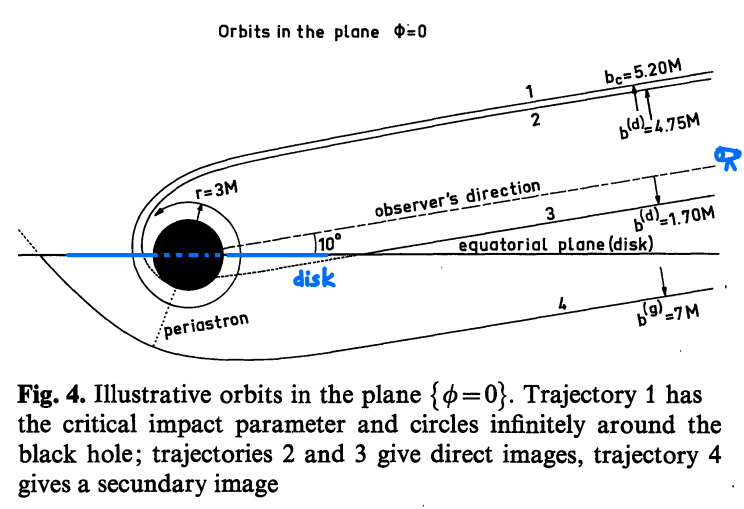
  • Cirtical impact parameter bc=33Mb_c=3\sqrt{3}M, for b<bcb<b_c, rays are captured by the hole.

  • The total deviation of the light ray μ\mu

    μ=2ϕπ\mu=2\phi_\infty-\pi

    ϕ=2PQζπ/2(1k2sin2x)1/2dx\phi_\infty=2\sqrt{\frac{P}{Q}}\int_{\zeta_\infty}^{\pi/2}(1-k^2\sin^2 x)^{-1/2}\mathrm{d}x

Image of a Clothed Black Hole

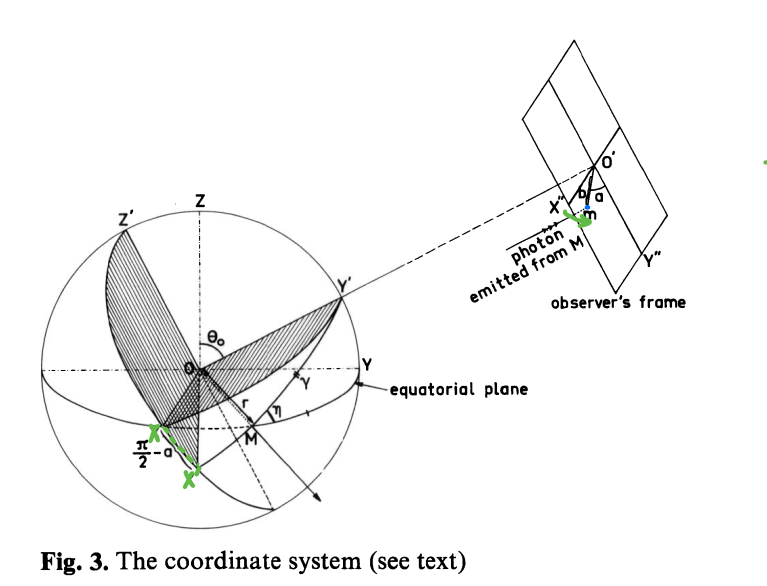
Fig.3

  • For a given emitter MM, the observer will detect two images:
    a direct (or primary) image at (b(d),α)(b^{(\text{d})},\alpha)
    a ghost (or secondary) image at (b(g),α+π)(b^{(\text{g})},\alpha+\pi)

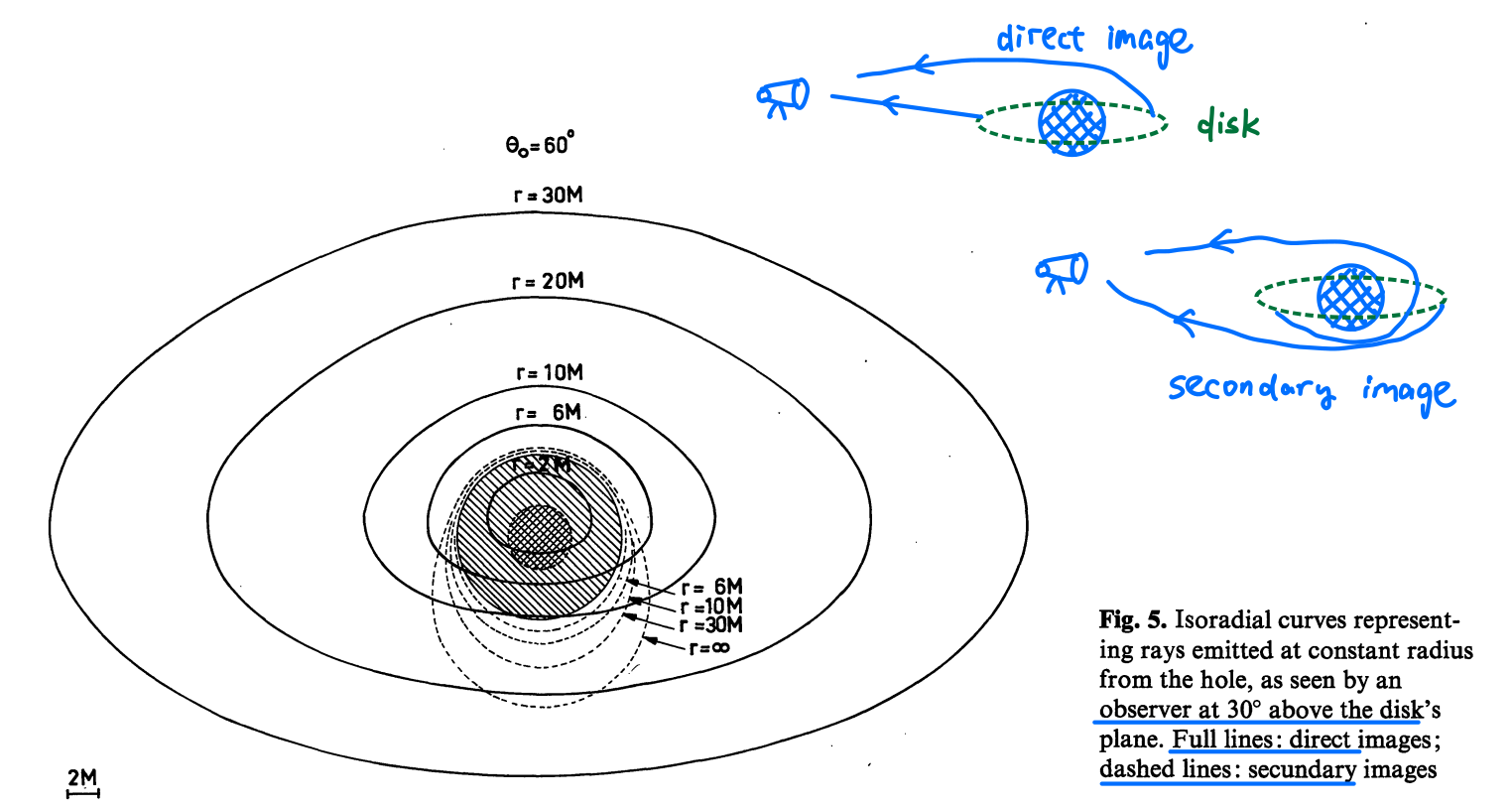
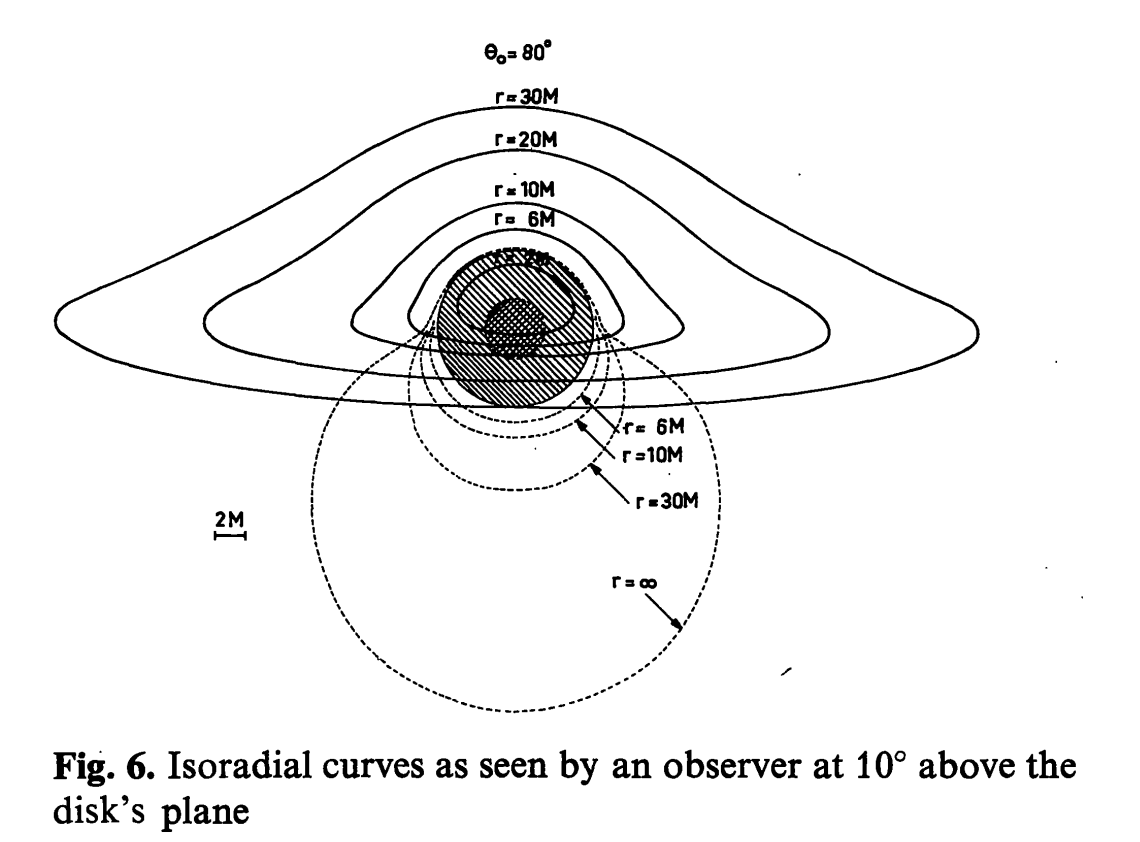
  • The isoradial curve:
    Given PP (periastron)

    cosγ=cosα(cos2α+cot2θ0)1/2(10)\cos\gamma=\cos\alpha(\cos^2\alpha+\cot^2\theta_0)^{-1/2}\tag{10}

    1r=QP+2M4MP+QP+6M4MPsn2[γ2PQ+F(ζ,k)](13)\frac{1}{r}=-\frac{Q-P+2M}{4MP}+\frac{Q-P+6M}{4MP}\text{sn}^2\left[\frac{\gamma}{2}\sqrt{\frac{P}{Q}}+F(\zeta_\infty,k)\right]\tag{13}

    r=r(γ,P)=r(α,P)P=P(r,α)r=r(\gamma,P)=r(\alpha,P)\Rightarrow P=P(r,\alpha)
    For a given angle θ0\theta_0

    b=P3P2M(5)b=\frac{P^3}{P-2M}\tag{5}

    b(d)=b(d)(P)=b(d)(r,α)b^{(\text{d})}=b^{(\text{d})}(P)=b^{(\text{d})}(r,\alpha)
    For a constant rr from the hole, the isoradial curves we can see are b(d)=b(d)(α)b^{(\text{d})}=b^{(\text{d})}(\alpha).

Fig.4
Fig.5
Fig.6

Realistic Appearance of a Black Hole Accrection Disk

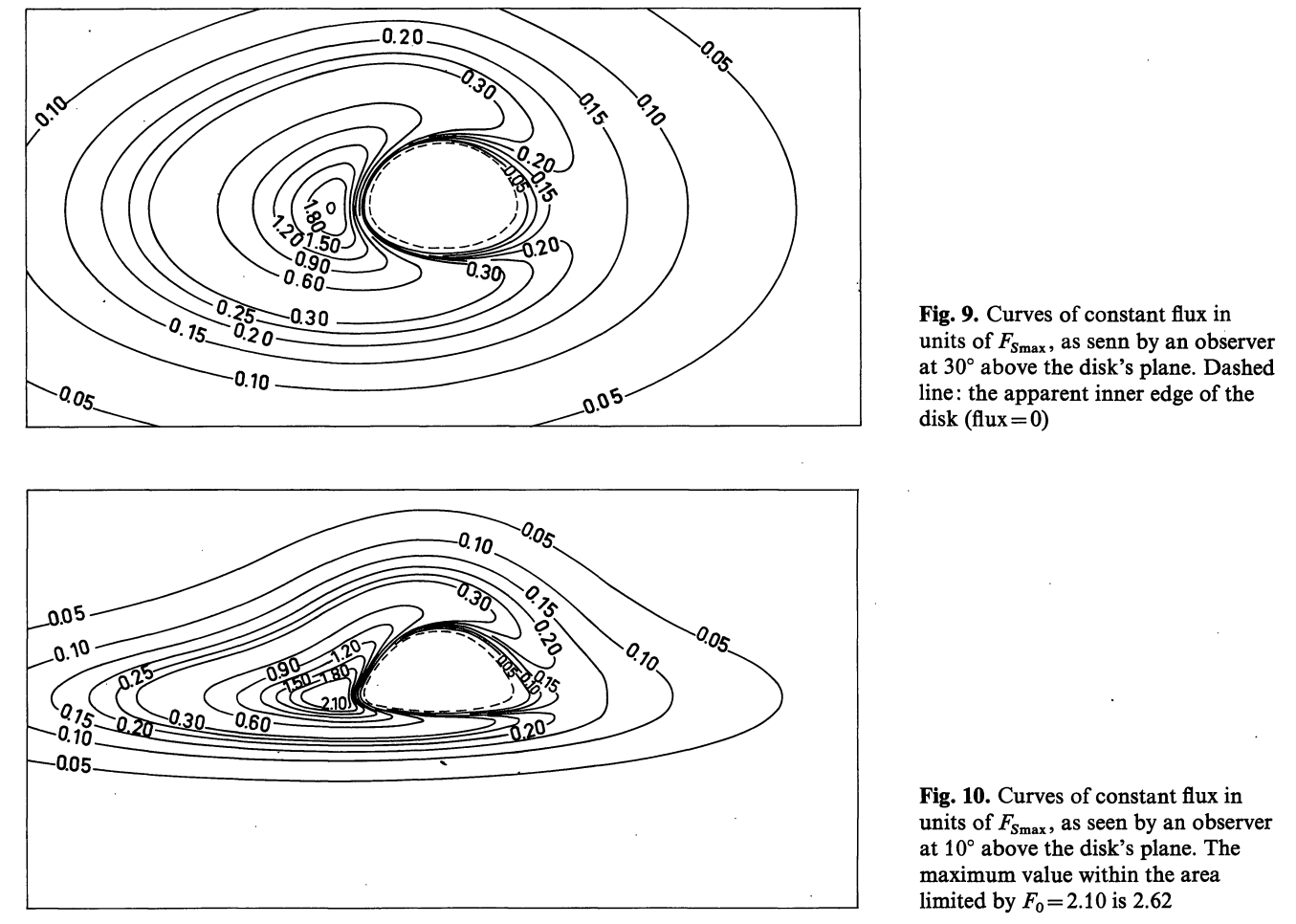
Consider the flux of radiation from the disk and the redshift Fobs=FS/(1+z)4F^{\text{obs}}=F_S/(1+z)^4

Fig.9&10
(The flux for the secondary image has not been depicted)


Image of a spherical black hole with thin accretion disk
http://jingliangwei.github.io/blog-hexo/2026/05/29/Image-of-a-spherical-black-hole-with-thin-accretion-disk/
Author
Arwell
Posted on
May 29, 2026
Licensed under