Black hole shadow

The shadow of a black hole

Luminet, J.-P. (1979). Image of a spherical black hole with thin accretion disk. Astronomy and Astrophysics, 75(1-2), 228–235.
Perlick, V., & Tsupko, O. Y. (2022). Calculating black hole shadows: Review of analytical studies. Physics Reports, 947, 1–39. https://doi.org/10.1016/j.physrep.2021.10.004
Gralla, S. E., Holz, D. E., & Wald, R. M. (2019). Black hole shadows, photon rings, and lensing rings. Physical Review D, 100(2), Article 024018. https://doi.org/10.1103/PhysRevD.100.024018
Beckwith, K., & Done, C. (2005). Extreme gravitational lensing near rotating black holes. Monthly Notices of the Royal Astronomical Society, 359(4), 1217–1228. https://doi.org/10.1111/j.1365-2966.2005.08980.x

The photon trajectory in Schwarzschild metric

  • Schwarzschild metric

    ds2=(12mr)c2dt2+dr212m/r+r2(dθ2+sin2θdϕ2),m=GMc2\mathrm{d}s^2=-\left(1-\frac{2m}{r}\right)c^2\mathrm{d}t^2+\frac{\mathrm{d}r^2}{1-2m/r}+r^2(\mathrm{d}\theta^2+\sin^2\theta\mathrm{d}\phi^2),\quad m=\frac{GM}{c^2}

  • The critial impact parameter bc=27mb_c=\sqrt{27}m, for b<bcb<b_c, the light is captured by the black hole.

    The impact parameter bL/Eb\equiv L/E is the perpendicular distance from the black hole to the asymptotic straight-line trajectory of the photon.
    see my note on Image of a spherical black hole with thin accretion disk for details.

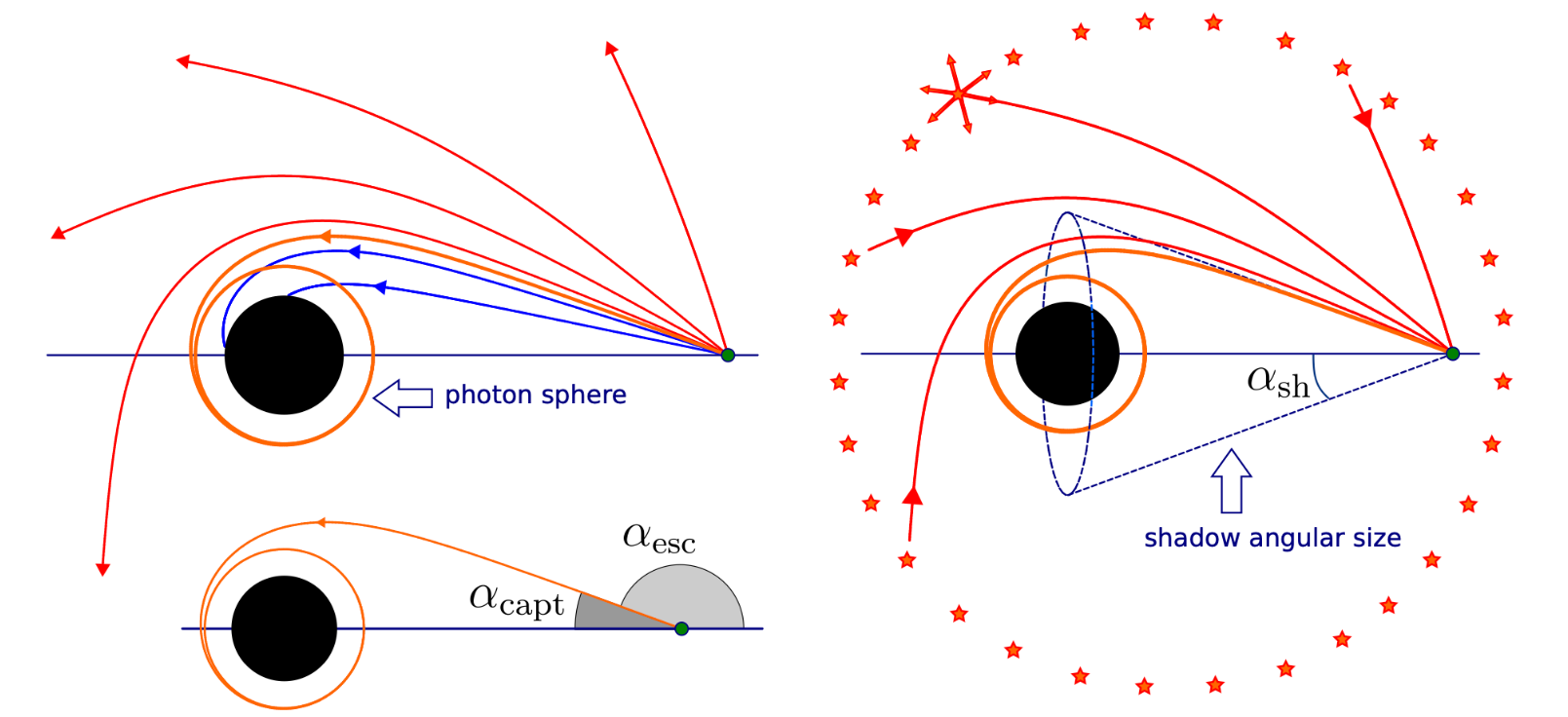
  • The shadow angle αcapt\alpha_\text{capt} and the escape angle αesc\alpha_\text{esc} (Perlick & Tsupko, 2022)

    sin2αesc=27m2(12m/rO)rO2\sin^2\alpha_\text{esc}=\frac{27m^2(1-2m/r_O)}{r_O^2}

    αcapt=αsh=παesc\alpha_\text{capt}=\alpha_\text{sh}=\pi-\alpha_\text{esc}

    escape angle

    From Schwarzschild metric

    ds2=(12mr)c2dt2+dr212m/r+r2(dθ2+sin2θdϕ2),m=GMc2\mathrm{d}s^2=-\left(1-\frac{2m}{r}\right)c^2\mathrm{d}t^2+\frac{\mathrm{d}r^2}{1-2m/r}+r^2(\mathrm{d}\theta^2+\sin^2\theta\mathrm{d}\phi^2),\quad m=\frac{GM}{c^2}

    in the “equatorial” plane ( θ=π/2\theta=\pi/2 )

    E=(12mr)dtdλ,L=r2dϕdλE=\left(1-\frac{2m}{r}\right)\frac{\mathrm{d}t}{\mathrm{d}\lambda},\quad L=r^2\frac{\mathrm{d}\phi}{\mathrm{d}\lambda}

    the geodesic ds2=0\mathrm{d}s^2=0 reads

    (drdλ)2=E2[1b2r2(12mr)]\left(\frac{\mathrm{d}r}{\mathrm{d}\lambda}\right)^2=E^2\left[1-\frac{b^2}{r^2}\left(1-\frac{2m}{r}\right)\right]

    where the impact parameter b=L/Eb=L/E.
    In the local frame located at rOr_O,

    p(r^)=grrpr=112m/rOdrdλ=E12m/rO1b2rO2(12mrO)p^{(\hat{r})}=\sqrt{g_{rr}}p^r=\frac{1}{\sqrt{1-2m/r_O}}\frac{\mathrm{d}r}{\mathrm{d}\lambda}=\frac{E}{\sqrt{1-2m/r_O}}\sqrt{1-\frac{b^2}{r_O^2}\left(1-\frac{2m}{r_O}\right)}

    p(ϕ^)=rOpϕ=LrO=bErOp^{(\hat{\phi})}=r_Op^\phi=\frac{L}{r_O}=\frac{bE}{r_O}

    sinα=p(ϕ^)(p(r^))2+(p(ϕ^))2\sin\alpha=\frac{p^{(\hat{\phi})}}{\sqrt{(p^{(\hat{r})})^2+(p^{(\hat{\phi})})^2}}

    subtituting bc=27mb_c=\sqrt{27}m

    sinα=bc/rO1/(12m/rO)=27m2rO2(12mrO)\sin\alpha=\frac{b_c/r_O}{\sqrt{1/(1-2m/r_O)}}=\sqrt{\frac{27m^2}{r_O^2}\left(1-\frac{2m}{r_O}\right)}

  • The photon sphere radius rph=3mr_\text{ph}=3m (Perlick & Tsupko, 2022)

    From radial equation:

    (drdλ)2=E2[1b2r2(12mr)]\left(\frac{\mathrm{d}r}{\mathrm{d}\lambda}\right)^2=E^2\left[1-\frac{b^2}{r^2}\left(1-\frac{2m}{r}\right)\right]

    define the effective potential

    Veff(r)=L2r2(12mr)V_\text{eff}(r)=\frac{L^2}{r^2}\left(1-\frac{2m}{r}\right)

    and the circular orbits dVeff/dr=0\mathrm{d}V_\text{eff}/\mathrm{d}r=0 give r=3mr=3m.

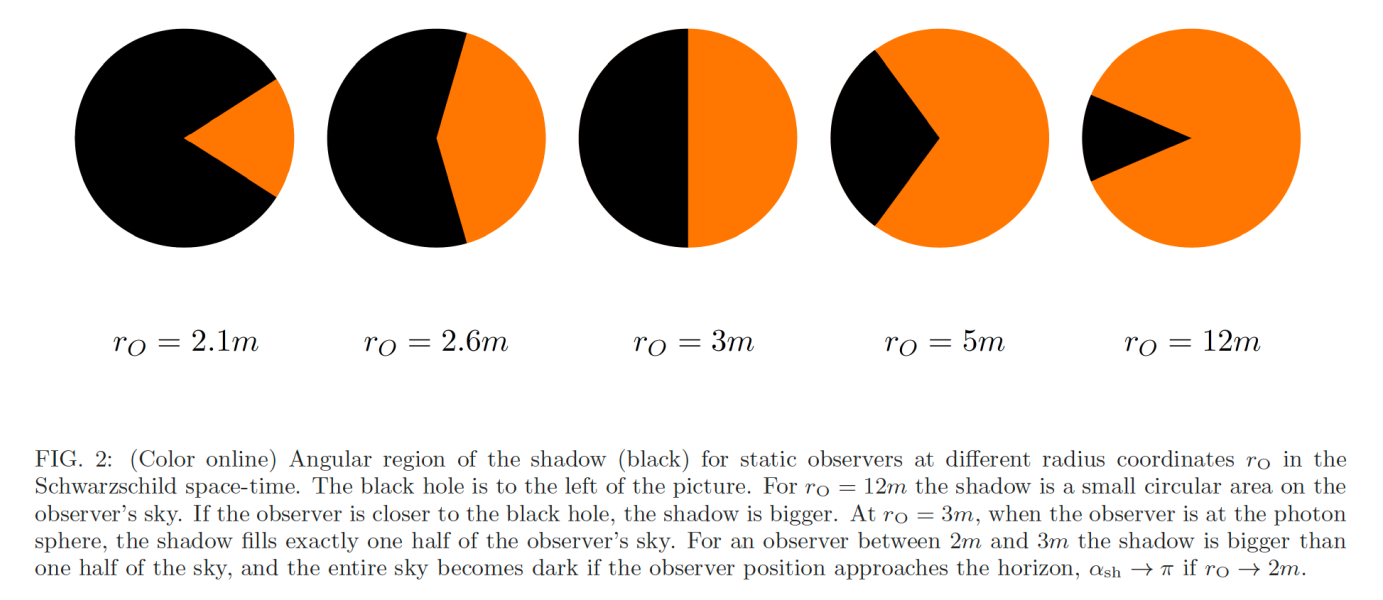
shadow vs rO

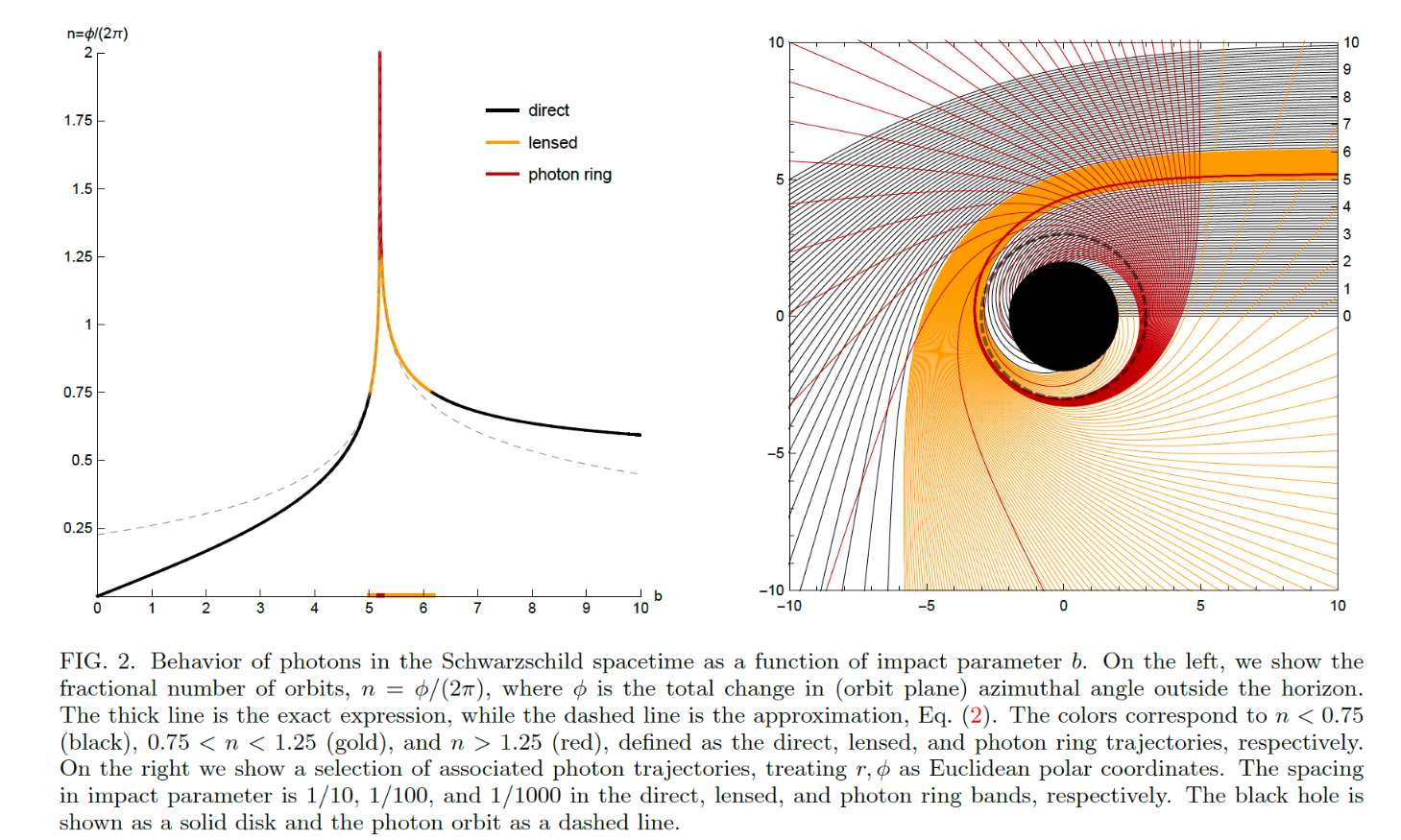
  • For bb near bc=27M5.196Mb_c=\sqrt{27}M\approx 5.196M, the elliptic integral gives the approximation (Gralla et al., 2019)

    ϕlog(C±bbc),bbc±(2)\phi\sim\log\left(\frac{C_\pm}{|b-b_c|}\right),\quad b\rightarrow b_c^\pm\tag{2}

    with

    C+=194412+73M80.6MC_+=\frac{1944}{12+7\sqrt{3}}M\approx 80.6 M

    C=648(26345)M21.6MC_-=648(26\sqrt{3}-45)M\approx 21.6 M

    1. Direct: n<3/4n<3/4
      b/M(5.02,6.17)b/M\notin(5.02,6.17)
    2. Lensed: 3/4<n<5/43/4<n<5/4
      b/M(5.02,5.19)b/M\in(5.02,5.19) or (5.23,6.17)(5.23,6.17)
    3. Photon ring: n>5/4n>5/4
      b/M(5.19,5.23)b/M\in(5.19,5.23)

    Schwarzschild impact

The image of Schwarzschild black hole

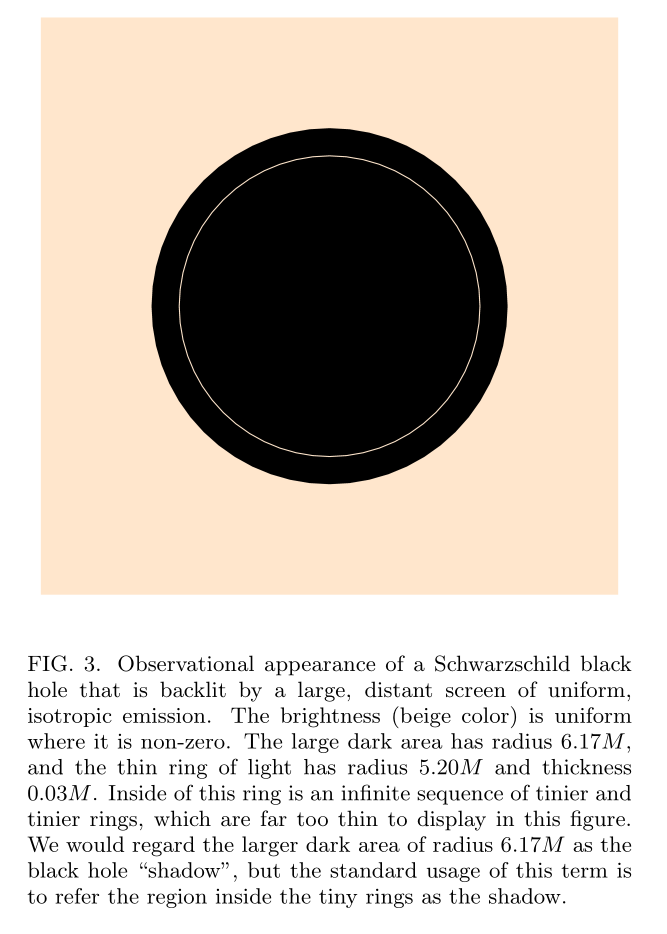
  • Backlit black hole (Gralla et al., 2019)

    Backlit BH

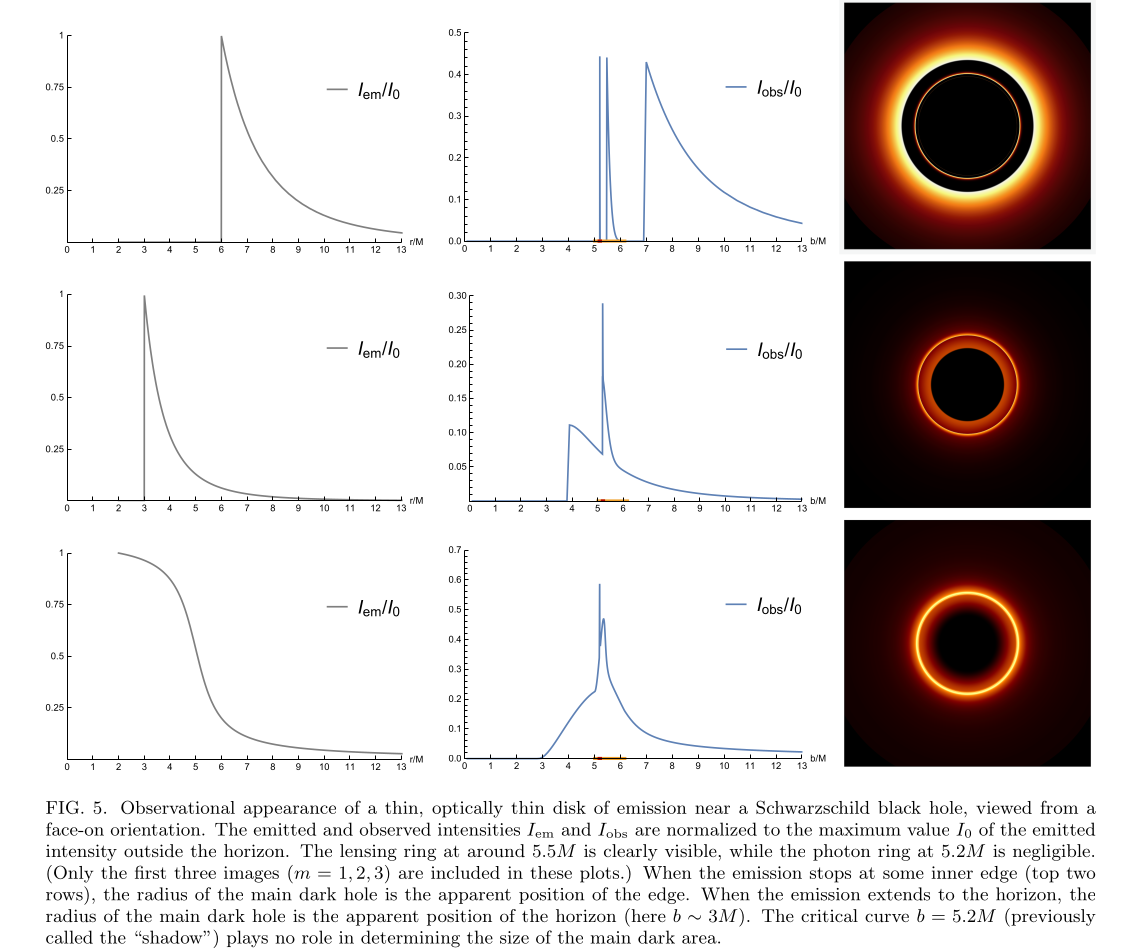
  • Face-on, optically and geometrically thin disk near a Schwarzschild black hole (Gralla et al., 2019)

    the figures in each low, from left to right are the IemI_\text{em}, IobsI_\text{obs} and the visual image.

    thin disk

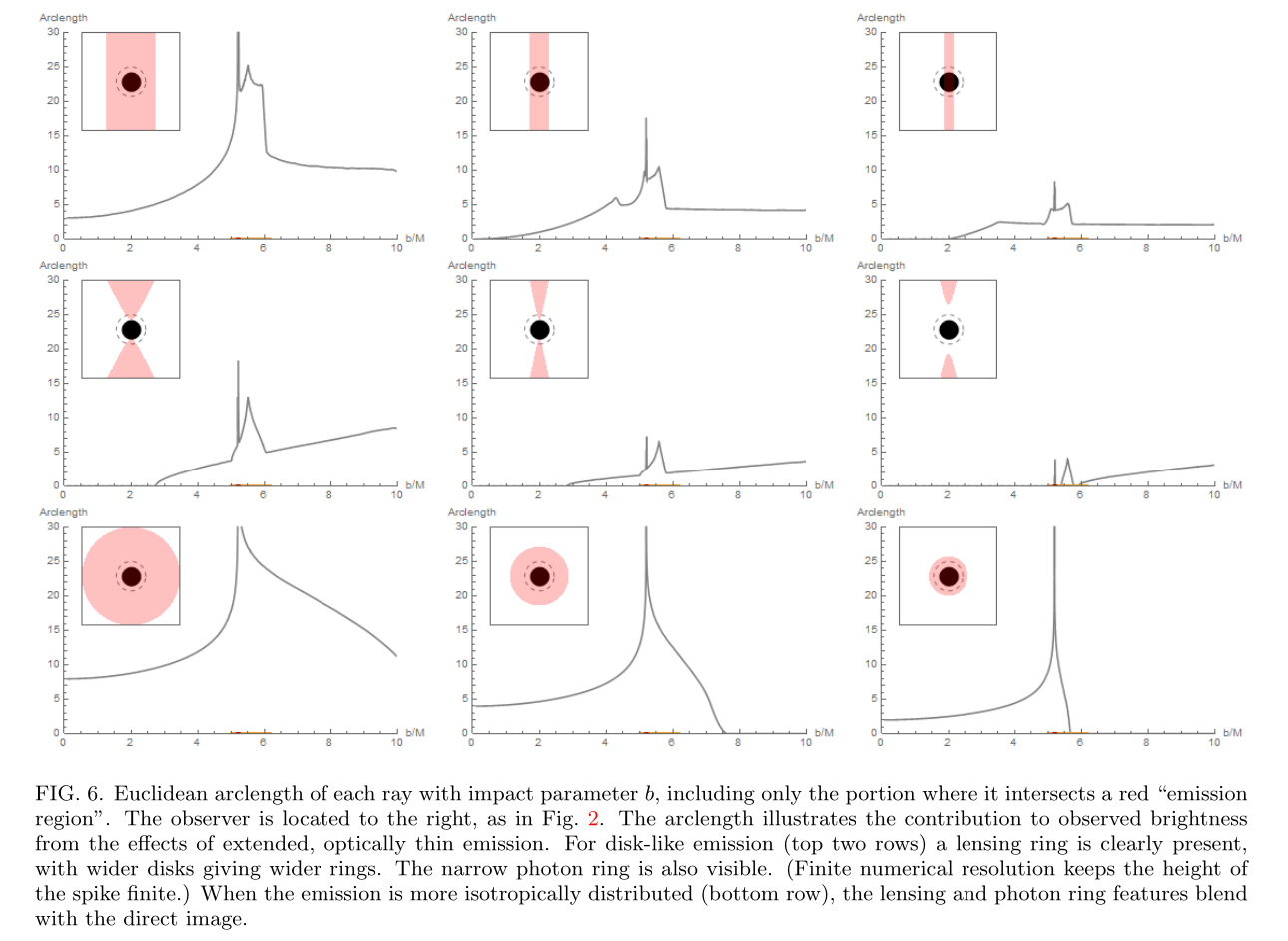
  • Geometrically thick and optically thin disk (Gralla et al., 2019)

    the pink region are the emission region, with the observer located to the right.

    thick disk

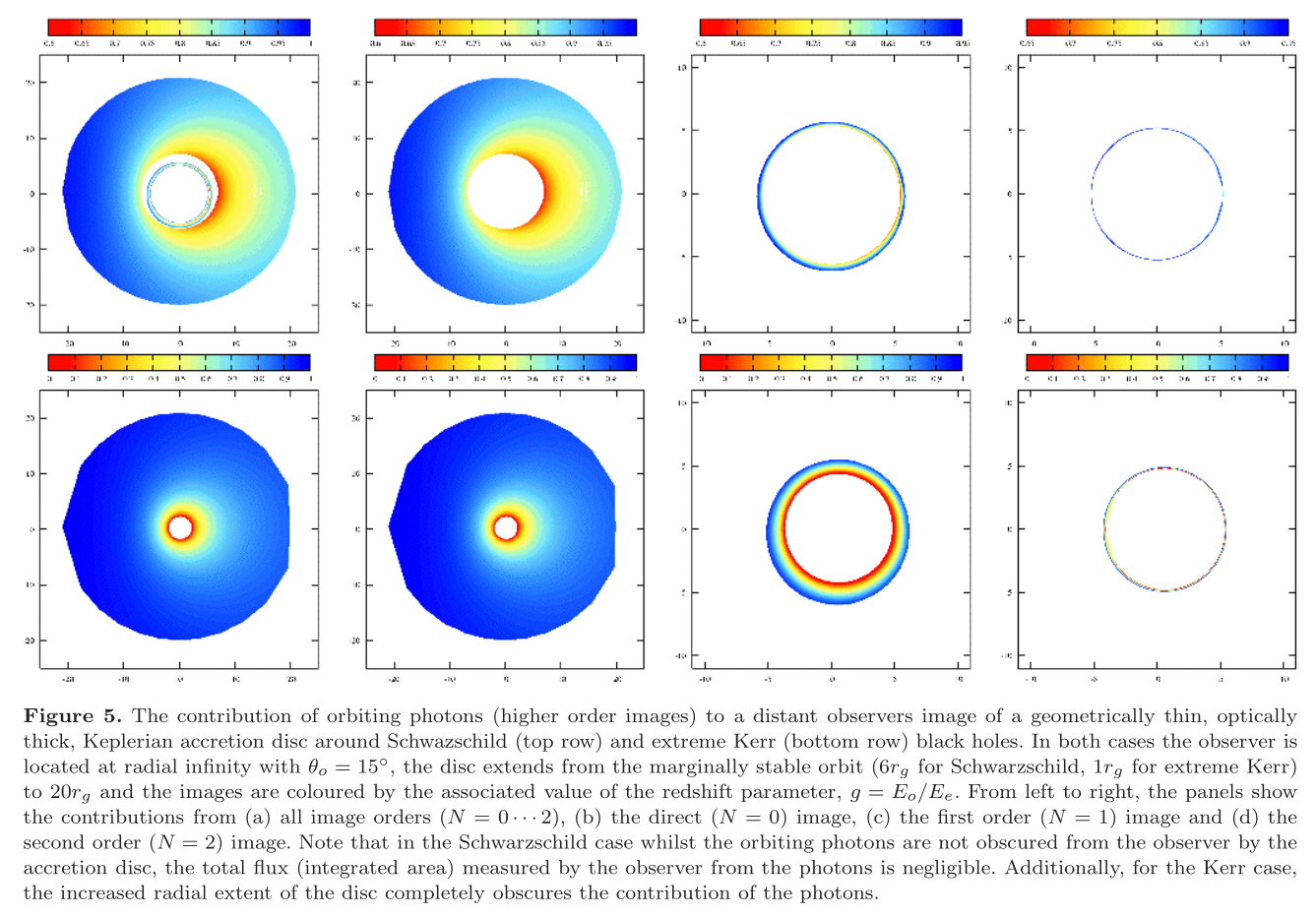
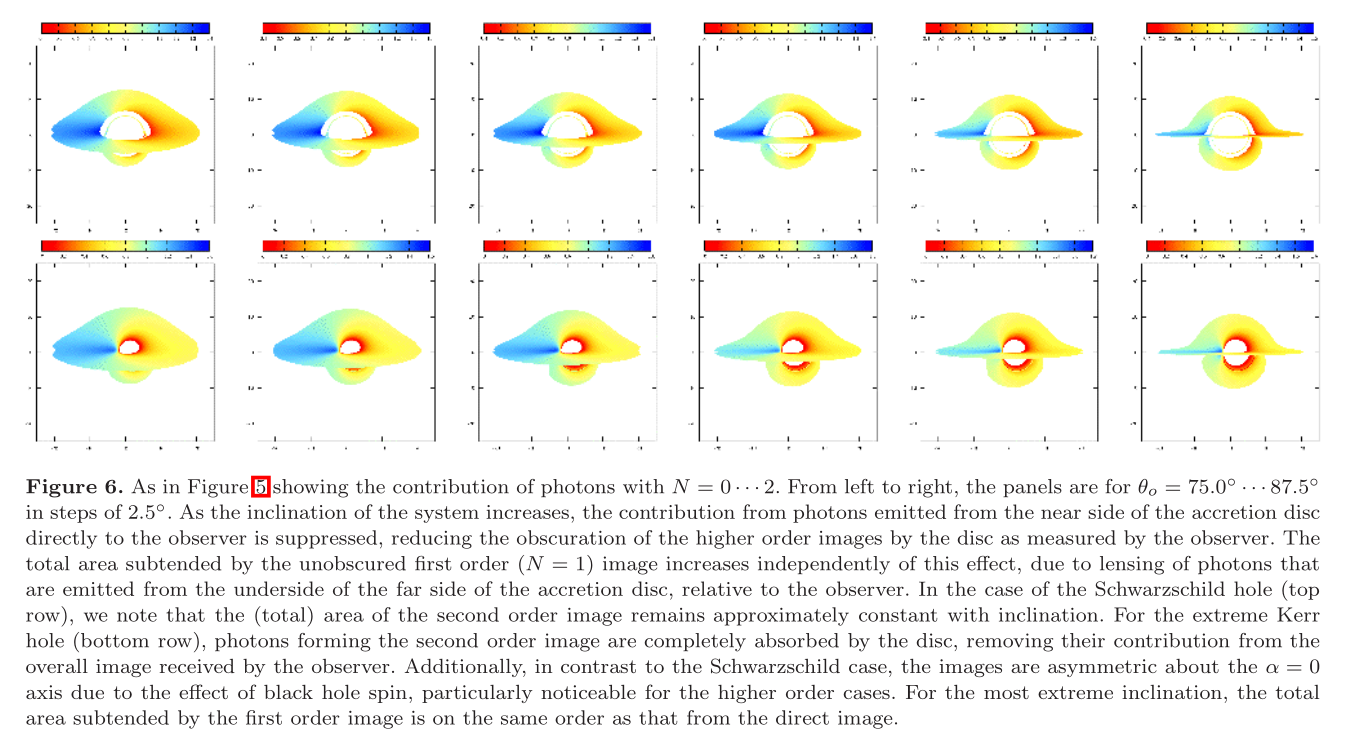
  • Geometrically thin and optically thick disk (Beckwith & Done, 2005)

    thin disk
    thin disk

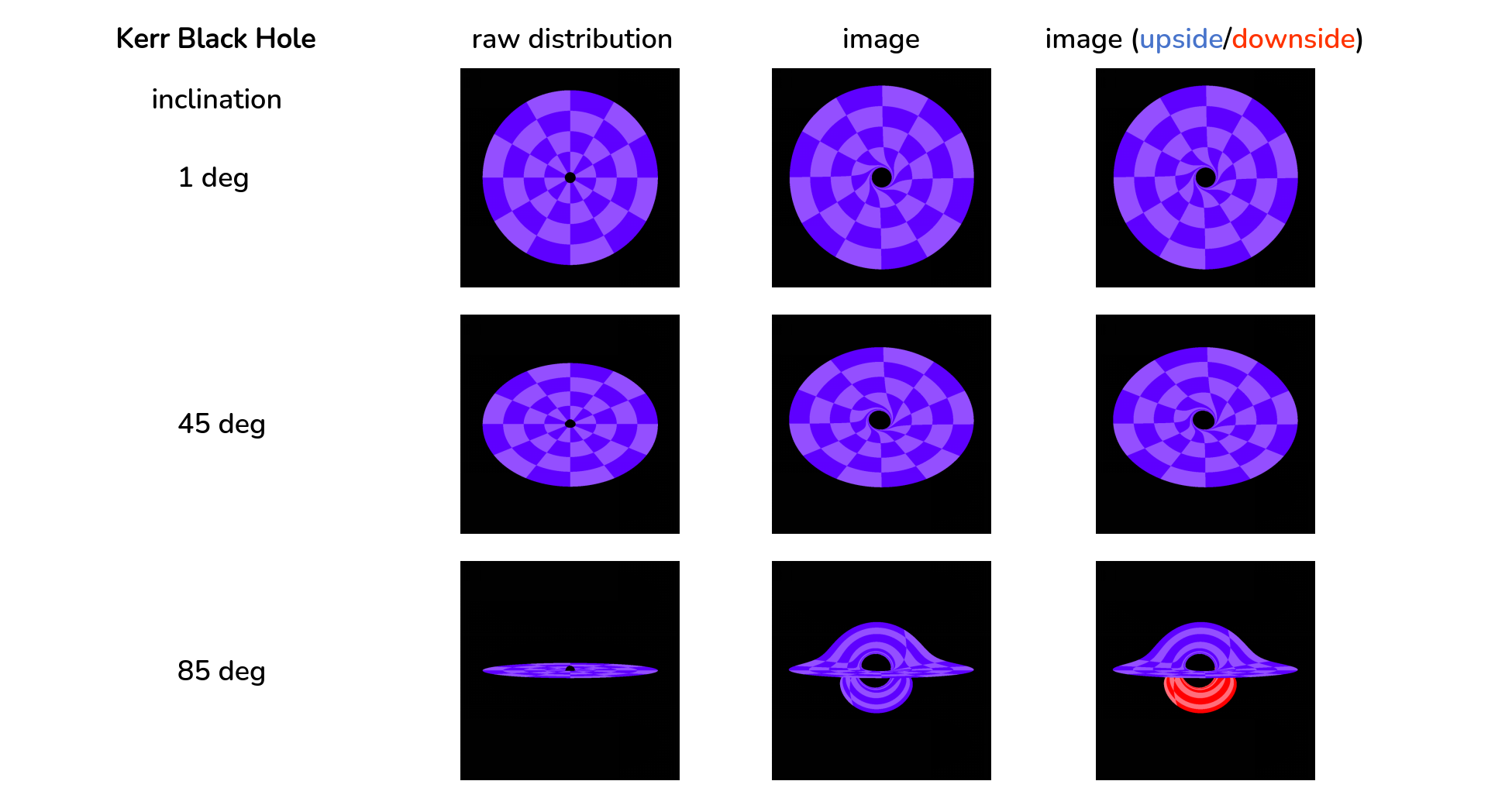
In Kerr metric

  • Kerr metric (in Boyer-Lindquist coordinates)

    ds2=(1rsrΣ)c2dt2+ΣΔdr2+Σdθ2+(r2+a2+rsra2Σsin2θ)sin2θdϕ22rsrasin2θΣcdtdϕ\mathrm{d}s^2=-\left(1-\frac{r_sr}{\Sigma}\right)c^2\mathrm{d}t^2+\frac{\Sigma}{\Delta}\mathrm{d}r^2+\Sigma\mathrm{d}\theta^2+\left(r^2+a^2+\frac{r_sra^2}{\Sigma}\sin^2\theta\right)\sin^2\theta\mathrm{d}\phi^2-\frac{2r_sra\sin^2\theta}{\Sigma}c\mathrm{d}t\mathrm{d}\phi

    where (r,θ,ϕ)(r,\theta,\phi) are standard oblate spheroidal coordinates

    {x=r2+a2sinθcosϕy=r2+a2sinθsinϕz=rcosθ\left\{\begin{array}{l} x=\sqrt{r^2+a^2}\sin\theta\cos\phi \\ y=\sqrt{r^2+a^2}\sin\theta\sin\phi \\ z=r\cos\theta \end{array}\right.

    rsr_s is the Schwarzschild radius

    rs=2GMc2r_s=\frac{2GM}{c^2}

    and the length scales a,Σ,Δa,\Sigma,\Delta are

    a=JMca=\dfrac{J}{Mc}

    Σ=r2+a2cos2θ\Sigma=r^2+a^2\cos^2\theta

    Δ=r2rsr+a2\Delta=r^2-r_sr+a^2

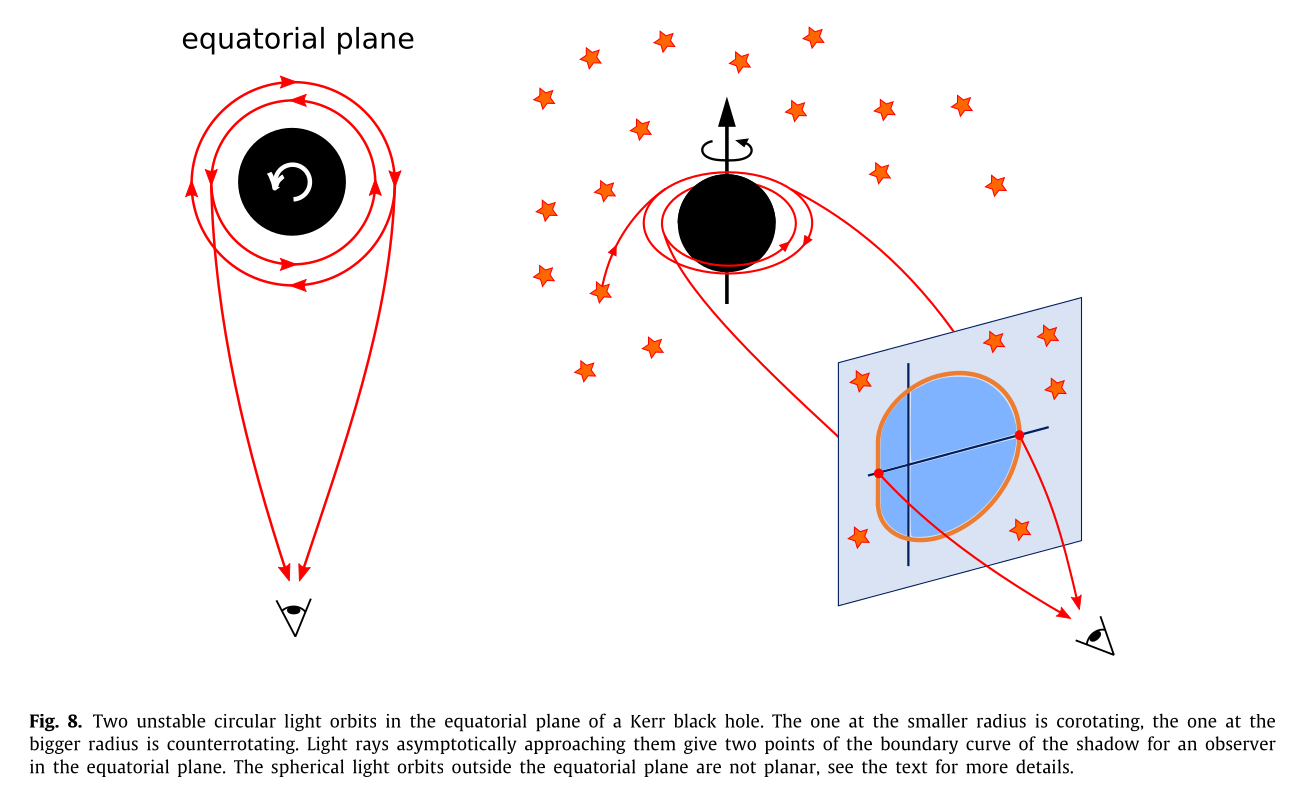
  • Two circular light orbits in the equatorial plane of a Kerr black hole (Perlick & Tsupko, 2022):

    rph=3mbab+a,rph3=m(ba)2r_\text{ph}=3m\frac{b-a}{b+a},\quad r_\text{ph}^3=m(b-a)^2

    b=arph+3mrph3mb=-a\frac{r_\text{ph}+3m}{r_\text{ph}-3m}

    For a=ma=m, rph=mr_\text{ph}=m, b=2mb=2m.
    For a=ma=-m, rph=4mr_\text{ph}=4m, b=7mb=7m.

two circular orbits

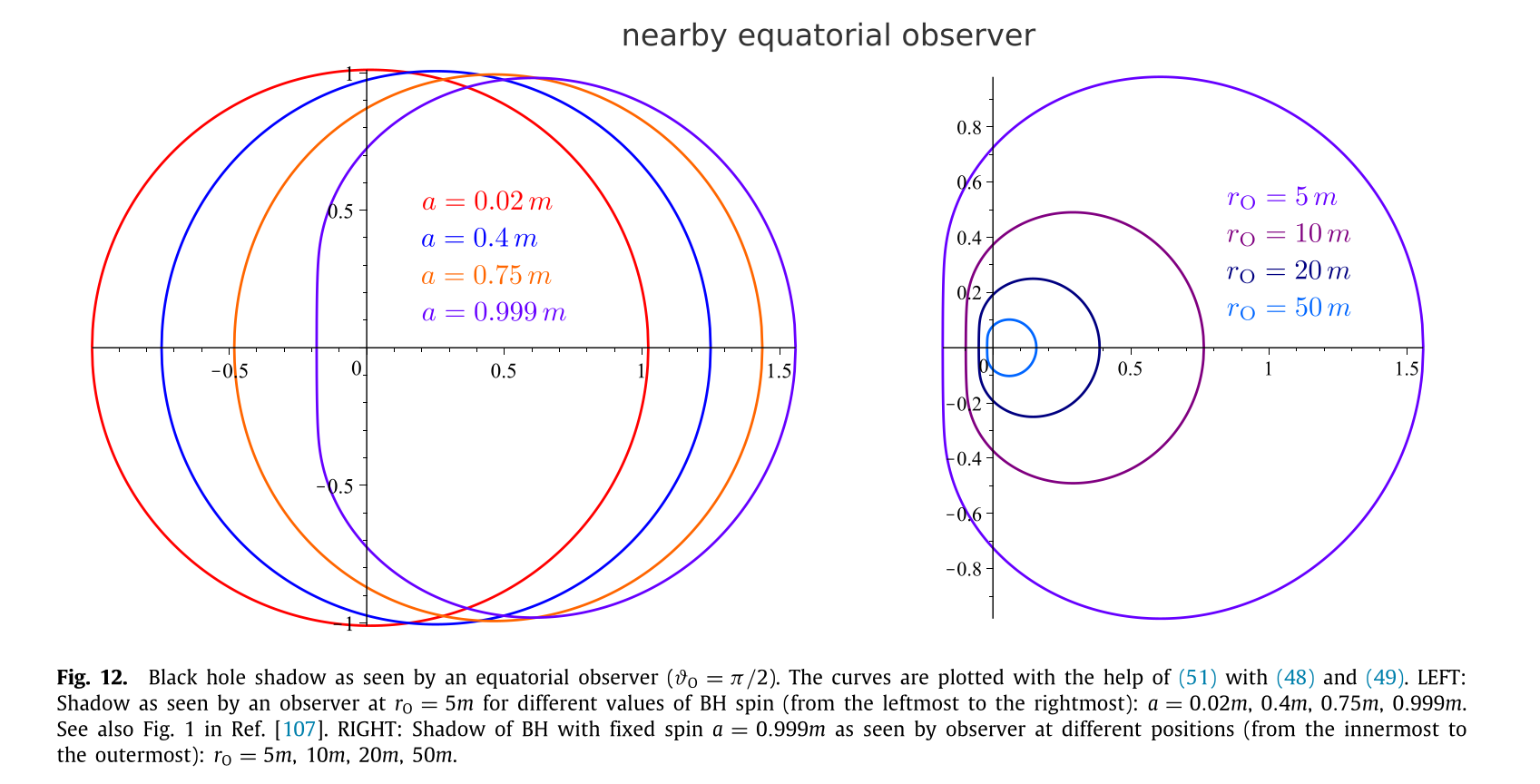
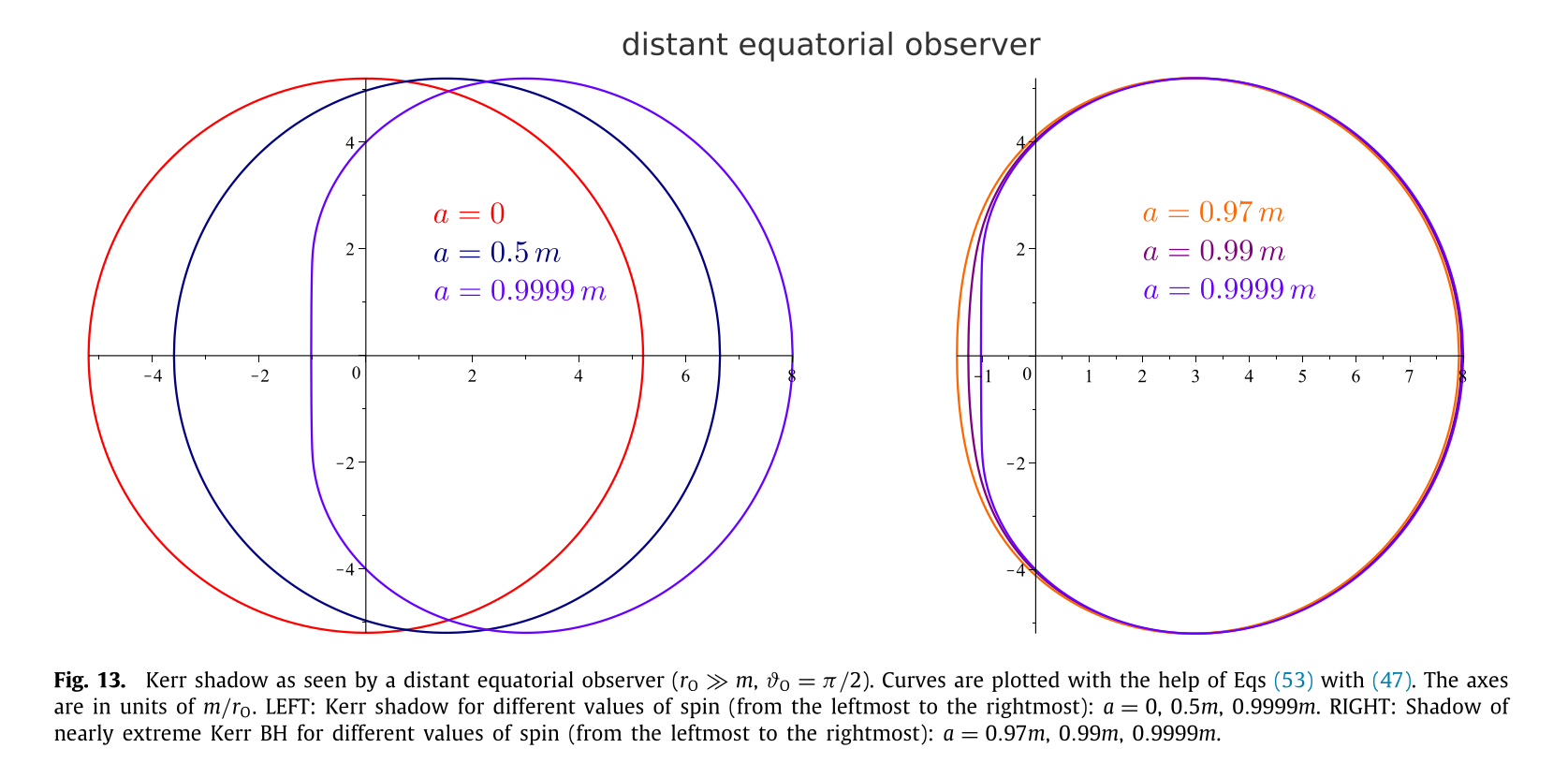
  • The Kerr black hole shadows (Perlick & Tsupko, 2022):

Kerr BH shadow (nearby)
Kerr BH shadow (distant)

Ray tracing

Ray tracing: The photons are parameterized by x, y in the “view port” of the observer. By scanning over x and y, we can build up an image once we know where each photon goes. (see http://locklessinc.com/articles/raytracing/ for details)

parameter:
a: spin parameter a=J/Ma=J/M
size: refinement of figure size
inclination: the view inclination (0 means face-on, 90 means edge-on)

complie using gcc main.c -o bh_shadow -lm (on Ubuntu24.04)

1
2
3
4
5
6
7
8
9
10
11
12
13
14
15
16
17
18
19
20
21
22
23
24
25
26
27
28
29
30
31
32
33
34
35
36
37
38
39
40
41
42
43
44
45
46
47
48
49
50
51
52
53
54
55
56
57
58
59
60
61
62
63
64
65
66
67
68
69
70
71
72
73
74
75
76
77
78
79
80
81
82
83
84
85
86
87
88
89
90
91
92
93
94
95
96
97
98
99
100
101
102
103
104
105
106
107
108
109
110
111
112
113
114
115
116
117
118
119
120
121
122
123
124
125
126
127
128
129
130
131
132
133
134
135
136
137
138
139
140
141
142
143
144
145
146
147
148
149
150
151
152
153
154
155
156
157
158
159
160
161
162
163
164
165
166
167
168
169
170
171
172
173
174
175
176
177
178
179
180
181
182
183
184
185
186
187
188
189
190
191
192
193
194
195
196
197
198
199
200
201
202
203
204
205
206
207
208
209
210
211
212
213
214
215
216
217
218
219
220
221
222
223
224
225
226
227
228
229
230
231
232
233
234
235
236
237
238
239
240
241
242
243
244
245
246
247
248
249
250
251
252
253
254
255
256
257
258
259
260
261
262
263
264
265
266
267
268
269
270
271
272
273
274
275
276
277
278
279
280
281
282
283
284
285
286
287
288
289
290
291
292
293
294
295
296
297
298
299
300
301
302
303
304
305
306
307
308
309
310
311
312
313
314
315
316
317
318
319
320
321
322
323
324
325
326
327
328
329
330
331
332
333
334
335
336
337
338
339
340
341
342
343
344
345
346
347
348
349
350
351
352
353
354
355
356
357
358
359
360
361
362
363
364
365
366
367
368
369
370
371
372
373
374
375
376
377
378
379
380
381
382
383
384
385
386
387
388
389
390
391
392
393
394
395
396
397
398
399
400
401
402
403
404
405
406
407
408
409
410
411
412
413
414
415
416
417
418
419
420
421
422
423
424
425
426
427
428
429
430
431
432
433
434
435
436
437
438
439
440
441
442
443
444
445
446
447
448
449
450
#define _GNU_SOURCE
#include <math.h>
#include <stdlib.h>
#include <stdio.h>
#include <string.h>
#include <err.h>
#include <sys/stat.h>
#include <fcntl.h>
#include <unistd.h>
#include <errno.h>

#define N 6

static const double a = 0;
static const int size = 100;
static double inclination = 85;

static double r0, theta0;

static double a2;
static double Rhor, Rmstable, Rdisk;

static double L, kappa;

/* Coupled differential equations describing motion of photon */
static void geodesic(double *y, double *dydx)
{
double r, theta, pr, ptheta;

r = y[0];
theta = y[1];
pr = y[4];
ptheta = y[5];

double r2 = r*r;
double twor = 2.0*r;

double sintheta, costheta;
sincos(theta, &sintheta, &costheta);
double cos2 = costheta*costheta;
double sin2 = sintheta*sintheta;

double sigma = r2+a2*cos2;
double delta = r2-twor+a2;
double sd = sigma*delta;
double siginv = 1.0/sigma;
double bot = 1.0/sd;

/* Prevent problems with the axis */
if (sintheta < 1e-8)
{
sintheta = 1e-8;
sin2 = 1e-16;
}

dydx[0] = -pr*delta*siginv;
dydx[1] = -ptheta*siginv;
dydx[2] = -(twor*a+(sigma-twor)*L/sin2)*bot;
dydx[3] = -(1.0+(twor*(r2+a2)-twor*a*L)*bot);
dydx[4] = -(((r-1.0)*(-kappa)+twor*(r2+a2)-2.0*a*L)*bot-2.0*pr*pr*(r-1.0)*siginv);
dydx[5] = -sintheta*costheta*(L*L/(sin2*sin2)-a2)*siginv;
}

/* Initial Conditions for Ray */
static void initial(double *y0, double *ydot0, double x, double y)
{
y0[0] = r0;
y0[1] = theta0;
y0[2] = 0;
y0[3] = 0;
y0[4] = cos(y)*cos(x);
y0[5] = sin(y)/r0;

double sintheta, costheta;
sincos(theta0, &sintheta, &costheta);
double cos2 = costheta*costheta;
double sin2 = sintheta*sintheta;

double rdot0 = y0[4];
double thetadot0 = y0[5];

double r2 = r0 * r0;
double sigma = r2 + a2*cos2;
double delta = r2 - 2.0 * r0 + a2;
double s1 = sigma - 2.0 * r0;

y0[4]= rdot0*sigma/delta;
y0[5]= thetadot0*sigma;

ydot0[0] = rdot0;
ydot0[1] = thetadot0;
ydot0[2] = cos(y)*sin(x)/(r0*sin(theta0));

double phidot0 = ydot0[2];
double energy2 = s1*(rdot0*rdot0/delta+thetadot0*thetadot0)
+ delta*sin2*phidot0*phidot0;

double energy = sqrt(energy2);

/* Rescale */
y0[4] = y0[4]/energy;
y0[5] = y0[5]/energy;

/* Angular Momentum with E = 1 */
L = ((sigma*delta*phidot0-2.0*a*r0*energy)*sin2/s1)/energy;

kappa = y0[5]*y0[5]+a2*sin2+L*L/sin2;

/* Hack - make sure everything is normalized correctly by a call to geodesic */
geodesic(y0, ydot0);
}

static void rkstep(double *y, double *dydx, double h, double *yout, double *yerr)
{
int i;

double ak[N];

double ytemp1[N], ytemp2[N], ytemp3[N], ytemp4[N], ytemp5[N];

for (i = 0; i < N; i++)
{
double hdydx = h * dydx[i];
double yi = y[i];
ytemp1[i] = yi + 0.2 * hdydx;
ytemp2[i] = yi + (3.0/40.0) * hdydx;
ytemp3[i] = yi + 0.3 * hdydx;
ytemp4[i] = yi -(11.0/54.0) * hdydx;
ytemp5[i] = yi + (1631.0/55296.0) * hdydx;
yout[i] = yi + (37.0/378.0) * hdydx;
yerr[i] = ((37.0/378.0)-(2825.0/27648.0)) * hdydx;
}

geodesic(ytemp1, ak);

for (i = 0; i < N; i++)
{
double yt = h * ak[i];
ytemp2[i] += (9.0/40.0) * yt;
ytemp3[i] -= 0.9 * yt;
ytemp4[i] += 2.5 * yt;
ytemp5[i] += (175.0/512.0) * yt;
}

geodesic(ytemp2, ak);

for (i = 0; i < N; i++)
{
double yt = h * ak[i];
ytemp3[i] += 1.2 * yt;
ytemp4[i] -= (70.0/27.0) * yt;
ytemp5[i] += (575.0/13824.0) * yt;
yout[i] += (250.0/621.0) * yt;
yerr[i] += ((250.0/621.0)-(18575.0/48384.0)) * yt;
}

geodesic(ytemp3, ak);

for (i = 0; i < N; i++)
{
double yt = h * ak[i];
ytemp4[i] += (35.0/27.0) * yt;
ytemp5[i] += (44275.0/110592.0) * yt;
yout[i] += (125.0/594.0) * yt;
yerr[i] += ((125.0/594.0)-(13525.0/55296.0)) * yt;
}

geodesic(ytemp4, ak);

for (i = 0; i < N; i++)
{
double yt = h * ak[i];
ytemp5[i] += (253.0/4096.0) * yt;
yerr[i] -= (277.0/14336.0) * yt;
}

geodesic(ytemp5, ak);

for (i = 0; i < N; i++)
{
double yt = h * ak[i];
yout[i] += (512.0/1771.0) * yt;
yerr[i] += ((512.0/1771.0)-0.25) * yt;
}
}

static double rkqs(double *y, double *dydx, double htry, double escal, double *yscal, double *hdid)
{
int i;

double hnext;

double errmax, h = htry, htemp;
double yerr[N], ytemp[N];

while (1)
{
rkstep(y, dydx, h, ytemp, yerr);

errmax = 0.0;
for (i = 0; i < N; i++)
{
double temp = fabs(yerr[i]/yscal[i]);
if (temp > errmax) errmax = temp;
}

errmax *= escal;
if (errmax <= 1.0) break;

htemp = 0.9 * h / sqrt(sqrt(errmax));

h *= 0.1;

if (h >= 0.0)
{
if (htemp > h) h = htemp;
}
else
{
if (htemp < h) h = htemp;
}
}

if (errmax > 1.89e-4)
{
hnext = 0.9 * h * pow(errmax, -0.2);
}
else
{
hnext = 5.0 * h;
}

*hdid = h;

memcpy(y, ytemp, N * sizeof(double));

return hnext;
}

static void binarysearch(double *y, double *dydx, double hbig)
{
double hsmall = 0.0;

int side;
if (y[1] > M_PI/2.0)
{
side = 1;
}
else if (y[1] < M_PI/2.0)
{
side = -1;
}
else
{
/* Already at the equator */
return;
}

geodesic(y,dydx);

while ((y[0] > Rhor) && (y[0] < r0) && (side != 0))
{
double yout[N], yerr[N];

double hdiff = hbig - hsmall;

if (hdiff < 1e-7)
{
rkstep(y, dydx, hbig, yout, yerr);

memcpy(y, yout, N * sizeof(double));

return;
}

double hmid = (hbig + hsmall) / 2;

rkstep(y, dydx, hmid, yout, yerr);

if (side * (yout[1] - M_PI/2.0) > 0)
{
hsmall = hmid;
}
else
{
hbig = hmid;
}
}
}

static void fire_ray(unsigned char *rgb, int x1, int y1)
{
double htry = 0.5, escal = 1e11, hdid = 0.0, hnext = 0.0;

double range = 0.0025 * Rdisk / (size - 1.0);

double y[N], dydx[N], yscal[N], ylaststep[N];

int side;
int i;

initial(y, dydx, (x1 - (size + 1.0) / 2) * range, (y1 - (size + 1.0) / 2) * range);

while (1)
{
memcpy(ylaststep, y, N * sizeof(double));

geodesic(y, dydx);

for (i = 0; i < N; i++)
{
yscal[i] = fabs(y[i]) + fabs(dydx[i] * htry) + 1.0e-3;
}

if (y[1] > M_PI/2) side = 1;
else if (y[1] < M_PI/2) side = -1;
else side = 0;

hnext = rkqs(y, dydx, htry, escal, yscal, &hdid);

if ((y[1]-M_PI/2)*side < 0)
{
memcpy(y, ylaststep, N * sizeof(double));

binarysearch(y, dydx, hdid);

/* Did we hit the disk? */
if ((y[0] <= Rdisk) && (y[0] >= Rmstable))
{
unsigned p1 = 4.0 * (y[0] - Rmstable) / (Rdisk - Rmstable);
unsigned p2 = floor(y[2] * 6.0 / M_PI);

if ((p1 ^ p2) & 1)
{
rgb[0] = 255;
rgb[1] = 128;
rgb[2] = 128;
}
else
{
rgb[0] = 255;
rgb[1] = 0;
rgb[2] = 0;
}

return;
}
}

/* Inside the hole, or escaped to infinity */
if ((y[0] < Rhor) || (y[0] > r0))
{
rgb[0] = 0;
rgb[1] = 0;
rgb[2] = 0;

return;
}

htry = hnext;
}
}

/* Write all the data, or fail and exit */
static void full_write(int fd, void *buf, size_t size)
{
while (size)
{
ssize_t did = write(fd, buf, size);
if (did == -1)
{
if (errno == EINTR) continue;

errx(1, "Error writing file: %s\n", strerror(errno));
}

size -= did;
buf = (char *)buf - did;
}
}

/* Open a file, and output a tga header for a square image of the given size */
static int open_tga(const char *filename, int size)
{
char c1, c2;

int fd = open(filename, O_CREAT | O_WRONLY | O_TRUNC, S_IRUSR | S_IWUSR | S_IRGRP | S_IROTH);

if (fd == -1) errx(1, "Couldn't open %s for writing\n", filename);

/* Output the header (embedded zeros explicit) */
write(fd, "\0\0\2\0\0\0\0\0\0\0\0\0", 12);

c1 = size%256;
c2 = size/256;
full_write(fd, &c1, 1);
full_write(fd, &c2, 1);

c1 = size%256;
c2 = size/256;
full_write(fd, &c1, 1);
full_write(fd, &c2, 1);

full_write(fd, "\x18\0", 2);

return fd;
}

static double inner_orbit(void)
{
double z1 = 1+cbrt(1-a2)*(cbrt(1+a)+cbrt(1-a));
double z2 = sqrt(3*a2+z1*z1);
return 3+z2-sqrt((3-z1)*(3+z1+2*z2));
}

int main(void)
{
int i, j;

int fd = open_tga("image.tga", size);

unsigned char *buffer = calloc(size, 3);
if (!buffer) errx(1, "Out of memory\n");

r0 = 1000.0;
theta0 = (M_PI/180.0) * inclination;

a2 = a*a;

Rhor = 1.0 + sqrt(1.0-a2) + 1e-5;
Rdisk = 20.0;
Rmstable = inner_orbit();

for (j = 0; j < size; j++)
{
for (i = 0; i < size; i++)
{
fire_ray(&buffer[i * 3], i, j);
}

full_write(fd, buffer, size * 3);
printf("%d\n", j);
}

close(fd);

free(buffer);

return 0;
}

complie using mpicc main_mpi.c -o bh_shadow_mpi -lm (on Ubuntu24.04)
run using mpirun -np 4 ./bh_shadow_mpi

1
2
3
4
5
6
7
8
9
10
11
12
13
14
15
16
17
18
19
20
21
22
23
24
25
26
27
28
29
30
31
32
33
34
35
36
37
38
39
40
41
42
43
44
45
46
47
48
49
50
51
52
53
54
55
56
57
58
59
60
61
62
63
64
65
66
67
68
69
70
71
72
73
74
75
76
77
78
79
80
81
82
83
84
85
86
87
88
89
90
91
92
93
94
95
96
97
98
99
100
101
102
103
104
105
106
107
108
109
110
111
112
113
114
115
116
117
118
119
120
121
122
123
124
125
126
127
128
129
130
131
132
133
134
135
136
137
138
139
140
141
142
143
144
145
146
147
148
149
150
151
152
153
154
155
156
157
158
159
160
161
162
163
164
165
166
167
168
169
170
171
172
173
174
175
176
177
178
179
180
181
182
183
184
185
186
187
188
189
190
191
192
193
194
195
196
197
198
199
200
201
202
203
204
205
206
207
208
209
210
211
212
213
214
215
216
217
218
219
220
221
222
223
224
225
226
227
228
229
230
231
232
233
234
235
236
237
238
239
240
241
242
243
244
245
246
247
248
249
250
251
252
253
254
255
256
257
258
259
260
261
262
263
264
265
266
267
268
269
270
271
272
273
274
275
276
277
278
279
280
281
282
283
284
285
286
287
288
289
290
291
292
293
294
295
296
297
298
299
300
301
302
303
304
305
306
307
308
309
310
311
312
313
314
315
316
317
318
319
320
321
322
323
324
325
326
327
328
329
330
331
332
333
334
335
336
337
338
339
340
341
342
343
344
345
346
347
348
349
350
351
352
353
354
355
356
357
358
359
360
361
362
363
364
365
366
367
368
369
370
371
372
373
374
375
376
377
378
379
380
381
382
383
384
385
386
387
388
389
390
391
392
393
394
395
396
397
398
399
400
401
402
403
404
405
406
407
408
409
410
411
412
413
414
415
416
417
418
419
420
421
422
423
424
425
426
427
428
429
430
431
432
433
434
435
436
437
438
439
440
441
442
443
444
445
446
447
448
449
450
451
452
453
454
455
456
457
458
459
460
461
462
463
464
465
466
467
468
469
470
471
472
473
474
475
476
477
478
479
480
481
482
483
484
485
486
487
488
489
490
491
492
493
494
495
496
497
498
499
500
501
502
503
504
505
506
507
508
509
510
511
512
513
514
515
516
517
518
519
520
521
522
523
524
525
526
527
528
529
530
531
532
533
534
535
536
537
538
539
540
541
542
543
544
545
546
547
548
549
550
551
552
553
554
555
#define _GNU_SOURCE
#include <math.h>
#include <stdlib.h>
#include <stdio.h>
#include <string.h>
#include <err.h>
#include <sys/stat.h>
#include <fcntl.h>
#include <unistd.h>
#include <errno.h>
#include "mpi.h"

#define N 6

static const double a = 0;
static const int size = 1000;
static double inclination = 45;

static double r0, theta0;

static double a2;
static double Rhor, Rmstable, Rdisk;

static double L, kappa;

/* Coupled differential equations describing motion of photon */
static void geodesic(double *y, double *dydx)
{
double r, theta, pr, ptheta;

r = y[0];
theta = y[1];
pr = y[4];
ptheta = y[5];

double r2 = r*r;
double twor = 2.0*r;

double sintheta, costheta;
sincos(theta, &sintheta, &costheta);
double cos2 = costheta*costheta;
double sin2 = sintheta*sintheta;

double sigma = r2+a2*cos2;
double delta = r2-twor+a2;
double sd = sigma*delta;
double siginv = 1.0/sigma;
double bot = 1.0/sd;

/* Prevent problems with the axis */
if (sintheta < 1e-8)
{
sintheta = 1e-8;
sin2 = 1e-16;
}

dydx[0] = -pr*delta*siginv;
dydx[1] = -ptheta*siginv;
dydx[2] = -(twor*a+(sigma-twor)*L/sin2)*bot;
dydx[3] = -(1.0+(twor*(r2+a2)-twor*a*L)*bot);
dydx[4] = -(((r-1.0)*(-kappa)+twor*(r2+a2)-2.0*a*L)*bot-2.0*pr*pr*(r-1.0)*siginv);
dydx[5] = -sintheta*costheta*(L*L/(sin2*sin2)-a2)*siginv;
}

/* Initial Conditions for Ray */
static void initial(double *y0, double *ydot0, double x, double y)
{
y0[0] = r0;
y0[1] = theta0;
y0[2] = 0;
y0[3] = 0;
y0[4] = cos(y)*cos(x);
y0[5] = sin(y)/r0;

double sintheta, costheta;
sincos(theta0, &sintheta, &costheta);
double cos2 = costheta*costheta;
double sin2 = sintheta*sintheta;

double rdot0 = y0[4];
double thetadot0 = y0[5];

double r2 = r0 * r0;
double sigma = r2 + a2*cos2;
double delta = r2 - 2.0 * r0 + a2;
double s1 = sigma - 2.0 * r0;

y0[4]= rdot0*sigma/delta;
y0[5]= thetadot0*sigma;

ydot0[0] = rdot0;
ydot0[1] = thetadot0;
ydot0[2] = cos(y)*sin(x)/(r0*sin(theta0));

double phidot0 = ydot0[2];
double energy2 = s1*(rdot0*rdot0/delta+thetadot0*thetadot0)
+ delta*sin2*phidot0*phidot0;

double energy = sqrt(energy2);

/* Rescale */
y0[4] = y0[4]/energy;
y0[5] = y0[5]/energy;

/* Angular Momentum with E = 1 */
L = ((sigma*delta*phidot0-2.0*a*r0*energy)*sin2/s1)/energy;

kappa = y0[5]*y0[5]+a2*sin2+L*L/sin2;

/* Hack - make sure everything is normalized correctly by a call to geodesic */
geodesic(y0, ydot0);
}

static void rkstep(double *y, double *dydx, double h, double *yout, double *yerr)
{
int i;

double ak[N];

double ytemp1[N], ytemp2[N], ytemp3[N], ytemp4[N], ytemp5[N];

for (i = 0; i < N; i++)
{
double hdydx = h * dydx[i];
double yi = y[i];
ytemp1[i] = yi + 0.2 * hdydx;
ytemp2[i] = yi + (3.0/40.0) * hdydx;
ytemp3[i] = yi + 0.3 * hdydx;
ytemp4[i] = yi -(11.0/54.0) * hdydx;
ytemp5[i] = yi + (1631.0/55296.0) * hdydx;
yout[i] = yi + (37.0/378.0) * hdydx;
yerr[i] = ((37.0/378.0)-(2825.0/27648.0)) * hdydx;
}

geodesic(ytemp1, ak);

for (i = 0; i < N; i++)
{
double yt = h * ak[i];
ytemp2[i] += (9.0/40.0) * yt;
ytemp3[i] -= 0.9 * yt;
ytemp4[i] += 2.5 * yt;
ytemp5[i] += (175.0/512.0) * yt;
}

geodesic(ytemp2, ak);

for (i = 0; i < N; i++)
{
double yt = h * ak[i];
ytemp3[i] += 1.2 * yt;
ytemp4[i] -= (70.0/27.0) * yt;
ytemp5[i] += (575.0/13824.0) * yt;
yout[i] += (250.0/621.0) * yt;
yerr[i] += ((250.0/621.0)-(18575.0/48384.0)) * yt;
}

geodesic(ytemp3, ak);

for (i = 0; i < N; i++)
{
double yt = h * ak[i];
ytemp4[i] += (35.0/27.0) * yt;
ytemp5[i] += (44275.0/110592.0) * yt;
yout[i] += (125.0/594.0) * yt;
yerr[i] += ((125.0/594.0)-(13525.0/55296.0)) * yt;
}

geodesic(ytemp4, ak);

for (i = 0; i < N; i++)
{
double yt = h * ak[i];
ytemp5[i] += (253.0/4096.0) * yt;
yerr[i] -= (277.0/14336.0) * yt;
}

geodesic(ytemp5, ak);

for (i = 0; i < N; i++)
{
double yt = h * ak[i];
yout[i] += (512.0/1771.0) * yt;
yerr[i] += ((512.0/1771.0)-0.25) * yt;
}
}

static double rkqs(double *y, double *dydx, double htry, double escal, double *yscal, double *hdid)
{
int i;

double hnext;

double errmax, h = htry, htemp;
double yerr[N], ytemp[N];

while (1)
{
rkstep(y, dydx, h, ytemp, yerr);

errmax = 0.0;
for (i = 0; i < N; i++)
{
double temp = fabs(yerr[i]/yscal[i]);
if (temp > errmax) errmax = temp;
}

errmax *= escal;
if (errmax <= 1.0) break;

htemp = 0.9 * h / sqrt(sqrt(errmax));

h *= 0.1;

if (h >= 0.0)
{
if (htemp > h) h = htemp;
}
else
{
if (htemp < h) h = htemp;
}
}

if (errmax > 1.89e-4)
{
hnext = 0.9 * h * pow(errmax, -0.2);
}
else
{
hnext = 5.0 * h;
}

*hdid = h;

memcpy(y, ytemp, N * sizeof(double));

return hnext;
}

static void binarysearch(double *y, double *dydx, double hbig)
{
double hsmall = 0.0;

int side;
if (y[1] > M_PI/2.0)
{
side = 1;
}
else if (y[1] < M_PI/2.0)
{
side = -1;
}
else
{
/* Already at the equator */
return;
}

geodesic(y,dydx);

while ((y[0] > Rhor) && (y[0] < r0) && (side != 0))
{
double yout[N], yerr[N];

double hdiff = hbig - hsmall;

if (hdiff < 1e-7)
{
rkstep(y, dydx, hbig, yout, yerr);

memcpy(y, yout, N * sizeof(double));

return;
}

double hmid = (hbig + hsmall) / 2;

rkstep(y, dydx, hmid, yout, yerr);

if (side * (yout[1] - M_PI/2.0) > 0)
{
hsmall = hmid;
}
else
{
hbig = hmid;
}
}
}

static void fire_ray(unsigned char *rgb, int x1, int y1)
{
double htry = 0.5, escal = 1e11, hdid = 0.0, hnext = 0.0;

double range = 0.0025 * Rdisk / (size - 1.0);

double y[N], dydx[N], yscal[N], ylaststep[N];

int side;
int i;

initial(y, dydx, (x1 - (size + 1.0) / 2) * range, (y1 - (size + 1.0) / 2) * range);

while (1)
{
memcpy(ylaststep, y, N * sizeof(double));

geodesic(y, dydx);

for (i = 0; i < N; i++)
{
yscal[i] = fabs(y[i]) + fabs(dydx[i] * htry) + 1.0e-3;
}

if (y[1] > M_PI/2) side = 1;
else if (y[1] < M_PI/2) side = -1;
else side = 0;

hnext = rkqs(y, dydx, htry, escal, yscal, &hdid);

if ((y[1]-M_PI/2)*side < 0)
{
memcpy(y, ylaststep, N * sizeof(double));

binarysearch(y, dydx, hdid);

/* Did we hit the disk? */
if ((y[0] <= Rdisk) && (y[0] >= Rmstable))
{
unsigned p1 = 4.0 * (y[0] - Rmstable) / (Rdisk - Rmstable);
unsigned p2 = floor(y[2] * 6.0 / M_PI);

if ((p1 ^ p2) & 1)
{
rgb[0] = 255;
rgb[1] = 128;
rgb[2] = 128;
}
else
{
rgb[0] = 255;
rgb[1] = 0;
rgb[2] = 0;
}

return;
}
}

/* Inside the hole, or escaped to infinity */
if ((y[0] < Rhor) || (y[0] > r0))
{
rgb[0] = 0;
rgb[1] = 0;
rgb[2] = 0;

return;
}

htry = hnext;
}
}

/* Write all the data, or fail and exit */
static void full_write(int fd, void *buf, size_t size)
{
while (size)
{
ssize_t did = write(fd, buf, size);
if (did == -1)
{
if (errno == EINTR) continue;

errx(1, "Error writing file: %s\n", strerror(errno));
}

size -= did;
buf = (char *)buf - did;
}
}

/* Open a file, and output a tga header for a square image of the given size */
static int open_tga(const char *filename, int size)
{
char c1, c2;

int fd = open(filename, O_CREAT | O_WRONLY | O_TRUNC, S_IRUSR | S_IWUSR | S_IRGRP | S_IROTH);

if (fd == -1) errx(1, "Couldn't open %s for writing\n", filename);

/* Output the header (embedded zeros explicit) */
write(fd, "\0\0\2\0\0\0\0\0\0\0\0\0", 12);

c1 = size%256;
c2 = size/256;
full_write(fd, &c1, 1);
full_write(fd, &c2, 1);

c1 = size%256;
c2 = size/256;
full_write(fd, &c1, 1);
full_write(fd, &c2, 1);

full_write(fd, "\x18\0", 2);

return fd;
}

static double inner_orbit(void)
{
double z1 = 1+cbrt(1-a2)*(cbrt(1+a)+cbrt(1-a));
double z2 = sqrt(3*a2+z1*z1);
return 3+z2-sqrt((3-z1)*(3+z1+2*z2));
}

static void full_pwrite(int fd, void *buf, size_t size, size_t offset)
{
while (size)
{
ssize_t did = pwrite(fd, buf, size, offset);
if (did == -1)
{
if (errno == EINTR) continue;

errx(1, "Error writing file: %s\n", strerror(errno));
}

size -= did;
buf = (char *)buf - did;
offset += did;
}
}

/* The master process handles the IO */
static void master(int numslaves)
{
int fd = open_tga("image.tga", size);

int *row = calloc(numslaves, sizeof(int));
off_t offset;

int i;

MPI_Status status;

unsigned char *buf = calloc(size, 3);
if (!buf || !row) errx(1, "Out of memory\n");

/* Initialize the starting rows every slave will be working on */
for (i = 0; i < numslaves; i++) row[i] = i;

/* Wait for size rows of data */
for (i = 0; i < size; i++)
{
/* Wait to get some data */
MPI_Recv(buf, 3 * size, MPI_BYTE, MPI_ANY_SOURCE, 0, MPI_COMM_WORLD, &status);

/* Calculate offset within output file from the source of the row */
offset = ((off_t) row[status.MPI_SOURCE - 1]) * size * 3 + 18;

/* Output to the correct spot in the file */
full_pwrite(fd, buf, size * 3, offset);

/* The next row it will be working on */
row[status.MPI_SOURCE - 1] += numslaves;
}

close(fd);

free(buf);
free(row);
}

/* Slave compute processes send their results to the master */
static void slave(int numslaves, int rank)
{
MPI_Request rq = MPI_REQUEST_NULL;

int i, j;

unsigned char *buffer1 = calloc(size, 3);
unsigned char *buffer2 = calloc(size, 3);
unsigned char *buf = buffer1;
if (!buffer1 || !buffer2) errx(1, "Out of memory\n");

r0 = 1000.0;
theta0 = (M_PI/180.0) * inclination;

a2 = a*a;

Rhor = 1.0 + sqrt(1.0-a2) + 1e-5;
Rdisk = 20.0;
Rmstable = inner_orbit();

for (j = rank; j < size; j += numslaves)
{
printf("%d\n", j);

for (i = 0; i < size; i++)
{
fire_ray(&buf[i * 3], i, j);
}

/* Wait for the previous send to complete */
MPI_Wait(&rq, MPI_STATUS_IGNORE);

/* Send the new data */
MPI_Isend(buf, 3 * size, MPI_BYTE, 0, 0, MPI_COMM_WORLD, &rq);

/* Flip the buffer to use */
if (buf == buffer1)
{
buf = buffer2;
}
else
{
buf = buffer1;
}
}

/* Wait for the final send to complete */
MPI_Wait(&rq, MPI_STATUS_IGNORE);

/* Free memory */
free(buffer1);
free(buffer2);
}

int main(int argc, char **argv)
{
int numprocs;
int rank;

/* Initialize MPI */
MPI_Init(&argc, &argv);

MPI_Comm_size(MPI_COMM_WORLD, &numprocs);
MPI_Comm_rank(MPI_COMM_WORLD, &rank);

if (numprocs == 1) errx(1, "We need more than one rank\n");

if (!rank)
{
master(numprocs - 1);
}
else
{
slave(numprocs - 1, rank - 1);
}

MPI_Finalize();

return 0;
}

complie using mpicc raw_mpi.c -o raw_mpi -lm (on Ubuntu24.04)
run using mpirun -np 4 raw_mpi

1
2
3
4
5
6
7
8
9
10
11
12
13
14
15
16
17
18
19
20
21
22
23
24
25
26
27
28
29
30
31
32
33
34
35
36
37
38
39
40
41
42
43
44
45
46
47
48
49
50
51
52
53
54
55
56
57
58
59
60
61
62
63
64
65
66
67
68
69
70
71
72
73
74
75
76
77
78
79
80
81
82
83
84
85
86
87
88
89
90
91
92
93
94
95
96
97
98
99
100
101
102
103
104
105
106
107
108
109
110
111
112
113
114
115
116
117
118
119
120
121
122
123
124
125
126
127
128
129
130
131
132
133
134
135
136
137
138
139
140
141
142
143
144
145
146
147
148
149
150
151
152
153
154
155
156
157
158
159
160
161
162
163
164
165
166
167
168
169
170
171
172
173
174
175
176
177
178
179
180
181
182
183
184
185
186
187
188
189
190
191
192
193
194
195
196
197
198
199
200
201
202
203
204
205
206
207
208
209
210
211
212
213
214
215
216
217
218
219
220
221
222
223
224
225
226
227
228
229
230
231
232
233
234
235
236
237
238
239
240
241
242
243
244
245
246
247
248
249
250
251
252
253
254
255
256
257
258
259
260
261
262
263
264
265
266
267
268
269
270
271
272
273
274
275
276
277
278
279
280
281
282
283
284
285
286
287
288
289
290
291
292
293
294
295
296
297
298
299
300
301
302
303
304
305
306
307
308
309
310
311
312
313
314
315
316
317
318
319
320
321
322
323
324
325
326
327
328
329
330
331
332
333
334
335
336
337
338
339
340
341
342
343
344
345
346
347
348
349
350
351
352
353
354
355
356
357
358
359
360
361
362
363
364
365
366
367
368
369
370
371
372
373
374
375
376
377
378
379
380
381
382
383
384
385
386
387
388
389
390
391
392
393
394
395
396
397
398
399
400
401
402
403
404
405
406
407
408
409
410
411
412
413
414
415
416
417
418
419
420
421
422
423
424
425
426
427
428
429
430
431
432
433
434
435
436
437
438
439
440
441
442
443
444
445
446
447
448
449
450
451
452
453
454
455
456
457
458
459
460
461
462
463
464
465
466
467
468
469
470
471
472
473
474
475
476
477
478
479
480
481
482
483
484
485
486
487
488
489
490
491
492
493
494
495
496
497
498
499
500
501
502
503
504
505
506
507
508
509
510
511
512
513
514
515
516
517
518
519
520
521
522
523
524
525
526
527
528
529
530
531
532
533
534
535
536
537
538
539
540
541
542
543
544
545
546
547
548
549
550
551
552
553
554
555
556
557
558
559
560
561
562
563
564
565
566
567
568
569
570
571
572
573
574
575
576
577
578
579
580
581
582
583
584
585
586
587
588
589
590
591
592
593
594
595
596
597
598
599
600
601
602
603
604
605
606
607
608
609
610
611
612
613
614
615
616
617
618
619
620
621
622
623
624
625
626
627
628
629
630
631
632
633
634
635
636
637
638
639
640
#define _GNU_SOURCE
#include <math.h>
#include <stdlib.h>
#include <stdio.h>
#include <string.h>
#include <err.h>
#include <sys/stat.h>
#include <fcntl.h>
#include <unistd.h>
#include <errno.h>
#include "mpi.h"

#define N 6

static const double a = 0;
static const int size = 1000;
static double inclination = 45;

static double r0, theta0;

static double a2;
static double Rhor, Rmstable, Rdisk;

static double L, kappa;

/* Static constants for straight‑line motion (filled by initial()) */
static double vx = 0.0, vy = 0.0, vz = 0.0; /* Cartesian velocity components */
static double vt = 1.0; /* dt/dλ (normalised to 1) */

/* Utility: convert spherical to Cartesian */
static void sph2cart(double r, double theta, double phi,
double *x, double *y, double *z)
{
double sint = sin(theta), cost = cos(theta);
double sinp = sin(phi), cosp = cos(phi);
*x = r * sint * cosp;
*y = r * sint * sinp;
*z = r * cost;
}

/* Coupled differential equations for straight‑line photon motion */
static void geodesic(double *y, double *dydx)
{
double r = y[0];
double theta = y[1];
double phi = y[2];

/* Convert current position to Cartesian */
double x, yc, z;
sph2cart(r, theta, phi, &x, &yc, &z);

/* Spherical velocity components from constant Cartesian velocity */
double r_vec[3] = {x, yc, z};
double v_vec[3] = {vx, vy, vz};

double dot_rv = x*vx + yc*vy + z*vz;
double r2 = r*r;
double v2 = vx*vx + vy*vy + vz*vz; /* should be 1 if normalised */

/* dr/dλ */
double drdl = dot_rv / r;

/* dθ/dλ */
double cos_theta = cos(theta), sin_theta = sin(theta);
double cos_phi = cos(phi), sin_phi = sin(phi);
double v_theta = vx*cos_theta*cos_phi + vy*cos_theta*sin_phi - vz*sin_theta;
double dthetadl = v_theta / r;

/* dφ/dλ */
double v_phi = -vx*sin_phi + vy*cos_phi;
double dphidl = v_phi / (r * sin_theta);

/* dt/dλ is constant */
double dtdl = vt;

/* Canonical momenta in flat spherical coordinates:
p_r = dr/dλ , p_θ = r^2 dθ/dλ */
double pr = drdl;
double ptheta = r2 * dthetadl;

/* Constants of motion: p_t = -vt , p_φ = x*vy - yc*vx */
double pt = -vt;
double pphi = x*vy - yc*vx;

/* Derivatives of canonical momenta from Hamilton's equations (flat space) */
double dprdl = (ptheta*ptheta + pphi*pphi/(sin_theta*sin_theta)) / (r*r*r);
double dpthetadl = (pphi*pphi * cos_theta) / (r2 * sin_theta*sin_theta*sin_theta);

/* Guard against sinθ = 0 */
if (sin_theta < 1e-8) {
dphidl = 0.0;
dpthetadl = 0.0;
}

/* Fill output derivatives in the same order as the state vector */
dydx[0] = drdl; /* dr/dλ */
dydx[1] = dthetadl; /* dθ/dλ */
dydx[2] = dphidl; /* dφ/dλ */
dydx[3] = dtdl; /* dt/dλ */
dydx[4] = dprdl; /* dp_r/dλ */
dydx[5] = dpthetadl; /* dp_θ/dλ */
}

/* Initial Conditions for Ray – straight line, observer at (r0, θ0, φ=0) */
static void initial(double *y0, double *ydot0, double x, double y)
{
/* Pixel coordinates (x,y) are offsets from the image centre.
They map to angular offsets α (horizontal) and β (vertical) in radians.
The field of view scaling is taken from fire_ray().
Here we need only the direction, not the absolute scaling.
We'll compute the unit vector from the observer to the pixel. */

double alpha = x; /* already in radians (see fire_ray: x = (x1 - centre)*range) */
double beta = y; /* same for y */

/* Observer position in Cartesian (assuming φ=0 initially) */
double sin_th0 = sin(theta0);
double cos_th0 = cos(theta0);
double obs_x = r0 * sin_th0;
double obs_y = 0.0;
double obs_z = r0 * cos_th0;

/* Line of sight: from observer toward the origin (black hole) */
double los_x = -obs_x;
double los_y = -obs_y;
double los_z = -obs_z;
double los_norm = sqrt(los_x*los_x + los_y*los_y + los_z*los_z);
double forward_x = los_x / los_norm;
double forward_y = los_y / los_norm;
double forward_z = los_z / los_norm;

/* Build orthonormal basis (right, up) perpendicular to line of sight.
'up' is the projection of the global Z axis onto the image plane,
except when forward is parallel to Z (inclination 0 or π). */
double global_up_x = 0.0, global_up_y = 0.0, global_up_z = 1.0;
double right_x, right_y, right_z;
double up_x, up_y, up_z;

/* Compute right = forward × global_up (normalised) */
right_x = forward_y * global_up_z - forward_z * global_up_y;
right_y = forward_z * global_up_x - forward_x * global_up_z;
right_z = forward_x * global_up_y - forward_y * global_up_x;
double rnorm = sqrt(right_x*right_x + right_y*right_y + right_z*right_z);
if (rnorm > 1e-12) {
right_x /= rnorm; right_y /= rnorm; right_z /= rnorm;
/* up = right × forward */
up_x = right_y * forward_z - right_z * forward_y;
up_y = right_z * forward_x - right_x * forward_z;
up_z = right_x * forward_y - right_y * forward_x;
} else {
/* forward is parallel to global Z (θ0 = 0 or π) – use X axis as right */
right_x = 1.0; right_y = 0.0; right_z = 0.0;
up_x = 0.0; up_y = 1.0; up_z = 0.0;
}

/* Direction to the pixel: forward + α·right + β·up */
double dir_x = forward_x + alpha * right_x + beta * up_x;
double dir_y = forward_y + alpha * right_y + beta * up_y;
double dir_z = forward_z + alpha * right_z + beta * up_z;
double dir_norm = sqrt(dir_x*dir_x + dir_y*dir_y + dir_z*dir_z);
dir_x /= dir_norm;
dir_y /= dir_norm;
dir_z /= dir_norm;

/* Store constant Cartesian velocity (normalised to c=1) */
vx = dir_x;
vy = dir_y;
vz = dir_z;
vt = 1.0; /* dt/dλ = 1 */

/* Initial spherical state: observer's position */
y0[0] = r0;
y0[1] = theta0;
y0[2] = 0.0; /* φ = 0 */
y0[3] = 0.0; /* t = 0 */

/* Compute initial spherical velocities from the Cartesian velocity */
double x0_cart, y0_cart, z0_cart;
sph2cart(r0, theta0, 0.0, &x0_cart, &y0_cart, &z0_cart);

double dot_rv = x0_cart*vx + y0_cart*vy + z0_cart*vz;
double r0_sq = r0 * r0;
double cos_phi0 = 1.0, sin_phi0 = 0.0; /* φ = 0 */

double drdl0 = dot_rv / r0;
double v_theta0 = vx*cos_th0*cos_phi0 + vy*cos_th0*sin_phi0 - vz*sin_th0;
double dthetadl0 = v_theta0 / r0;
double v_phi0 = -vx*sin_phi0 + vy*cos_phi0;
double dphidl0 = v_phi0 / (r0 * sin_th0);

/* Canonical momenta */
y0[4] = drdl0; /* p_r = dr/dλ */
y0[5] = r0_sq * dthetadl0; /* p_θ = r² dθ/dλ */

/* Initial derivatives (for consistency) */
geodesic(y0, ydot0);
}

static void rkstep(double *y, double *dydx, double h, double *yout, double *yerr)
{
int i;

double ak[N];

double ytemp1[N], ytemp2[N], ytemp3[N], ytemp4[N], ytemp5[N];

for (i = 0; i < N; i++)
{
double hdydx = h * dydx[i];
double yi = y[i];
ytemp1[i] = yi + 0.2 * hdydx;
ytemp2[i] = yi + (3.0/40.0) * hdydx;
ytemp3[i] = yi + 0.3 * hdydx;
ytemp4[i] = yi -(11.0/54.0) * hdydx;
ytemp5[i] = yi + (1631.0/55296.0) * hdydx;
yout[i] = yi + (37.0/378.0) * hdydx;
yerr[i] = ((37.0/378.0)-(2825.0/27648.0)) * hdydx;
}

geodesic(ytemp1, ak);

for (i = 0; i < N; i++)
{
double yt = h * ak[i];
ytemp2[i] += (9.0/40.0) * yt;
ytemp3[i] -= 0.9 * yt;
ytemp4[i] += 2.5 * yt;
ytemp5[i] += (175.0/512.0) * yt;
}

geodesic(ytemp2, ak);

for (i = 0; i < N; i++)
{
double yt = h * ak[i];
ytemp3[i] += 1.2 * yt;
ytemp4[i] -= (70.0/27.0) * yt;
ytemp5[i] += (575.0/13824.0) * yt;
yout[i] += (250.0/621.0) * yt;
yerr[i] += ((250.0/621.0)-(18575.0/48384.0)) * yt;
}

geodesic(ytemp3, ak);

for (i = 0; i < N; i++)
{
double yt = h * ak[i];
ytemp4[i] += (35.0/27.0) * yt;
ytemp5[i] += (44275.0/110592.0) * yt;
yout[i] += (125.0/594.0) * yt;
yerr[i] += ((125.0/594.0)-(13525.0/55296.0)) * yt;
}

geodesic(ytemp4, ak);

for (i = 0; i < N; i++)
{
double yt = h * ak[i];
ytemp5[i] += (253.0/4096.0) * yt;
yerr[i] -= (277.0/14336.0) * yt;
}

geodesic(ytemp5, ak);

for (i = 0; i < N; i++)
{
double yt = h * ak[i];
yout[i] += (512.0/1771.0) * yt;
yerr[i] += ((512.0/1771.0)-0.25) * yt;
}
}

static double rkqs(double *y, double *dydx, double htry, double escal, double *yscal, double *hdid)
{
int i;

double hnext;

double errmax, h = htry, htemp;
double yerr[N], ytemp[N];

while (1)
{
rkstep(y, dydx, h, ytemp, yerr);

errmax = 0.0;
for (i = 0; i < N; i++)
{
double temp = fabs(yerr[i]/yscal[i]);
if (temp > errmax) errmax = temp;
}

errmax *= escal;
if (errmax <= 1.0) break;

htemp = 0.9 * h / sqrt(sqrt(errmax));

h *= 0.1;

if (h >= 0.0)
{
if (htemp > h) h = htemp;
}
else
{
if (htemp < h) h = htemp;
}
}

if (errmax > 1.89e-4)
{
hnext = 0.9 * h * pow(errmax, -0.2);
}
else
{
hnext = 5.0 * h;
}

*hdid = h;

memcpy(y, ytemp, N * sizeof(double));

return hnext;
}

static void binarysearch(double *y, double *dydx, double hbig)
{
double hsmall = 0.0;

int side;
if (y[1] > M_PI/2.0)
{
side = 1;
}
else if (y[1] < M_PI/2.0)
{
side = -1;
}
else
{
/* Already at the equator */
return;
}

geodesic(y,dydx);

while ((y[0] > Rhor) && (y[0] < r0) && (side != 0))
{
double yout[N], yerr[N];

double hdiff = hbig - hsmall;

if (hdiff < 1e-7)
{
rkstep(y, dydx, hbig, yout, yerr);

memcpy(y, yout, N * sizeof(double));

return;
}

double hmid = (hbig + hsmall) / 2;

rkstep(y, dydx, hmid, yout, yerr);

if (side * (yout[1] - M_PI/2.0) > 0)
{
hsmall = hmid;
}
else
{
hbig = hmid;
}
}
}

static void fire_ray(unsigned char *rgb, int x1, int y1)
{
double htry = 0.5, escal = 1e11, hdid = 0.0, hnext = 0.0;

double range = 0.0025 * Rdisk / (size - 1.0);

double y[N], dydx[N], yscal[N], ylaststep[N];

int side;
int i;

initial(y, dydx, (x1 - (size + 1.0) / 2) * range, (y1 - (size + 1.0) / 2) * range);

while (1)
{
memcpy(ylaststep, y, N * sizeof(double));

geodesic(y, dydx);

for (i = 0; i < N; i++)
{
yscal[i] = fabs(y[i]) + fabs(dydx[i] * htry) + 1.0e-3;
}

if (y[1] > M_PI/2) side = 1;
else if (y[1] < M_PI/2) side = -1;
else side = 0;

hnext = rkqs(y, dydx, htry, escal, yscal, &hdid);

if ((y[1]-M_PI/2)*side < 0)
{
memcpy(y, ylaststep, N * sizeof(double));

binarysearch(y, dydx, hdid);

/* Did we hit the disk? */
if ((y[0] <= Rdisk) && (y[0] >= Rmstable))
{
unsigned p1 = 4.0 * (y[0] - Rmstable) / (Rdisk - Rmstable);
unsigned p2 = floor(y[2] * 6.0 / M_PI);

if ((p1 ^ p2) & 1)
{
rgb[0] = 255;
rgb[1] = 128;
rgb[2] = 128;
}
else
{
rgb[0] = 255;
rgb[1] = 0;
rgb[2] = 0;
}

return;
}
}

/* Inside the hole, or escaped to infinity */
if ((y[0] < Rhor) || (y[0] > r0))
{
rgb[0] = 0;
rgb[1] = 0;
rgb[2] = 0;

return;
}

htry = hnext;
}
}

/* Write all the data, or fail and exit */
static void full_write(int fd, void *buf, size_t size)
{
while (size)
{
ssize_t did = write(fd, buf, size);
if (did == -1)
{
if (errno == EINTR) continue;

errx(1, "Error writing file: %s\n", strerror(errno));
}

size -= did;
buf = (char *)buf - did;
}
}

/* Open a file, and output a tga header for a square image of the given size */
static int open_tga(const char *filename, int size)
{
char c1, c2;

int fd = open(filename, O_CREAT | O_WRONLY | O_TRUNC, S_IRUSR | S_IWUSR | S_IRGRP | S_IROTH);

if (fd == -1) errx(1, "Couldn't open %s for writing\n", filename);

/* Output the header (embedded zeros explicit) */
write(fd, "\0\0\2\0\0\0\0\0\0\0\0\0", 12);

c1 = size%256;
c2 = size/256;
full_write(fd, &c1, 1);
full_write(fd, &c2, 1);

c1 = size%256;
c2 = size/256;
full_write(fd, &c1, 1);
full_write(fd, &c2, 1);

full_write(fd, "\x18\0", 2);

return fd;
}

static double inner_orbit(void)
{
double z1 = 1+cbrt(1-a2)*(cbrt(1+a)+cbrt(1-a));
double z2 = sqrt(3*a2+z1*z1);
return 3+z2-sqrt((3-z1)*(3+z1+2*z2));
}

static void full_pwrite(int fd, void *buf, size_t size, size_t offset)
{
while (size)
{
ssize_t did = pwrite(fd, buf, size, offset);
if (did == -1)
{
if (errno == EINTR) continue;

errx(1, "Error writing file: %s\n", strerror(errno));
}

size -= did;
buf = (char *)buf - did;
offset += did;
}
}

/* The master process handles the IO */
static void master(int numslaves)
{
int fd = open_tga("image.tga", size);

int *row = calloc(numslaves, sizeof(int));
off_t offset;

int i;

MPI_Status status;

unsigned char *buf = calloc(size, 3);
if (!buf || !row) errx(1, "Out of memory\n");

/* Initialize the starting rows every slave will be working on */
for (i = 0; i < numslaves; i++) row[i] = i;

/* Wait for size rows of data */
for (i = 0; i < size; i++)
{
/* Wait to get some data */
MPI_Recv(buf, 3 * size, MPI_BYTE, MPI_ANY_SOURCE, 0, MPI_COMM_WORLD, &status);

/* Calculate offset within output file from the source of the row */
offset = ((off_t) row[status.MPI_SOURCE - 1]) * size * 3 + 18;

/* Output to the correct spot in the file */
full_pwrite(fd, buf, size * 3, offset);

/* The next row it will be working on */
row[status.MPI_SOURCE - 1] += numslaves;
}

close(fd);

free(buf);
free(row);
}

/* Slave compute processes send their results to the master */
static void slave(int numslaves, int rank)
{
MPI_Request rq = MPI_REQUEST_NULL;

int i, j;

unsigned char *buffer1 = calloc(size, 3);
unsigned char *buffer2 = calloc(size, 3);
unsigned char *buf = buffer1;
if (!buffer1 || !buffer2) errx(1, "Out of memory\n");

r0 = 1000.0;
theta0 = (M_PI/180.0) * inclination;

a2 = a*a;

Rhor = 1.0 + sqrt(1.0-a2) + 1e-5;
Rdisk = 20.0;
Rmstable = inner_orbit();

for (j = rank; j < size; j += numslaves)
{
printf("%d\n", j);

for (i = 0; i < size; i++)
{
fire_ray(&buf[i * 3], i, j);
}

/* Wait for the previous send to complete */
MPI_Wait(&rq, MPI_STATUS_IGNORE);

/* Send the new data */
MPI_Isend(buf, 3 * size, MPI_BYTE, 0, 0, MPI_COMM_WORLD, &rq);

/* Flip the buffer to use */
if (buf == buffer1)
{
buf = buffer2;
}
else
{
buf = buffer1;
}
}

/* Wait for the final send to complete */
MPI_Wait(&rq, MPI_STATUS_IGNORE);

/* Free memory */
free(buffer1);
free(buffer2);
}

int main(int argc, char **argv)
{
int numprocs;
int rank;

/* Initialize MPI */
MPI_Init(&argc, &argv);

MPI_Comm_size(MPI_COMM_WORLD, &numprocs);
MPI_Comm_rank(MPI_COMM_WORLD, &rank);

if (numprocs == 1) errx(1, "We need more than one rank\n");

if (!rank)
{
master(numprocs - 1);
}
else
{
slave(numprocs - 1, rank - 1);
}

MPI_Finalize();

return 0;
}

complie using mpicc side_mpi.c -o side_mpi -lm (on Ubuntu24.04)
run using mpirun -np 4 side_mpi

1
2
3
4
5
6
7
8
9
10
11
12
13
14
15
16
17
18
19
20
21
22
23
24
25
26
27
28
29
30
31
32
33
34
35
36
37
38
39
40
41
42
43
44
45
46
47
48
49
50
51
52
53
54
55
56
57
58
59
60
61
62
63
64
65
66
67
68
69
70
71
72
73
74
75
76
77
78
79
80
81
82
83
84
85
86
87
88
89
90
91
92
93
94
95
96
97
98
99
100
101
102
103
104
105
106
107
108
109
110
111
112
113
114
115
116
117
118
119
120
121
122
123
124
125
126
127
128
129
130
131
132
133
134
135
136
137
138
139
140
141
142
143
144
145
146
147
148
149
150
151
152
153
154
155
156
157
158
159
160
161
162
163
164
165
166
167
168
169
170
171
172
173
174
175
176
177
178
179
180
181
182
183
184
185
186
187
188
189
190
191
192
193
194
195
196
197
198
199
200
201
202
203
204
205
206
207
208
209
210
211
212
213
214
215
216
217
218
219
220
221
222
223
224
225
226
227
228
229
230
231
232
233
234
235
236
237
238
239
240
241
242
243
244
245
246
247
248
249
250
251
252
253
254
255
256
257
258
259
260
261
262
263
264
265
266
267
268
269
270
271
272
273
274
275
276
277
278
279
280
281
282
283
284
285
286
287
288
289
290
291
292
293
294
295
296
297
298
299
300
301
302
303
304
305
306
307
308
309
310
311
312
313
314
315
316
317
318
319
320
321
322
323
324
325
326
327
328
329
330
331
332
333
334
335
336
337
338
339
340
341
342
343
344
345
346
347
348
349
350
351
352
353
354
355
356
357
358
359
360
361
362
363
364
365
366
367
368
369
370
371
372
373
374
375
376
377
378
379
380
381
382
383
384
385
386
387
388
389
390
391
392
393
394
395
396
397
398
399
400
401
402
403
404
405
406
407
408
409
410
411
412
413
414
415
416
417
418
419
420
421
422
423
424
425
426
427
428
429
430
431
432
433
434
435
436
437
438
439
440
441
442
443
444
445
446
447
448
449
450
451
452
453
454
455
456
457
458
459
460
461
462
463
464
465
466
467
468
469
470
471
472
473
474
475
476
477
478
479
480
481
482
483
484
485
486
487
488
489
490
491
492
493
494
495
496
497
498
499
500
501
502
503
504
505
506
507
508
509
510
511
512
513
514
515
516
517
518
519
520
521
522
523
524
525
526
527
528
529
530
531
532
533
534
535
536
537
538
539
540
541
542
543
544
545
546
547
548
549
550
551
552
553
554
555
556
557
558
559
560
561
562
563
564
565
566
567
#define _GNU_SOURCE
#include <math.h>
#include <stdlib.h>
#include <stdio.h>
#include <string.h>
#include <err.h>
#include <sys/stat.h>
#include <fcntl.h>
#include <unistd.h>
#include <errno.h>
#include "mpi.h"

#define N 6

static const double a = 0.998;
static const int size = 1000;
static double inclination = 1;

static double r0, theta0;

static double a2;
static double Rhor, Rmstable, Rdisk;

static double L, kappa;

/* Coupled differential equations describing motion of photon */
static void geodesic(double *y, double *dydx)
{
double r, theta, pr, ptheta;

r = y[0];
theta = y[1];
pr = y[4];
ptheta = y[5];

double r2 = r*r;
double twor = 2.0*r;

double sintheta, costheta;
sincos(theta, &sintheta, &costheta);
double cos2 = costheta*costheta;
double sin2 = sintheta*sintheta;

double sigma = r2+a2*cos2;
double delta = r2-twor+a2;
double sd = sigma*delta;
double siginv = 1.0/sigma;
double bot = 1.0/sd;

/* Prevent problems with the axis */
if (sintheta < 1e-8)
{
sintheta = 1e-8;
sin2 = 1e-16;
}

dydx[0] = -pr*delta*siginv;
dydx[1] = -ptheta*siginv;
dydx[2] = -(twor*a+(sigma-twor)*L/sin2)*bot;
dydx[3] = -(1.0+(twor*(r2+a2)-twor*a*L)*bot);
dydx[4] = -(((r-1.0)*(-kappa)+twor*(r2+a2)-2.0*a*L)*bot-2.0*pr*pr*(r-1.0)*siginv);
dydx[5] = -sintheta*costheta*(L*L/(sin2*sin2)-a2)*siginv;
}

/* Initial Conditions for Ray */
static void initial(double *y0, double *ydot0, double x, double y)
{
y0[0] = r0;
y0[1] = theta0;
y0[2] = 0;
y0[3] = 0;
y0[4] = cos(y)*cos(x);
y0[5] = sin(y)/r0;

double sintheta, costheta;
sincos(theta0, &sintheta, &costheta);
double cos2 = costheta*costheta;
double sin2 = sintheta*sintheta;

double rdot0 = y0[4];
double thetadot0 = y0[5];

double r2 = r0 * r0;
double sigma = r2 + a2*cos2;
double delta = r2 - 2.0 * r0 + a2;
double s1 = sigma - 2.0 * r0;

y0[4]= rdot0*sigma/delta;
y0[5]= thetadot0*sigma;

ydot0[0] = rdot0;
ydot0[1] = thetadot0;
ydot0[2] = cos(y)*sin(x)/(r0*sin(theta0));

double phidot0 = ydot0[2];
double energy2 = s1*(rdot0*rdot0/delta+thetadot0*thetadot0)
+ delta*sin2*phidot0*phidot0;

double energy = sqrt(energy2);

/* Rescale */
y0[4] = y0[4]/energy;
y0[5] = y0[5]/energy;

/* Angular Momentum with E = 1 */
L = ((sigma*delta*phidot0-2.0*a*r0*energy)*sin2/s1)/energy;

kappa = y0[5]*y0[5]+a2*sin2+L*L/sin2;

/* Hack - make sure everything is normalized correctly by a call to geodesic */
geodesic(y0, ydot0);
}

static void rkstep(double *y, double *dydx, double h, double *yout, double *yerr)
{
int i;

double ak[N];

double ytemp1[N], ytemp2[N], ytemp3[N], ytemp4[N], ytemp5[N];

for (i = 0; i < N; i++)
{
double hdydx = h * dydx[i];
double yi = y[i];
ytemp1[i] = yi + 0.2 * hdydx;
ytemp2[i] = yi + (3.0/40.0) * hdydx;
ytemp3[i] = yi + 0.3 * hdydx;
ytemp4[i] = yi -(11.0/54.0) * hdydx;
ytemp5[i] = yi + (1631.0/55296.0) * hdydx;
yout[i] = yi + (37.0/378.0) * hdydx;
yerr[i] = ((37.0/378.0)-(2825.0/27648.0)) * hdydx;
}

geodesic(ytemp1, ak);

for (i = 0; i < N; i++)
{
double yt = h * ak[i];
ytemp2[i] += (9.0/40.0) * yt;
ytemp3[i] -= 0.9 * yt;
ytemp4[i] += 2.5 * yt;
ytemp5[i] += (175.0/512.0) * yt;
}

geodesic(ytemp2, ak);

for (i = 0; i < N; i++)
{
double yt = h * ak[i];
ytemp3[i] += 1.2 * yt;
ytemp4[i] -= (70.0/27.0) * yt;
ytemp5[i] += (575.0/13824.0) * yt;
yout[i] += (250.0/621.0) * yt;
yerr[i] += ((250.0/621.0)-(18575.0/48384.0)) * yt;
}

geodesic(ytemp3, ak);

for (i = 0; i < N; i++)
{
double yt = h * ak[i];
ytemp4[i] += (35.0/27.0) * yt;
ytemp5[i] += (44275.0/110592.0) * yt;
yout[i] += (125.0/594.0) * yt;
yerr[i] += ((125.0/594.0)-(13525.0/55296.0)) * yt;
}

geodesic(ytemp4, ak);

for (i = 0; i < N; i++)
{
double yt = h * ak[i];
ytemp5[i] += (253.0/4096.0) * yt;
yerr[i] -= (277.0/14336.0) * yt;
}

geodesic(ytemp5, ak);

for (i = 0; i < N; i++)
{
double yt = h * ak[i];
yout[i] += (512.0/1771.0) * yt;
yerr[i] += ((512.0/1771.0)-0.25) * yt;
}
}

static double rkqs(double *y, double *dydx, double htry, double escal, double *yscal, double *hdid)
{
int i;

double hnext;

double errmax, h = htry, htemp;
double yerr[N], ytemp[N];

while (1)
{
rkstep(y, dydx, h, ytemp, yerr);

errmax = 0.0;
for (i = 0; i < N; i++)
{
double temp = fabs(yerr[i]/yscal[i]);
if (temp > errmax) errmax = temp;
}

errmax *= escal;
if (errmax <= 1.0) break;

htemp = 0.9 * h / sqrt(sqrt(errmax));

h *= 0.1;

if (h >= 0.0)
{
if (htemp > h) h = htemp;
}
else
{
if (htemp < h) h = htemp;
}
}

if (errmax > 1.89e-4)
{
hnext = 0.9 * h * pow(errmax, -0.2);
}
else
{
hnext = 5.0 * h;
}

*hdid = h;

memcpy(y, ytemp, N * sizeof(double));

return hnext;
}

static void binarysearch(double *y, double *dydx, double hbig)
{
double hsmall = 0.0;

int side;
if (y[1] > M_PI/2.0)
{
side = 1;
}
else if (y[1] < M_PI/2.0)
{
side = -1;
}
else
{
/* Already at the equator */
return;
}

geodesic(y,dydx);

while ((y[0] > Rhor) && (y[0] < r0) && (side != 0))
{
double yout[N], yerr[N];

double hdiff = hbig - hsmall;

if (hdiff < 1e-7)
{
rkstep(y, dydx, hbig, yout, yerr);

memcpy(y, yout, N * sizeof(double));

return;
}

double hmid = (hbig + hsmall) / 2;

rkstep(y, dydx, hmid, yout, yerr);

if (side * (yout[1] - M_PI/2.0) > 0)
{
hsmall = hmid;
}
else
{
hbig = hmid;
}
}
}

static void fire_ray(unsigned char *rgb, int x1, int y1)
{
double htry = 0.5, escal = 1e11, hdid = 0.0, hnext = 0.0;

double range = 0.0025 * Rdisk / (size - 1.0);

double y[N], dydx[N], yscal[N], ylaststep[N];

int side;
int i;

initial(y, dydx, (x1 - (size + 1.0) / 2) * range, (y1 - (size + 1.0) / 2) * range);

while (1)
{
memcpy(ylaststep, y, N * sizeof(double));

geodesic(y, dydx);

for (i = 0; i < N; i++)
{
yscal[i] = fabs(y[i]) + fabs(dydx[i] * htry) + 1.0e-3;
}

if (y[1] > M_PI/2) side = 1;
else if (y[1] < M_PI/2) side = -1;
else side = 0;

hnext = rkqs(y, dydx, htry, escal, yscal, &hdid);

if ((y[1]-M_PI/2)*side < 0)
{
memcpy(y, ylaststep, N * sizeof(double));

binarysearch(y, dydx, hdid);

/* Did we hit the disk? */
if ((y[0] <= Rdisk) && (y[0] >= Rmstable))
{
unsigned p1 = 4.0 * (y[0] - Rmstable) / (Rdisk - Rmstable);
unsigned p2 = floor(y[2] * 6.0 / M_PI);
int is_upper = (side == -1); /* side == -1: upside */

if (is_upper) {
/* upside: blue */
if ((p1 ^ p2) & 1) {
rgb[0] = 255;
rgb[1] = 128;
rgb[2] = 128;
} else {
rgb[0] = 255;
rgb[1] = 0;
rgb[2] = 0;
}
} else {
/* downside: red */
if ((p1 ^ p2) & 1) {
rgb[0] = 128;
rgb[1] = 128;
rgb[2] = 255;
} else {
rgb[0] = 0;
rgb[1] = 0;
rgb[2] = 255;
}
}

return;
}
}

/* Inside the hole, or escaped to infinity */
if ((y[0] < Rhor) || (y[0] > r0))
{
rgb[0] = 0;
rgb[1] = 0;
rgb[2] = 0;

return;
}

htry = hnext;
}
}

/* Write all the data, or fail and exit */
static void full_write(int fd, void *buf, size_t size)
{
while (size)
{
ssize_t did = write(fd, buf, size);
if (did == -1)
{
if (errno == EINTR) continue;

errx(1, "Error writing file: %s\n", strerror(errno));
}

size -= did;
buf = (char *)buf - did;
}
}

/* Open a file, and output a tga header for a square image of the given size */
static int open_tga(const char *filename, int size)
{
char c1, c2;

int fd = open(filename, O_CREAT | O_WRONLY | O_TRUNC, S_IRUSR | S_IWUSR | S_IRGRP | S_IROTH);

if (fd == -1) errx(1, "Couldn't open %s for writing\n", filename);

/* Output the header (embedded zeros explicit) */
write(fd, "\0\0\2\0\0\0\0\0\0\0\0\0", 12);

c1 = size%256;
c2 = size/256;
full_write(fd, &c1, 1);
full_write(fd, &c2, 1);

c1 = size%256;
c2 = size/256;
full_write(fd, &c1, 1);
full_write(fd, &c2, 1);

full_write(fd, "\x18\0", 2);

return fd;
}

static double inner_orbit(void)
{
double z1 = 1+cbrt(1-a2)*(cbrt(1+a)+cbrt(1-a));
double z2 = sqrt(3*a2+z1*z1);
return 3+z2-sqrt((3-z1)*(3+z1+2*z2));
}

static void full_pwrite(int fd, void *buf, size_t size, size_t offset)
{
while (size)
{
ssize_t did = pwrite(fd, buf, size, offset);
if (did == -1)
{
if (errno == EINTR) continue;

errx(1, "Error writing file: %s\n", strerror(errno));
}

size -= did;
buf = (char *)buf - did;
offset += did;
}
}

/* The master process handles the IO */
static void master(int numslaves)
{
int fd = open_tga("image.tga", size);

int *row = calloc(numslaves, sizeof(int));
off_t offset;

int i;

MPI_Status status;

unsigned char *buf = calloc(size, 3);
if (!buf || !row) errx(1, "Out of memory\n");

/* Initialize the starting rows every slave will be working on */
for (i = 0; i < numslaves; i++) row[i] = i;

/* Wait for size rows of data */
for (i = 0; i < size; i++)
{
/* Wait to get some data */
MPI_Recv(buf, 3 * size, MPI_BYTE, MPI_ANY_SOURCE, 0, MPI_COMM_WORLD, &status);

/* Calculate offset within output file from the source of the row */
offset = ((off_t) row[status.MPI_SOURCE - 1]) * size * 3 + 18;

/* Output to the correct spot in the file */
full_pwrite(fd, buf, size * 3, offset);

/* The next row it will be working on */
row[status.MPI_SOURCE - 1] += numslaves;
}

close(fd);

free(buf);
free(row);
}

/* Slave compute processes send their results to the master */
static void slave(int numslaves, int rank)
{
MPI_Request rq = MPI_REQUEST_NULL;

int i, j;

unsigned char *buffer1 = calloc(size, 3);
unsigned char *buffer2 = calloc(size, 3);
unsigned char *buf = buffer1;
if (!buffer1 || !buffer2) errx(1, "Out of memory\n");

r0 = 1000.0;
theta0 = (M_PI/180.0) * inclination;

a2 = a*a;

Rhor = 1.0 + sqrt(1.0-a2) + 1e-5;
Rdisk = 20.0;
Rmstable = inner_orbit();

for (j = rank; j < size; j += numslaves)
{
printf("%d\n", j);

for (i = 0; i < size; i++)
{
fire_ray(&buf[i * 3], i, j);
}

/* Wait for the previous send to complete */
MPI_Wait(&rq, MPI_STATUS_IGNORE);

/* Send the new data */
MPI_Isend(buf, 3 * size, MPI_BYTE, 0, 0, MPI_COMM_WORLD, &rq);

/* Flip the buffer to use */
if (buf == buffer1)
{
buf = buffer2;
}
else
{
buf = buffer1;
}
}

/* Wait for the final send to complete */
MPI_Wait(&rq, MPI_STATUS_IGNORE);

/* Free memory */
free(buffer1);
free(buffer2);
}

int main(int argc, char **argv)
{
int numprocs;
int rank;

/* Initialize MPI */
MPI_Init(&argc, &argv);

MPI_Comm_size(MPI_COMM_WORLD, &numprocs);
MPI_Comm_rank(MPI_COMM_WORLD, &rank);

if (numprocs == 1) errx(1, "We need more than one rank\n");

if (!rank)
{
master(numprocs - 1);
}
else
{
slave(numprocs - 1, rank - 1);
}

MPI_Finalize();

return 0;
}

images of Schwarzschild black hole
images of Kerr black hole

  • Function static void geodesic(double *y, double *dydx):

    Calculate the geodesic of the ray.

    Variable Physical meaning
    y[0] rr
    y[1] θ\theta
    y[2] ϕ\phi
    y[3] tt
    y[4] prp_r
    y[5] pθp_\theta

    The geodesic equations are

    r˙=prΔΣθ˙=pθΣϕ˙=1ΣΔ(2ra+(Σ2r)Lsin2θ)t˙=(1+2r(r2+a2)2raLΣΔ)p˙r=(κ(r1)+2r(r2+a2)2aLΣΔ2pr2(r1)Σ)p˙θ=sinθcosθΣ(L2sin4θa2) \begin{aligned} \dot{r} &= -\frac{p_r \Delta}{\Sigma} \\[6pt] \dot{\theta} &= -\frac{p_\theta}{\Sigma} \\[6pt] \dot{\phi} &= -\frac{1}{\Sigma\Delta}\left(2ra + (\Sigma - 2r)\frac{L}{\sin^2\theta}\right) \\[6pt] \dot{t} &= -\left(1 + \frac{2r(r^2+a^2) - 2raL}{\Sigma\Delta}\right) \\[6pt] \dot{p}_r &= -\left(\frac{-\kappa(r-1) + 2r(r^2+a^2) - 2aL}{\Sigma\Delta} - \frac{2p_r^2(r-1)}{\Sigma}\right) \\[6pt] \dot{p}_\theta &= -\frac{\sin\theta\cos\theta}{\Sigma}\left(\frac{L^2}{\sin^4\theta} - a^2\right) \end{aligned}

    where x˙dx/dλ\dot{x}\equiv\mathrm{d}x/\mathrm{d}\lambda, Σ=r2+a2cos2θ\Sigma=r^2+a^2\cos^2\theta, Δ=r22r+a2\Delta=r^2-2r+a^2.
    LL is angular momentum, κ\kappa is Carter constant (energy at infinity is set to E=1E=1).
    The negative sign in each equations above means tracing the ray in reverse.

  1. The Lagrangian

L=12gμνx˙μx˙ν,x˙μ=dxμdλ\mathcal{L}=\frac{1}{2}g_{\mu\nu}\dot{x}^\mu \dot{x}^\nu,\quad \dot{x}^\mu=\frac{\mathrm{d}x^\mu}{\mathrm{d}\lambda}

pμ=Lx˙μ=gμνx˙νp_\mu=\frac{\partial\mathcal{L}}{\partial \dot{x}^\mu}=g_{\mu\nu}\dot{x}^\nu

here pt=Ep_t=-E and pϕ=Lp_\phi=L are constants of motion.

  1. The Hamiltonian

H=12gμνpμpν=0\mathcal{H}=\frac{1}{2}g^{\mu\nu}p_\mu p_\nu=0

Hamilton’s equations

x˙μ=Hpμ=gμνpν\dot{x}^\mu=\frac{\partial\mathcal{H}}{\partial p_\mu}=g^{\mu\nu}p_\nu

  1. Momentum equation

p˙μ=Hxμ=12gαβxμpαpβ\dot{p}_\mu=-\frac{\partial\mathcal{H}}{\partial x^\mu}=-\frac{1}{2}\frac{\partial g^{\alpha\beta}}{\partial x^\mu}p_\alpha p_\beta

  • Function static void initial(double *y0, double *ydot0, double x, double y):

    Initiate the ray from (x,y)(x,y) in the observed plane to the Boyer-Lindquist Coordinates (t,r,θ,ϕ)(t,r,\theta,\phi).

  • Function static void fire_ray(unsigned char *rgb, int x1, int y1):

    Scan the (x,y)(x,y) in the observed plane and tracing the ray to check if it hit the disk.


Black hole shadow
http://jingliangwei.github.io/blog-hexo/2026/05/31/Black-hole-shadow/
Author
Arwell
Posted on
May 31, 2026
Licensed under