Exploring the role of accretion disk geometry in shaping black hole shadows

Wang, Z.-L. (2025). Exploring the role of accretion disk geometry in shaping black hole shadows. Physical Review D, 112(6), 064052. https://doi.org/10.1103/fhqj-wgcm

Accretion disk models

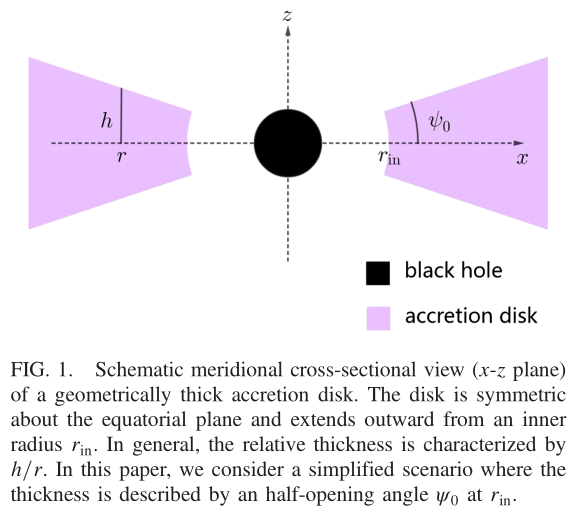
  • Inner edge rinr_\text{in} and half-opening angle ψ0\psi_0

    fig 1

  • Uniform motion of the disk matter, denoted by the four-velocity UμU^\mu

    1. Rotation-dominated flows:
      nearly Keplerian motion

      ΩK=UKϕUKt=(Mr3)1/2\Omega_\text{K}=\frac{U_\text{K}^\phi}{U^t_\text{K}}=\left(\frac{M}{r^3}\right)^{1/2}

      sub-Keplerian Ω=κKΩK\Omega=\kappa_\text{K}\Omega_\text{K} with 0<κK10<\kappa_\text{K}\le 1
    2. Infall-dominated flows:
      the local radial velocity

      vffr=UffrUfft=B(r)(2Mr)1/2v^r_\text{ff}=\frac{U^r_\text{ff}}{U^t_\text{ff}}=-B(r)\left(\frac{2M}{r}\right)^{1/2}

      here B(r)=12M/rB(r)=1-2M/r
      deviations from pure free fall vr=κffvffrv^r=\kappa_\text{ff}v^r_\text{ff} with 0κff<10\le\kappa_\text{ff}<1 (ADAF)
    3. Mixed flows:
      typical for thick disks at high accretion rates
  • Emission profile and absorption

    • For an optically thick disk

      Fem(r)ϵM˙r4π(Ω+rin2Ω(rin)r2)dΩdrF_\text{em}(r)\approx\frac{\epsilon\dot{M}r}{4\pi}\left(-\Omega+\frac{r_\text{in}^2\Omega(r_\text{in})}{r^2}\right)\frac{\mathrm{d}\Omega}{\mathrm{d}r}

      where ϵ\epsilon is a dimensionless efficiency parameter that characterizes the conversion of rotational energy into radiation due to viscous dissipation.

      Fobs=[g(r)]4Fem(r)F_\text{obs}=[g(r)]^4F_\text{em}(r)

    • For an optically thin disk

      δFemϵM˙4πψ0(Ω+rin2Ω(rin)r2)dΩdrBδl\delta F_\text{em}\approx\frac{\epsilon\dot{M}}{4\pi\psi_0}\left(-\Omega+\frac{r_\text{in}^2\Omega(r_\text{in})}{r^2}\right)\frac{\mathrm{d}\Omega}{\mathrm{d}r}\sqrt{B}\delta l

      Radiative transfer:

      F(r2)=F(r1)eχδl[g(r1)g(r2)]4+δFem(r2)F(r_2)=F(r_1)e^{-\chi\delta l}\left[\frac{g(r_1)}{g(r_2)}\right]^4 +\delta F_\text{em}(r_2)

      where
      (1) F(r1)F(r_1) is the accumulated flux
      (2) g(r)=νobs/νem(r)g(r)=\nu_\text{obs}/\nu_\text{em}(r) is the redshift factor
      (3) χ\chi denotes the effective absorption coefficient. χ\chi\rightarrow\infty for optically thick while χ0\chi\rightarrow0 for optically thin.

Exploring the role of accretion disk geometry in shaping black hole shadows
http://jingliangwei.github.io/blog-hexo/2026/07/09/Exploring-the-role-of-accretion-disk-geometry-in-shaping-black-hole-shadows/
Author
Arwell
Posted on
July 9, 2026
Licensed under