dynamics of astrophysical discs
the lecture notes dynamics of astrophysical discs
results below are just reshowed from the lecture notes, the derivation could be find in the notes.
lecture 2: Orbital dynamics
2.1 Orbits in an axisymmetric potential
- the effective potential
for the family of circular orbits (
the specific angular momentum
the angular velocity
the specific energy
the orbital shear rate
the dimensionless orbital shear parameter
e.g.
In the case of a point-mass potential, the circular Keplerian orbits satisfy
2.2 Oscillations and precession
Oscillations:
- the radial frequency (often called the epicyclic frequency and denoted
)
- the vertical frequency (sometimes denoted
)
Keplerian orbits satisfy
meaning that (slightly) eccentric or inclined orbits close after one turn.
- the radial frequency (often called the epicyclic frequency and denoted
precession:
- the apsidal precession rate
- the nodal precession rate
2.3 Mechanics of accretion
transfer of angular momentum:
consider two particles in circular orbits in the midplane. the total angular momentum and energy are
in an infinitesimal exchange:
if
then transfer of angular momentum and mass:
lecture 3: Global and local views
3.1 Local view of orbital dynamics
local coordinates
the tidal potential
the local representation of the family of circular orbits in the midplane is
derivation
start from the definition of local coordinates
: the first derivative of time above is:
which can be interpreted as an orbital shear flow with shear rate
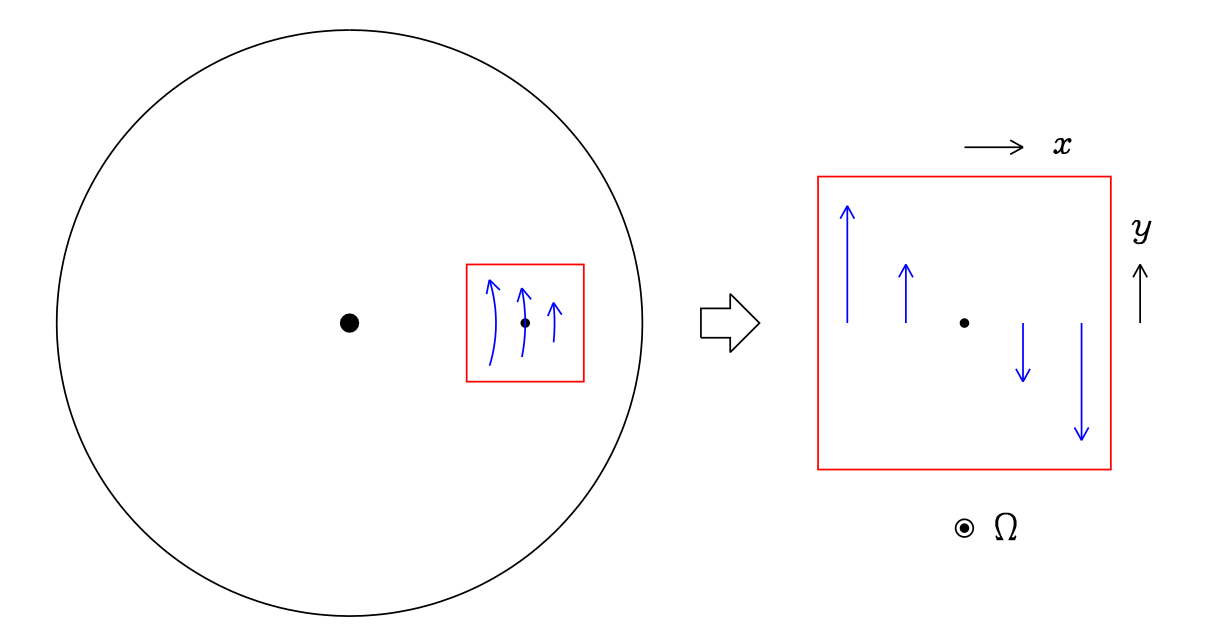
the solutions of motion equations:
three conserved quantities